

Medical courier startup costs depend on your vehicle, services, insurance, equipment responsibilities, and customer payment terms. Build your budget around three amounts: what you must pay before starting, the cash needed to operate until customers pay, and a reserve for unexpected expenses.
A driver using an accepted vehicle and some company-provided equipment will have a different budget from an owner buying a vehicle, purchasing transport systems, and hiring drivers. There is no single dollar amount that describes both businesses.
This guide explains the main cost categories and gives two worked examples for a business using an existing car. The examples show how to calculate a funding target. Replace their assumptions with your own quotes and expected payment dates.
Choose Your Type of Work Before Building the Budget
Start by deciding whether you want an employee position, independent contractor routes, or direct contracts with healthcare clients. Those choices affect which expenses you must pay.
If you are applying for an employee position, ask what the employer supplies and reimburses. If you plan to operate a business, confirm your responsibilities for the vehicle, insurance, equipment, records, invoicing, and backup service.
Write down the cargo you plan to transport, service area, expected driving, and whether you will be the only driver. Use our guide to finding medical courier jobs and contracts to compare the paths before committing to purchases.
What Costs Belong in a Medical Courier Startup Budget?
The U.S. Small Business Administration recommends separating one-time expenses from monthly expenses and checking estimates with vendors and service providers. For a medical courier business, start with the following categories.
Training and Preparation
Identify the training required for your duties and the records the company or client wants. Include the purchase price and time needed to complete training and onboarding.
MCC currently offers:
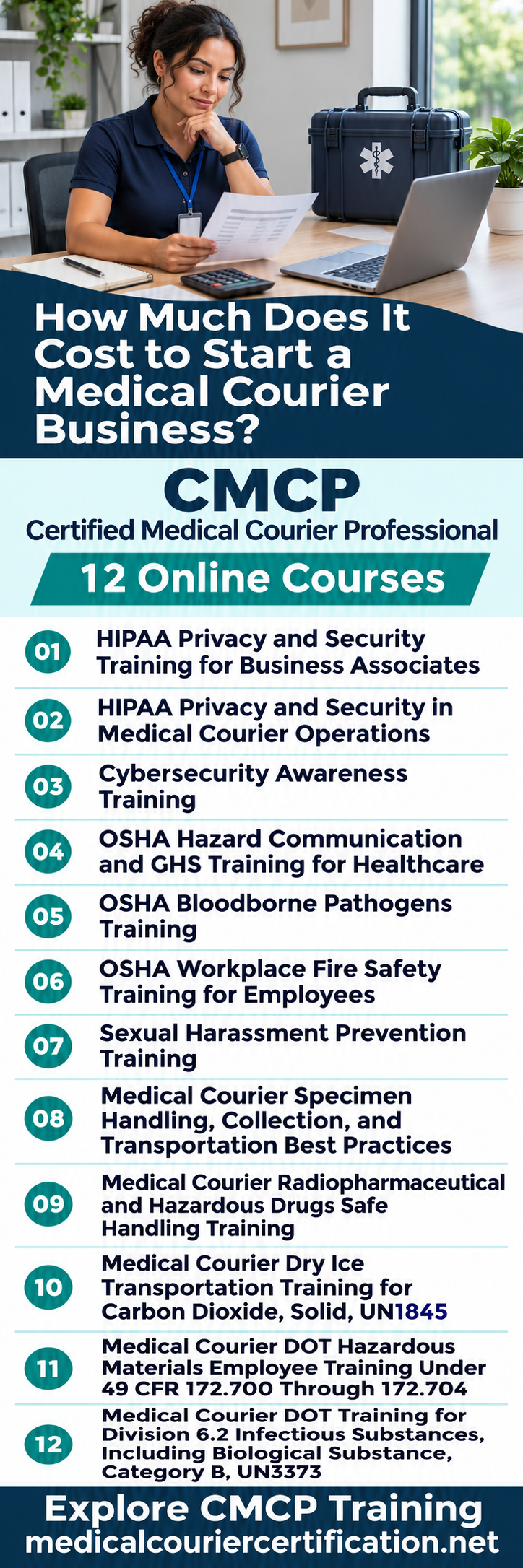
- Certified Medical Courier Professional, CMCP: 12 online courses for $150.
- Certified Medical Courier Expert, CMCE: 14 online courses for $249, including the CMCP foundation, highway driver training, the six-hour Medical Courier Business Builder course, and 70 downloadable resources.
The program price is one part of the budget. A private training credential does not replace applicable operating requirements, client approval, equipment, or insurance.
Vehicle Preparation or Purchase
If you already have a suitable vehicle, list the inspections, maintenance, repairs, or setup needed before the first assignment. Ask for the company’s vehicle criteria before spending money.
If you need another vehicle, obtain a purchase or lease quote and include the related taxes, title, registration, and payments that apply. For a financed vehicle, show the down payment and scheduled payments on the dates they are due.
An existing car still needs an operating budget. Include fuel or charging, maintenance, tires, parking, tolls, and any vehicle payments you must continue making.
Insurance
Request quotes for the actual delivery work, vehicle, drivers, service area, and cargo. Record the payment needed to start coverage, later installments, deductibles, and any client-required coverage.
The Texas Department of Insurance explains that personal policies differ in how they cover business deliveries. A company policy can also leave gaps, and damage to the goods being delivered may need additional or separate coverage.
The National Association of Insurance Commissioners identifies vehicle type, operating region, claims history, and deductibles as factors affecting commercial auto premiums. Use quotes with comparable coverage when deciding what belongs in your budget.
Business Registration and Required Permissions
Check the costs for your chosen business structure, location, and activities. These may include formation or assumed-name filings, applicable licenses, renewals, and professional help with setup or contracts.
SBA guidance explains that registration fees vary by state and structure, while licensing requirements depend on the business and location. Obtain the current amounts from the responsible agencies.
If you need an Employer Identification Number, applying directly through the IRS is free. A private service fee is separate from the IRS EIN application.
For Texas-specific preparation, see our guide to becoming a medical courier in Texas.
Equipment and Supplies
Ask for the approved equipment list before buying transport cases, temperature monitors, protective supplies, or securement equipment.
For each item, confirm who purchases it, who owns it, and who pays to clean, maintain, calibrate, or replace it when required. A client-supplied container can reduce your initial purchase cost while still creating responsibilities you need to understand.
Match purchases to the shipment and your assigned duties. Our medical cargo guide can help you identify the cargo-related questions to ask.
Communication and Business Systems
Budget for the phone, data, delivery application, recordkeeping, and invoicing tools the work requires. Confirm whether a client supplies a platform or expects you to provide one.
For direct client outreach, you may also choose to pay for a domain, business email, a simple website, and business documents. Separate initial setup charges from recurring subscriptions so renewals do not disappear from the plan.
How to Calculate the Cash Needed to Start
Use this planning formula:
Cash needed at launch = upfront payments + operating cash needed before collections + contingency reserve.
Upfront payments include purchases, fees, and initial payments due before work begins. Operating cash covers bills that come due while you wait for customers to pay. The contingency reserve is money kept available for unplanned costs.
List payment dates as well as amounts. A budget that shows only an annual total can hide a large payment due in the first week.
Two Illustrative Medical Courier Startup Budgets
These are hypothetical planning examples, not national averages, minimum budgets, or vendor quotes. Only the MCC training prices are current advertised prices. Every other amount is an example allowance to replace with your own figures.
Both examples assume one owner-driver, an existing accepted car and phone, no vehicle loan payments, no employees, and no rented office.
Example A covers a driver taking subcontracted routes, with approved transport cases and monitoring devices supplied by the contracting company.
Example B covers an owner preparing to serve direct clients and purchasing additional required equipment. Their assumed workloads and payment delays differ.
| Budget item | Example A | Example B |
|---|---|---|
| Training | CMCP: $150 | CMCE: $249 |
| Initial vehicle preparation | $250 | $400 |
| Initial insurance payment | $400 | $600 |
| Equipment and supplies to purchase | $150 | $600 |
| Applicable setup and administration allowance | $100 | $400 |
| Initial website and email setup | $100 | $400 |
| Upfront payments | $0 | $200 |
| Operating cash before first payment | $1,050 | $2,449 |
| Additional contingency reserve | 6 weeks × $250 = $1,500 | 8 weeks × $400 = $3,200 |
| Illustrative business cash target | $500 | $1000 |
| Equipment and supplies to purchase | $150 | $600 |
The weekly operating allowances represent cash needed for fuel, parking, communications, supplies, planned maintenance, and other bills due during the stated period. In these examples, the initial insurance payment is assumed to cover the entire six- or eight-week period, so it is excluded from the weekly allowance. Add any further installments that fall due during your own planning period.
These examples assume no customer payments arrive during the stated six or eight weeks. Neither includes a vehicle purchase, employees, specialized transport systems beyond the assumed equipment, personal living expenses, owner withdrawals, or taxes. Add each applicable amount to your own plan.
Why Your First Payment Date Changes the Budget
A completed delivery and payment for that delivery can happen at different times. SBA’s cash flow guidance discusses the gap between business payments and customer collections.
Consider this separate hypothetical arrangement:
- You start work on day 1.
- You invoice after the first 30 days of service.
- The customer pays 30 days after receiving that invoice.
Your first payment arrives around day 60. You need to fund the operating bills that come due before then. This example does not describe standard terms for every medical courier contract.
Ask when invoices can be submitted, which documents are required, whether approval affects timing, and when payment is expected. Allow for delays where appropriate.
For example, if weekly business cash needs are $400, two additional unpaid weeks require another $800, assuming the same spending and no other receipts. This is why a change in payment timing can matter even when equipment costs stay the same.
Avoid Counting the Same Cost Twice
A useful budget follows actual cash payments. Check these common overlaps:
- Training bundles: CMCE includes the CMCP foundation and Business Builder. Do not add their separate purchase prices to the same CMCE budget.
- Prepaid insurance: If a payment already covers a period, do not charge that same period again in your operating cash allowance.
- Vehicle purchases: A cash purchase and a financed purchase create different payment schedules. Do not add the full purchase price and the loan payments as if both leave your account at launch.
- Client-provided equipment: Count only the purchases, deposits, or charges you are responsible for paying.
- Vehicle wear: Plan for replacement and repairs, but distinguish cash payments from noncash accounting expenses when calculating how much money must be available on a particular date.
Keep personal living expenses visible in a separate plan. If you need to take money from the business before customer payments arrive, add those withdrawals to the cash forecast.
Which Expenses Can Wait?
Review discretionary spending against the work you are preparing to perform. An extra vehicle, rented office, elaborate website, or additional software may be unnecessary for your initial service plan.
Before committing to a purchase, ask:
- Is it required for the assignment or business setup?
- Does the client or contracting company provide it?
- Can an existing resource meet the stated requirement?
- Will delaying the purchase affect safe, dependable service?
- What recurring cost will the purchase create?
Use the answers to decide what must be funded before launch and what can be added as the business develops.
Build Your Own Startup Budget in Five Steps
- Define the cargo, service area, expected work, and number of drivers.
- Confirm which expenses belong to you and which belong to the client or contracting company.
- Gather current fees and written quotes, including payment schedules.
- Forecast weekly cash payments and collections through the expected first payment, allowing for possible delays.
- Add a contingency reserve and the personal funds you need, then compare the total with the money available.
Update the budget when the route, mileage, equipment, or payment terms change. Keep a longer operating forecast as well, so the end of the initial reserve period does not become the end of your planning.
Frequently Asked Questions
Can I Start a Medical Courier Business With My Own Car?
Possibly, if the company or client accepts it and it meets the assignment’s vehicle, insurance, capacity, and handling requirements. Using an existing car removes the need for a new purchase from that budget, but operating and maintenance costs still need funding.
Is Medical Courier Training the Entire Startup Cost?
No. Training is one expense. Your budget may also include vehicle preparation, insurance, business filings, equipment, software, and cash needed while waiting for payment. MCC currently lists CMCP at $150 and CMCE at $249.
How Much Should I Budget for Insurance?
Use a quote for the actual operation. Confirm the cargo, drivers, vehicle use, coverage limits, deductibles, and payment schedule. A monthly amount found online may not describe the coverage or initial payment your work requires.
Do I Need to Buy All the Equipment Before Applying?
Ask for the company’s requirements first. Confirm what it provides, what you must purchase, and when each item is needed. This lets you budget for the specified equipment and avoids buying items the company does not accept.
How Much Cash Should I Keep in Reserve?
Base the operating reserve on expected bills and the gap before customer payments arrive. Add a separate allowance for unexpected expenses. The right amount changes with your payment terms, workload, available backup arrangements, and personal financial needs.
Prepare a Budget for the Business You Want to Run
A useful startup budget connects each purchase to a real requirement and each recurring bill to a payment date. It helps you see what you can fund now and what still needs a quote or a clear agreement.
Our Medical Courier Business Builder Training covers business preparation, pricing, invoicing, cash flow, and operating systems. It is included in the CMCE program, alongside the courier training foundation and highway driver course.
Explore CMCE if your goal includes operating a medical courier business. Use the training to support your planning, then confirm the actual costs and requirements for the services you intend to offer.


How Much Does It Cost to Start a Medical Courier Business? - Medical Courier Certification says: