Transport Regulated Medical Waste Without Creating a New Exposure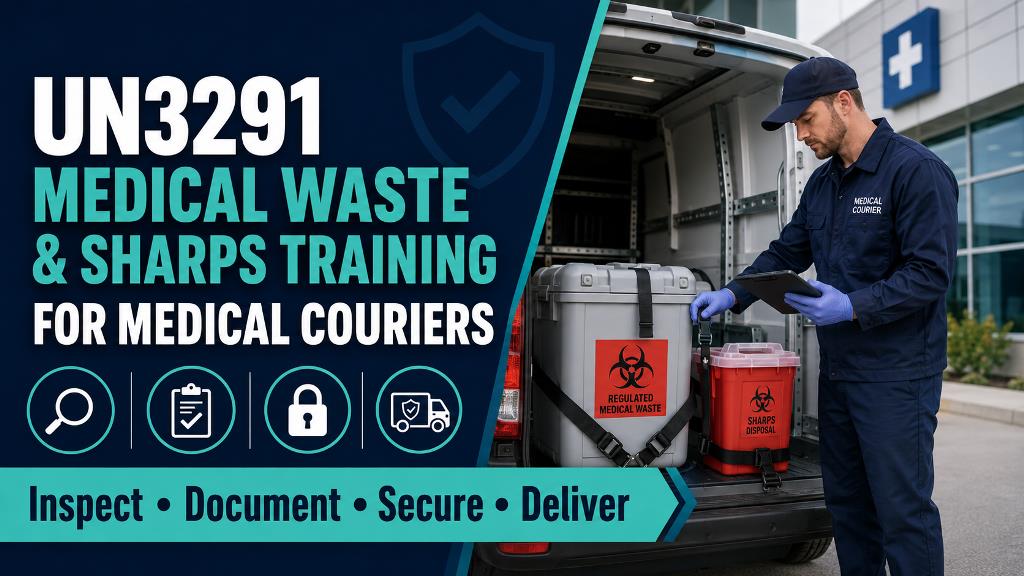
A closed medical-waste container may hold blood-contaminated materials, used sharps, laboratory waste, contaminated disposable items, or other waste being transported for processing, treatment, or disposal.
If a container leaks, tips, opens, is punctured, or is handled incorrectly, the courier and people nearby may be exposed to sharps, bloodborne pathogens, contaminated materials, or other hazards.
This function-specific course teaches medical courier personnel how to recognize UN3291 shipments, inspect containers without opening them, verify marks and documents, protect against sharps injuries, secure the load, complete an authorized handoff, and respond correctly to leaks, loose sharps, vehicle accidents, or possible exposures as per department of transportation (DOT) requirements.
Recognize. Inspect. Document. Secure. Deliver.
What Is UN3291 Medical Waste Training?
UN3291 medical-waste training provides function-specific instruction for employees who transport prepared regulated medical waste and sharps by highway.
The course focuses on courier duties such as:
- Recognizing UN3291 shipments
- Inspecting packages without opening them
- Checking closures, lids, and latches
- Recognizing sharps hazards
- Confirming marks and labels
- Reviewing shipping papers and emergency information
- Checking package counts and quantities
- Loading approved containers
- Securing containers against movement
- Separating waste from unrelated cargo
- Maintaining manifests and custody records
- Protecting shipping papers during transportation
- Delivering to an authorized recipient
- Inspecting the cargo area after delivery
- Reporting leaks, damage, loose sharps, contamination, or exposure
The courier normally receives waste after an authorized offeror has classified, packaged, closed, and marked the shipment.
This course does not authorize the courier to classify waste, open containers, sort contents, compress bags, transfer waste, pick up loose sharps by hand, create improvised packaging, tape leaking containers, or perform spill cleanup.
What Is UN3291?
UN3291 is the transportation identification number for certain regulated medical-waste shipping descriptions within Division 6.2 of department of transportation (DOT).
Authorized proper shipping names can include:
- Regulated medical waste, n.o.s.
- Clinical waste, unspecified, n.o.s.
- (BIO) Medical waste, n.o.s.
- Biomedical waste, n.o.s.
- Medical Waste, n.o.s.
A basic shipping description may appear as:
UN3291, Regulated medical waste, n.o.s., 6.2
UN3291 does not have a packing group. Although some packages may be tested at a Packing Group II performance level, that does not assign Packing Group II to the material.
The offeror or another trained and authorized person selects the correct classification, shipping name, packaging, marks, labels, and transportation documents.
A courier should not classify waste based only on a red bag, biohazard symbol, facility name, or verbal description.
What Is Regulated Medical Waste?
For transportation purposes, regulated medical waste generally includes waste or reusable material generated during:
- Diagnosis
- Treatment
- Immunization
- Medical research
- Biological-product work
- Human and animal medical activities
- Reusable materials that may qualify
Examples may include:
- Blood-soaked disposable materials
- Contaminated dressings
- Contaminated tubing
- Certain laboratory waste
- Disposable medical treatment items
- Sharps in approved containers
The exact classification can depend on federal transportation definitions and applicable state or local medical-waste rules.
The healthcare facility or another authorized shipper determines whether the material is regulated medical waste and how it must be packaged.
Why Medical Couriers Need Specialized DOT UN3291 Training
Medical-waste transportation can expose couriers to several hazards:
- Needles and syringes
- Scalpels and contaminated blades
- Broken contaminated glass
- Culture slides and dishes
- Exposed dental wires
- Blood-contaminated materials
- Leaking packages
- Overfilled sharps containers
- Protruding sharps
- Damaged closures
- Wet or contaminated exteriors
- Improvised packaging
- Unsecured cargo
- Incorrect classifications
- Missing or conflicting documents
- Unauthorized access
A sealed and properly prepared container can protect the courier. That protection may be lost when the container is damaged, overfilled, open, leaking, incorrectly marked, or improperly secured.
Medical couriers need to recognize these warning signs before loading the vehicle.
What You Will Learn
After completing this course, learners should be able to:
- Explain what UN3291 identifies
- Recognize common regulated medical-waste shipments
- Distinguish UN3291 waste from UN3373 specimens
- Recognize the Category A stop-work boundary
- Recognize sharps and puncture hazards
- Describe required sharps-container features
- Understand the standard and private-carrier transportation tracks
- Recognize the 6.2 label and BIOHAZARD marking distinction
- Identify authorized UN3291 shipping names
- Inspect containers before acceptance
- Recognize conditions requiring hold or rejection
- Verify package marks, labels, documents, and emergency information
- Keep shipping papers accessible
- Use assigned handling and securement equipment
- Keep regulated waste separate from unrelated cargo
- Maintain state manifests and custody records
- Complete an authorized delivery
- Inspect the vehicle after unloading
- Respond safely to loose sharps and possible exposure
- Report leaks, releases, injuries, and missing packages
- Stay within the medical courier’s authorized role
UN3291 Transportation Requirements Can Follow Different Tracks
Some regulated medical-waste shipments follow the standard UN3291 transportation requirements. Others may qualify for a private or contract carrier exception when all required conditions are met.
Couriers should not decide independently which track applies.
The employer must identify:
- The authorized packaging system
- Required marks and labels
- Whether shipping papers are required
- Emergency-information procedures
- Approved vehicle and route controls
- State manifest requirements
- Securement methods
An exception does not remove classification, inspection, training, documentation, securement, or state requirements.
Practical Medical Courier Scenarios
Accept, Hold, or Reject
Learners review several package conditions and decide whether each package can be accepted, held for clarification, or rejected.
The decision considers:
- Package condition
- Closure
- Visible leakage
- Exterior contamination
- Overfilled sharps containers
- Required marks
- Shipping documents
- Securement capability
A Route With Multiple Problems
A courier is presented with:
- One prepared UN3291 sharps container
- One UN3373 patient-specimen package
- One overfilled sharps container
- One package with a shipping-paper mismatch
- An unsecured cargo area
The learner must identify which shipments can move, which require clarification, and which must be rejected or escalated.
The courier follows a simple rule:
Do not open. Do not compress. Do not repackage. Never touch loose sharps by hand.
Who Should Take This Course?
This course is intended for employees whose work affects the highway transportation of regulated medical waste and sharps, including:
- Medical courier drivers transporting UN3291 waste
- Medical-waste transport drivers
- Route technicians
- Employees who load or unload waste containers
- Dispatchers who affect hazardous-material movement
- Supervisors who direct medical courier duties
- Transfer staff who handle prepared packages
- Storage personnel who handle packages during transportation
Training must match each employee’s actual assigned functions.
How This Course Is Different
Written for Medical Courier Functions: The course focuses on package acceptance, marks, labels, shipping papers, emergency information, loading, securement, manifests, delivery, and incident reporting.
Addresses Sharps Hazards: Learners review approved sharps containers, fill lines, protruding sharps, puncture prevention, loose sharps, and exposure response.
Separates Waste From Specimens: The course distinguishes UN3291 regulated medical waste from UN3373 patient specimens and Category A materials.
Explains Two Transportation Tracks: Learners review the standard UN3291 requirements and the conditional private or contract carrier exception.
Reinforces Courier Boundaries: Couriers inspect and transport closed packages. They do not classify, sort, compress, transfer, repackage, or clean waste under this course.
Recognizes State Requirements: State rules may affect permits, manifests, vehicle signs, storage, transportation, and treatment-facility delivery.
What This Course Does Not Replace
This course does not replace required training for:
- Category A infectious substances
- UN2814, UN2900, or UN3549
- UN3373 patient-specimen transportation
- Chemical or chemotherapy waste
- Pharmaceutical waste
- Radioactive waste
- Anatomical material requiring another classification
- Air transportation
- Waste classification
- Package preparation or repair
- Spill cleanup
- State medical-waste permits
- State transporter registration
- Employer-specific exposure and emergency procedures
The employee must complete the prerequisite training and any additional instruction required for the actual waste, package, vehicle, route, and jurisdiction.
Frequently Asked Questions
Prepare Couriers to Transport Medical Waste Safely
This course prepares medical courier personnel to:
- Recognize UN3291 waste
- Inspect packages without opening them
- Identify unsafe sharps containers
- Verify marks and shipping papers
- Secure containers inside the vehicle
- Maintain manifests and custody records
- Complete authorized delivery
- Respond to leaks, sharps, and exposures
- Follow state and company procedures
A closed container stays closed. A loose sharp is never handled by hand. An unsafe shipment does not move.
Important Training Notice
This course provides UN3291 function-specific training for medical courier personnel transporting prepared regulated medical waste and sharps by highway.
It does not replace the required DOT hazmat employee core training, OSHA Bloodborne Pathogens training, OSHA HazCom and GHS training, company exposure-control procedures, or company security and emergency procedures.
The course does not authorize waste classification, package preparation, package repair, spill cleanup, loose-sharps collection, Category A transportation, UN3373 specimen transportation, air transportation, or transportation of chemical, pharmaceutical, radioactive, or other separately regulated waste.
Employers must evaluate the employee’s assigned functions, waste types, packaging systems, transportation track, vehicle, route, state requirements, permits, manifests, PPE, emergency procedures, and response limits.
Course completion requires a written examination, practical evaluation, employer-specific instruction, practical signoff, and a retained training record.
UN3291 Medical Waste and Sharps Training is rated 4.8 out of 5 by 7832 users.