

Build Essential Fire Prevention and Emergency-Response Awareness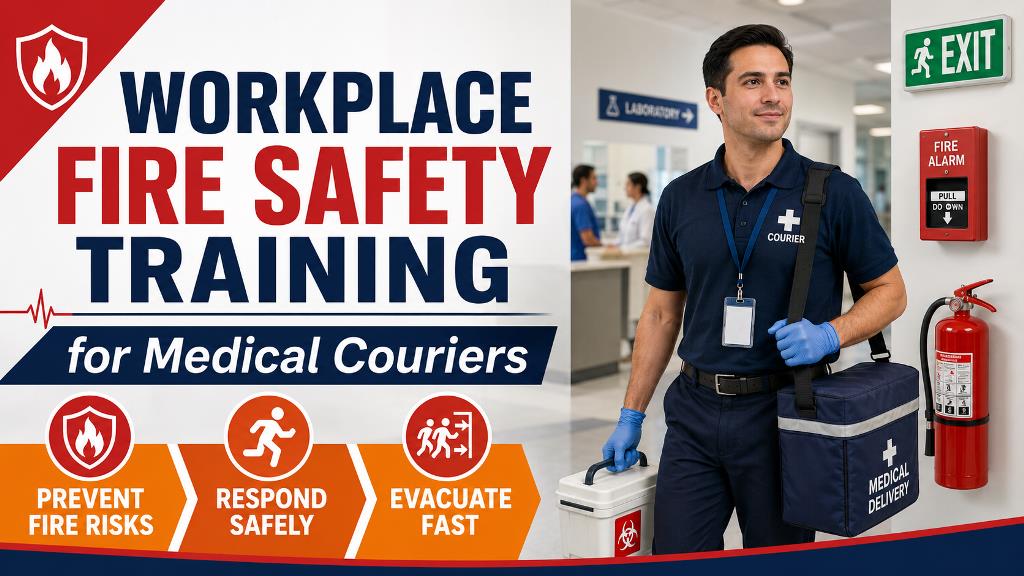
Medical couriers work in many different environments. These may include dispatch offices, warehouses, laboratories, hospitals, clinics, pharmacies, healthcare facilities, and other client locations.
Each workplace can have different fire hazards, alarms, exits, evacuation procedures, and emergency contacts. Couriers need a basic understanding of fire prevention and emergency response so they can act safely when a fire alarm sounds or another fire-related emergency occurs at client’s location or in their office.
This online Workplace Fire Safety Training provides foundational education for employees, including medical couriers and healthcare logistics personnel.
The course covers common fire risks, prevention, emergency response, fire classifications, evacuation, portable fire extinguishers, incident reporting, and post-incident considerations.
Life safety always comes before deliveries, schedules, equipment, and property.
What Is Workplace Fire Safety Training?
Workplace fire safety training teaches employees how to recognize fire hazards, reduce preventable risks, and respond appropriately when a fire, smoke condition, or alarm occurs.
The course addresses three important areas:
Prevention
Employees learn about common fire risks and steps that can help prevent workplace fires.
Response
Employees review basic response steps, fire classifications, emergency communication, hazardous materials, and actions to take when a fire occurs.
Evacuation
Employees learn about evacuation plans, clear exit routes, fire drills, fire wardens, emergency kits, and procedures for helping people with special needs.
The course also introduces portable fire extinguisher use, ABC extinguishers, situations when an ABC extinguisher should not be used, incident reporting, mental well-being, and future prevention.
Why Fire Safety Matters for Medical Couriers
Medical couriers may spend part of their workday at facilities they do not control. They may need to recognize alarms, locate exits, follow client instructions, and evacuate without delay.
Fire-safety awareness can help couriers:
- Recognize common workplace fire risks
- Avoid blocking exits and emergency equipment
- Respond appropriately when an alarm sounds
- Locate the nearest safe exit
- Follow client-facility evacuation procedures
- Communicate with supervisors and dispatch
- Understand basic fire classifications
- Recognize the limits of portable extinguishers
- Report fire-related incidents
- Avoid returning to an unsafe area
Employers should supplement this general course with information about the courier’s assigned workplace, client facilities, vehicles, transported materials, emergency contacts, and evacuation responsibilities.
The Most Important Fire-Safety Rule
When a fire alarm sounds or fire and smoke create immediate danger:
Warn others. Evacuate. Call for help. Report safely.
- Warn people nearby and activate an alarm when appropriate.
- Leave through the nearest safe exit.
- Call emergency services according to workplace procedures.
- Report your location and status after reaching safety.
- Follow instructions from emergency responders.
Employees should not delay evacuation to retrieve packages, paperwork, equipment, personal belongings, or vehicles.
Who Should Take This Course?
This employee-level course may be appropriate for:
- Medical courier drivers
- Laboratory and specimen couriers
- Hospital and clinic couriers
- Pharmacy delivery personnel
- Healthcare logistics employees
- Dispatch and route coordination personnel
- Courier warehouse employees
- Shipping and receiving employees
- Fleet support personnel
- Independent courier contractors
- Medical courier supervisors
- Courier company owners
- New employees
- Employees who enter healthcare client facilities
Employers must determine what general and workplace-specific instruction each employee needs.
What Medical Couriers Will Learn
After completing the course, learners should be able to:
- Explain why workplace fire safety matters
- Recognize common causes of workplace fires
- Identify actions that can help prevent fires
- Recognize the role of human error in fire prevention
- Apply basic cooking and appliance precautions
- Explain why equipment maintenance matters
- Identify general fire-response steps
- Recognize common fire classifications
- Explain how to alert the proper authorities
- Understand basic fire-containment principles
- Recognize hazards involving hazardous materials
- Explain the purpose of an evacuation plan
- Keep exits and evacuation routes clear
- Recognize considerations for people with special needs
- Explain the role of fire drills
- Describe the basic role of a fire warden
- Recognize the purpose of emergency kits
- Understand general portable fire-extinguisher principles
- Recognize an ABC extinguisher
- Identify situations when an ABC extinguisher should not be used
- Recognize when evacuation is safer than fighting a fire
- Explain why fire-related incidents must be reported
- Recognize the possible effect of a fire on mental well-being
- Identify ways to support future fire prevention
Fire Extinguishers and Employee Responsibilities
Not every employee should attempt to use a portable fire extinguisher.
The employer must establish whether:
- All employees must evacuate
- Certain employees are designated to use extinguishers
- Employees are permitted to use extinguishers
- Portable extinguishers are not intended for employee use
Employees should follow the employer’s Emergency Action Plan and fire-safety policy.
Where an employer provides portable fire extinguishers for employee use, OSHA requires an educational program covering general extinguisher-use principles and the hazards of early-stage firefighting. This education must be provided upon initial employment and at least annually thereafter.
Employees designated to use firefighting equipment as part of an Emergency Action Plan must receive additional training in the use of the appropriate equipment upon initial assignment and at least annually thereafter.
What This Online Course Does Not Provide
This course provides general workplace fire-safety education. It does not provide:
- Live-fire exercises
- Hands-on extinguisher practice
- Firefighter training
- Fire-brigade training
- Rescue training
- Emergency medical training
- Vehicle-specific firefighting instruction
- Hazardous-material emergency-response qualification
- Workplace evacuation drills
- Client-facility orientation
- An employer-specific Emergency Action Plan
- An employer-specific Fire Prevention Plan
Employers must determine whether additional education, training, drills, or practical exercises are required.
Medical Courier Fire-Safety Responsibilities
Medical couriers should:
- Learn their employer’s emergency procedures
- Know how to contact dispatch or a supervisor
- Follow alarms and instructions at client facilities
- Keep exits and emergency equipment accessible
- Report possible fire hazards
- Avoid unsafe electrical practices
- Follow smoking restrictions
- Store equipment according to company procedures
- Evacuate without unnecessary delay
- Call emergency services when required
- Report fire-related incidents after reaching safety
- Follow instructions from emergency responders
Medical couriers should not:
- Ignore an alarm
- Block an exit with packages or equipment
- Return to a dangerous area for a shipment
- Attempt to fight a spreading fire
- Use an extinguisher without authorization
- Enter an area filled with smoke
- Move fire-damaged hazardous materials
- Interfere with emergency responders
- Continue a route when conditions are unsafe
Frequently Asked Questions
Important Safety and Compliance Notice
This course provides general workplace fire-safety education for employees, including medical courier and healthcare logistics personnel.
It does not replace workplace-specific instruction, evacuation drills, client-facility procedures, specialized hazardous-material training, hands-on extinguisher training, an Emergency Action Plan, or a Fire Prevention Plan when one is required or adopted.
Employers must determine whether employees are expected to evacuate, permitted to use portable extinguishers, or designated to use firefighting equipment.
When extinguishers are provided for employee use, applicable OSHA requirements may require education upon initial employment and at least annually thereafter. Employees designated to use firefighting equipment may require additional initial and annual training.
Employees should always follow their employer’s emergency procedures and instructions from emergency responders.
Workplace Fire Safety Training for Medical Couriers is rated 4.4 out of 5 by 7456 users.