

HIPAA Privacy & Security Training for Business Associates

HIPAA Privacy & Security Training for Business Associates2026-08-13T09:04:41+00:00

Understand Your HIPAA Responsibilities Before Handling Protected Health InformationHIPAA Privacy & Security Training for Business Associates
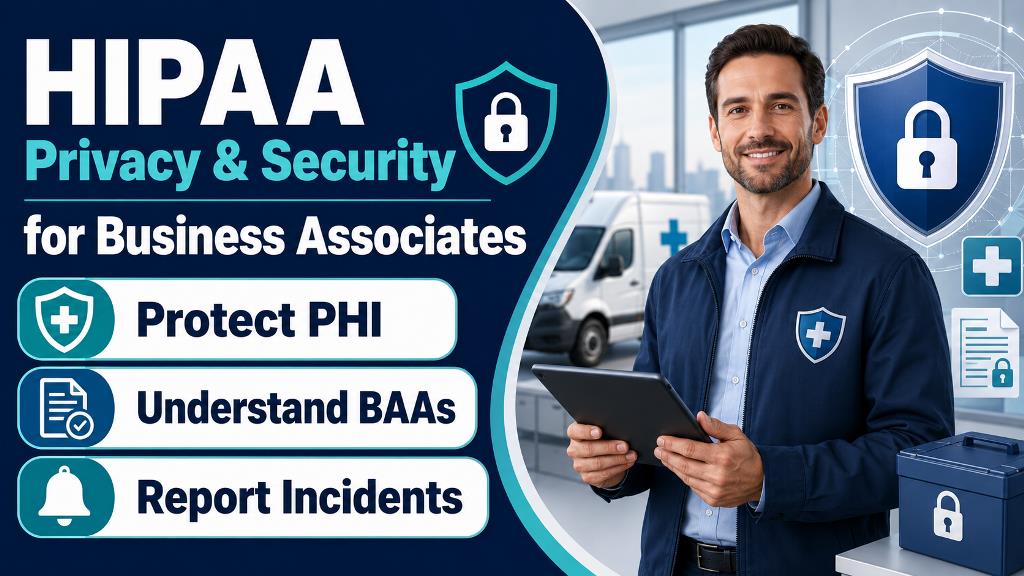
Organizations that provide services to healthcare providers may create, receive, maintain, or transmit protected health information as part of their work. When these activities make an organization a HIPAA Business Associate, both the company and members of its workforce need to understand how patient information must be protected.

Our online HIPAA Privacy & Security Training for Business Associates introduces the HIPAA requirements that apply to companies working with healthcare organizations. It explains privacy responsibilities, security safeguards, Business Associate Agreements, breach reporting, subcontractor obligations, and the appropriate handling of protected health information.

The course is especially relevant to medical courier companies whose services involve access to patient information, specimen documentation, delivery records, electronic manifests, medical records, pharmacy orders, or other sensitive healthcare information.

Course format: Online and self-paced
Approximate duration: 2 hours
Learning format: Audio-supported training
Course level: Foundational awareness
Certificate: Certificate provided after successful completion
Language options: English and Spanish

What Is HIPAA Training for Business Associates?

HIPAA training for Business Associates teaches employees and contractors how the HIPAA Privacy, Security, and Breach Notification Rules relate to organizations that provide services to covered healthcare entities.

A Business Associate is generally a person or organization that performs certain services for a covered entity and creates, receives, maintains, or transmits protected health information while performing those services. Certain HIPAA requirements apply directly to Business Associates. Business Associates may also have specific contractual responsibilities under a Business Associate Agreement.

This course turns those requirements into clear, practical guidance. Learners discover what information HIPAA protects, when it may be used or disclosed, how it should be secured, and what to do when something goes wrong.

Why Business Associates Need HIPAA Training

Medical courier companies and other healthcare vendors may encounter patient information in several forms. It might appear on a specimen label, laboratory requisition, delivery manifest, pharmacy package, mobile application, email, text message, or proof-of-delivery record.

Even brief or incidental access can create privacy and security risks. A package left in the wrong location, an unlocked mobile device, a photograph containing patient information, or a delivery record sent to the wrong recipient may become a reportable incident.

Effective training helps employees:

  • Recognize protected health information and electronic protected health information
  • Understand the company’s role as a Business Associate
  • Follow the requirements of applicable Business Associate Agreements
  • Limit access, use, and disclosure of patient information
  • Protect paper records, packages, mobile devices, and electronic data
  • Identify suspicious activity and possible security incidents
  • Report mistakes, lost items, and suspected breaches promptly
  • Follow company policies when working with healthcare clients

Training also helps owners and managers establish a more consistent privacy and security culture across employees, independent contractors, dispatch personnel, and subcontracted delivery partners.

Is Every Medical Courier a HIPAA Business Associate?

No. A medical courier is not automatically a Business Associate simply because it transports healthcare-related packages.

Business Associate status depends on the services performed, the relationship with the healthcare client, and whether the courier creates, receives, maintains, or transmits protected health information while providing those services.

The U.S. Department of Health and Human Services explains that delivery services whose access to protected health information is only random or infrequent may qualify for the conduit exception. By contrast, a courier company may have Business Associate responsibilities when its services require more than transient possession or involve routine access to PHI, electronic delivery systems, storage, record management, or other PHI-related functions.

Your healthcare client, contract, Business Associate Agreement, legal counsel, or compliance professional should determine how HIPAA applies to your specific operations. Training supports compliance, but it does not determine your organization’s legal status.

Who Should Take This Course?

This training is designed for personnel working for a HIPAA Business Associate or subcontractor whose duties may involve protected health information.

For a medical courier organization, appropriate learners may include:

  • Business owners and operations managers
  • HIPAA privacy or security coordinators
  • Medical courier drivers
  • Independent delivery contractors
  • Dispatchers and route coordinators
  • Customer service employees
  • Specimen pickup and delivery personnel
  • Pharmacy and medical supply couriers
  • Records transportation personnel
  • Billing and administrative employees
  • Information technology personnel
  • Subcontractors with access to PHI
  • Supervisors responsible for incident reporting

The course may also benefit billing companies, record storage providers, software vendors, consultants, answering services, cloud service providers, and other organizations serving healthcare clients.

What You Will Learn

After completing this course, learners should be able to:

  • Explain the difference between a covered entity, Business Associate, subcontractor, and workforce member
  • Identify common forms of PHI and electronic PHI
  • Understand why medical courier records may contain protected information
  • Describe the purpose of a Business Associate Agreement
  • Apply the minimum necessary principle to everyday work
  • Recognize permitted and prohibited uses of PHI
  • Identify administrative, physical, and technical safeguards
  • Protect PHI on mobile devices and in electronic communications
  • Recognize common privacy, security, and delivery-related incidents
  • Follow the correct internal reporting process
  • Understand basic breach notification responsibilities
  • Recognize the consequences of noncompliance
  • Apply HIPAA principles to realistic medical courier situations

HIPAA Business Associate Training Course Outline

1. Introduction to HIPAA

Learners receive an overview of HIPAA and the purpose of its Privacy, Security, and Breach Notification Rules. This section explains why patient information requires protection and how Business Associates fit into the healthcare system.

2. Covered Entities and Business Associates

This module explains the difference between covered entities and Business Associates. It also introduces Business Associate subcontractors and the circumstances under which subcontractors may have HIPAA responsibilities.

3. Understanding PHI and Electronic PHI

Learners explore what qualifies as protected health information. Examples include patient names, medical record numbers, laboratory information, prescription information, addresses, account details, photographs, and other identifiers connected to health information.

The module also explains electronic PHI, including information stored or transmitted through dispatch systems, mobile applications, email, cloud platforms, text messages, and digital delivery records.

4. Business Associate Agreements

A Business Associate Agreement, commonly called a BAA, establishes how PHI may be used, disclosed, protected, and reported between the parties.

Learners are introduced to:

  • The purpose of a BAA
  • Authorized uses and disclosures
  • Safeguarding obligations
  • Security incident and breach reporting
  • Subcontractor requirements
  • Returning or destroying PHI
  • Responsibilities when an agreement ends

Employees do not need to interpret or negotiate a BAA. However, they should understand that client requirements may affect their daily work.

5. HIPAA Privacy Rule Fundamentals

This section explains the appropriate use and disclosure of protected health information. Learners examine authorization, minimum necessary access, identity verification, individual privacy rights, and the importance of following approved procedures.

6. The Minimum Necessary Principle

Employees should access, use, or disclose only the information needed to complete an authorized task.

For example, a driver may need a destination, contact name, package identifier, and delivery instructions. The driver may not need access to a complete patient record or unrelated medical information.

7. HIPAA Security Rule Fundamentals

The Security Rule focuses on protecting electronic PHI. Learners receive an introduction to its three major safeguard categories:

  • Administrative safeguards
  • Physical safeguards
  • Technical safeguards

The course explains how policies, employee training, access controls, device protection, secure communication, and incident response work together to protect electronic information.

8. Mobile Devices and Electronic Communications

Medical couriers often rely on smartphones, tablets, scanning devices, GPS tools, and electronic proof-of-delivery systems. This module discusses practical precautions such as:

  • Using approved devices and applications
  • Protecting devices with secure access controls
  • Avoiding shared login credentials
  • Preventing unauthorized photographs
  • Verifying recipients before sending information
  • Reporting lost or stolen devices immediately
  • Avoiding unsecured communication methods
  • Following company rules for storing and deleting data

9. Physical Protection of Patient Information

PHI does not exist only in computer systems. Printed labels, requisitions, manifests, receipts, and packages may also reveal sensitive information.

Learners review ways to protect physical information during pickup, staging, transport, delivery, temporary storage, and disposal.

10. Medical Courier Privacy Scenarios

This section connects HIPAA principles to realistic courier situations, including:

  • A package delivered to the wrong department
  • A specimen left unattended
  • A delivery label photographed on a personal phone
  • Patient information visible inside a vehicle
  • A manifest lost during a route
  • Delivery information texted to the wrong person
  • A package discussed in a public setting
  • Login credentials shared between drivers
  • A subcontractor who has not completed required training
  • An electronic delivery record accessed without authorization

These scenarios help learners decide when to stop, protect the information, and contact a supervisor.

11. Security Incidents and Possible Breaches

Not every mistake is automatically a reportable HIPAA breach, but employees should never make that determination by themselves.

Learners are taught to report suspected incidents promptly. Examples may include:

  • Lost paperwork
  • Misdirected email or text messages
  • Missing packages
  • Delivery to an unauthorized recipient
  • Lost or stolen devices
  • Unauthorized access
  • Improper disposal
  • Malware or phishing activity
  • Unapproved photographs
  • Accidental disclosure of patient information

Prompt internal reporting gives the organization an opportunity to contain the incident, investigate what happened, and meet its contractual or legal obligations.

12. Breach Notification Responsibilities

This module provides a basic introduction to the HIPAA Breach Notification Rule. It explains that Business Associates must notify the affected covered entity of a breach of unsecured PHI in accordance with applicable requirements and the Business Associate Agreement.

Employees should follow their company’s reporting process immediately rather than delaying while trying to investigate an incident on their own.

13. Enforcement and Consequences

Learners receive an overview of how noncompliance can affect individuals and organizations. Consequences may include corrective action, contractual disputes, loss of healthcare clients, reputational damage, regulatory investigation, and civil or criminal penalties in appropriate circumstances.

14. Building a Culture of Privacy and Security

The final module emphasizes that compliance depends on everyday behavior. Employees are encouraged to ask questions, report concerns, follow approved procedures, and avoid shortcuts that could expose patient information.

Business Associate Training vs. Medical Courier HIPAA Operations Training

These courses serve different purposes and should remain separate.

HIPAA Training for Business Associates HIPAA Privacy & Security in Medical Courier Operations
Introduces the HIPAA rules that apply to Business Associates Applies privacy and security principles to daily courier work
Covers PHI, electronic PHI, BAAs, safeguards, and breach reporting Covers pickup, custody, transport, delivery, devices, and route incidents
Appropriate for different types of healthcare vendors Created specifically for medical courier personnel
Establishes foundational HIPAA awareness Provides operational and job-specific reinforcement

A medical courier company that qualifies as a Business Associate may choose to assign both courses. The Business Associate course establishes the compliance foundation. The Medical Courier Operations course shows how those principles apply during actual pickups and deliveries.

Benefits for Medical Courier Companies

Establish a Common HIPAA Foundation

Give drivers, dispatchers, contractors, and office personnel a shared understanding of privacy and security responsibilities.

Support Healthcare Client Requirements

Training records and certificates can help demonstrate that workforce members have received relevant awareness training. A certificate alone does not prove complete organizational compliance.

Improve Incident Recognition

Employees who recognize potential problems are more likely to report lost documents, misdirected packages, suspicious messages, or device-related incidents promptly.

Reinforce Professional Conduct

Healthcare clients expect courier personnel to protect sensitive information and follow established procedures throughout the delivery process.

Train at a Convenient Pace

The online, self-paced format allows employees to complete the approximately two-hour course around work schedules and delivery routes.

Frequently Asked Questions

A Business Associate is generally a person or organization that performs certain functions or services for a HIPAA-covered entity and creates, receives, maintains, or transmits PHI while performing that work. A subcontractor performing similar PHI-related work for a Business Associate may also be treated as a Business Associate.

Some are, and some may not be. The answer depends on the services performed and how the company interacts with PHI. A traditional delivery service with only random or infrequent access may qualify for the conduit exception. A company with routine access, storage responsibilities, electronic PHI systems, or broader PHI-related services may have Business Associate obligations.

A BAA is a written contract or arrangement between a covered entity and Business Associate. It establishes permitted uses and disclosures of PHI, required safeguards, reporting duties, subcontractor obligations, and other responsibilities.

Training should be appropriate to each person’s responsibilities and access. Drivers, dispatchers, managers, IT personnel, and privacy officers may require different levels of instruction. This course provides foundational Business Associate awareness and can be supplemented with company-specific policies and job-specific training.

The course includes medical courier examples, but its primary purpose is to teach Business Associate privacy and security fundamentals. The separate HIPAA Privacy & Security in Medical Courier Operations course provides more detailed job-specific guidance.

No single course can make an organization fully compliant. Compliance may also require risk analysis, policies, procedures, technical safeguards, Business Associate Agreements, incident-response processes, documentation, workforce management, and ongoing oversight.

Organizations should provide training when required by applicable HIPAA provisions, job responsibilities, internal policies, contracts, or material operational changes. Many employers also use periodic refresher training. Your organization should establish its own documented training schedule based on its responsibilities and risk profile.

The employee should protect the information from further exposure when it is safe to do so and report the incident immediately through the company’s approved process. Employees should not conceal the incident or independently decide whether it is a HIPAA breach.

Yes. English and Spanish training options are available.

A certificate is provided after successful completion of the course requirements. Organizations should retain appropriate training documentation according to their policies and contractual obligations.

Start HIPAA Training for Your Business Associate Workforce

Help your employees understand how to recognize PHI, follow Business Associate requirements, protect sensitive information, and report potential incidents.

This online course offers a practical foundation for medical courier companies and other organizations that serve healthcare clients.

Online and self-paced
Approximately two hours
Audio-supported lessons
English and Spanish options
Certificate after successful completion
$25 per learner

Important Compliance Notice

This course provides general educational information and does not constitute legal advice. Business Associate status depends on the facts of the service relationship. Organizations should consult their contracts, healthcare clients, legal counsel, or qualified compliance professionals when determining their obligations.

Go to Top