
Promote Respectful Conduct Across Every Workplace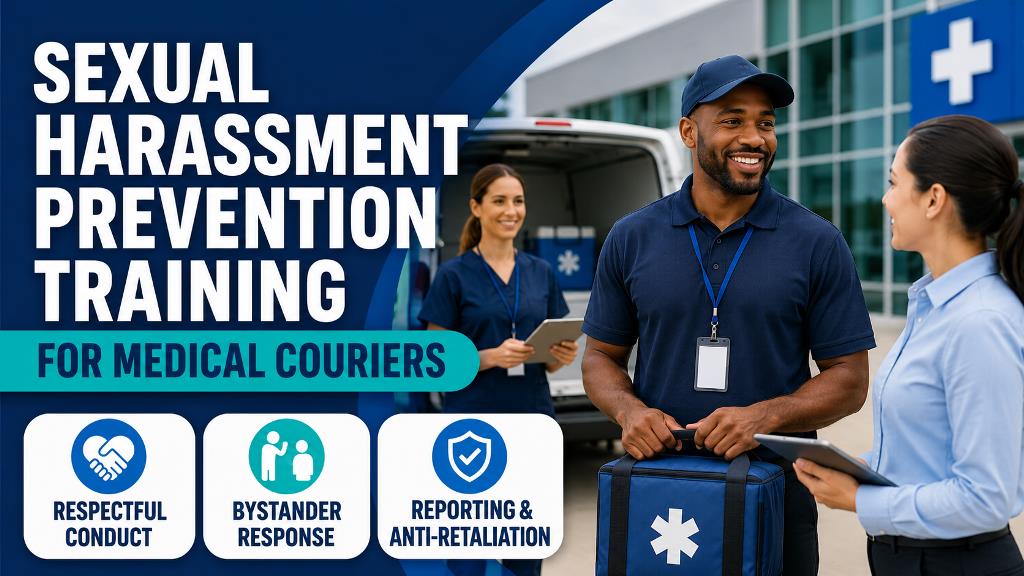
A medical courier’s workplace is not limited to a company office. Couriers may work in vehicles, dispatch centers, hospitals, laboratories, pharmacies, clinics, warehouses, loading areas, parking facilities, and other client locations.
They may also communicate with coworkers, supervisors, contractors, customers, and vendors through telephone calls, email, text messages, and other business communication systems.
Sexual harassment and other inappropriate workplace conduct can affect employees in any work-related setting. Employees need to understand how to recognize inappropriate conduct, use reporting procedures, respond safely as bystanders, and identify possible retaliation.
This online Sexual Harassment Prevention Training is designed for nonsupervisory employees. It provides foundational education about workplace harassment, prevention, reporting, bystander intervention, retaliation, and respectful workplace conduct.
Supervisors and managers should complete the separate two-hour supervisor course addressing their additional responsibilities.
What Is Sexual Harassment Prevention Training?
Sexual Harassment Prevention Training helps employees recognize, prevent, and respond to inappropriate workplace behavior.
The course introduces:
- The definition of sexual harassment
- Legal definitions and frameworks
- Quid pro quo harassment
- Hostile or offensive work environments
- Verbal harassment
- Nonverbal harassment
- Physical harassment
- Third-party harassment
- Workplace bullying
- Warning signs
- Documentation and reporting
- Bystander intervention
- The Five Ds of bystander response
- Retaliation
- Internal and external resources
- Practical case studies
- Respectful workplace conduct
The course helps employees understand their role in maintaining a professional, respectful, and inclusive workplace.
Why This Training Matters for Medical Courier Organizations
Medical courier personnel interact with many people throughout their workday. As a vendor, you are required to take these training before teh first day of the assignmnetThese interactions may involve:
- Other drivers
- Dispatch employees
- Route coordinators
- Supervisors
- Contractors
- Healthcare employees
- Laboratory personnel
- Pharmacy employees
- Customers
- Vendors
- Members of the public
Workplace conduct expectations may apply during routes, at client facilities, in company vehicles, at meetings, during work-related travel, and through business communications.
Training can help employees:
- Recognize inappropriate conduct
- Understand workplace expectations
- Identify warning signs
- Respond appropriately as bystanders
- Use approved reporting procedures
- Recognize possible retaliation
- Understand available support resources
- Contribute to a respectful workplace
A Simple Respectful Workplace Standard
Employees can support a professional workplace by following four basic principles:
Be professional. Respect boundaries. Report concerns. Avoid retaliation.
- Treat coworkers, clients, contractors, and others professionally.
- Avoid verbal, nonverbal, visual, or physical conduct that may be unwelcome.
- Follow the employer’s reporting procedure when concerns arise.
- Never punish or threaten someone for reporting or participating in a complaint process.
Who Should Take This Course?
This one-hour course is intended for nonsupervisory employees.
For medical courier and healthcare logistics organizations, appropriate learners may include:
- Medical courier drivers
- Laboratory and specimen couriers
- Hospital and clinic couriers
- Pharmacy delivery personnel
- Independent courier contractors
- Dispatch employees
- Route coordination personnel
- Warehouse and logistics employees
- Customer service personnel
- Administrative employees
- Temporary employees
- Part-time employees
- New hires
- Other nonsupervisory healthcare logistics personnel
Contractors, temporary workers, volunteers, interns, students with part-time employment, and other workforce members may also benefit from employee-level training.
Important Information for Supervisors and Managers
Supervisors and managers should not take this one-hour employee course as their only sexual harassment prevention training.
Supervisors may have additional responsibilities involving:
- Receiving complaints
- Recognizing possible harassment
- Responding to employee concerns
- Escalating reports
- Preserving documentation
- Protecting employees from retaliation
- Participating in investigations
- Applying workplace policies
- Taking or recommending corrective action
- Maintaining a respectful work environment
A separate two-hour supervisor course is available. Employers should also determine whether state or local requirements require a particular course length, content, frequency, delivery method, or level of interactivity.
Learning Objectives
After completing the course, learners should be able to:
- Explain the general meaning of sexual harassment
- Recognize verbal, nonverbal, visual, and physical harassment
- Understand basic legal definitions and frameworks
- Recognize quid pro quo harassment
- Recognize conduct that may create a hostile or offensive environment
- Identify third-party harassment
- Distinguish sexual harassment from workplace bullying
- Recognize warning signs
- Understand the importance of documentation
- Follow workplace reporting procedures
- Identify internal and external support resources
- Explain the role of a bystander
- Apply the Five Ds of bystander intervention
- Recognize possible retaliation
- Understand basic protections against retaliation
- Apply respectful conduct principles to daily workplace interactions
Employee Responsibilities
Employees help maintain a respectful workplace when they:
- Follow the employer’s conduct policy
- Treat other people professionally
- Avoid inappropriate behavior
- Respect workplace boundaries
- Report concerns through approved procedures
- Support coworkers appropriately
- Avoid gossip
- Cooperate honestly with authorized investigations
- Avoid retaliation
- Ask questions when expectations are unclear
State and Local Training Requirements
Sexual harassment prevention training requirements vary by state and locality.
Applicable requirements may address:
- Employer size
- Employee location
- Supervisory status
- Required course duration
- Training frequency
- Required content
- Interactivity
- Trainer qualifications
- Language and accessibility
- Recordkeeping
- Policy distribution
- Notice and posting requirements
This course should not be described as automatically satisfying every federal, state, or local requirement.
Employers should verify the current requirements that apply to their workforce before assigning training. Supervisors may require separate or longer training.
Frequently Asked Questions
Build a More Respectful Medical Courier Workplace
Professional conduct matters during every pickup, delivery, message, meeting, and client interaction.
This course helps employees understand:
- Sexual harassment
- Quid pro quo conduct
- Hostile work environment concerns
- Verbal, visual, physical, and electronic behavior
- Professional boundaries
- Third-party harassment
- Bystander response
- Reporting procedures
- Workplace investigations
- Protection from retaliation
- Respectful workplace practices
Online and self-paced
Approximately one hour
60 days of access
Audio-supported training
English and Spanish options
Certificate of completion
$25 per learner
Important Legal and Training Notice
This course provides sexual harassment prevention education for nonsupervisory employees. It is not legal advice and should not be described as satisfying every federal, state, or local training requirement.
Employers are responsible for confirming the requirements that apply to their workforce and for providing workplace-specific policies, reporting contacts, complaint procedures, and protection against prohibited retaliation. Supervisors and managers may require separate or additional training.
Sexual Harassment Prevention Training for Medical Couriers is rated 4.8 out of 5 by 8456 users.