
Learn How to Prevent Occupational Exposure to Blood and Other Potentially Infectious Materials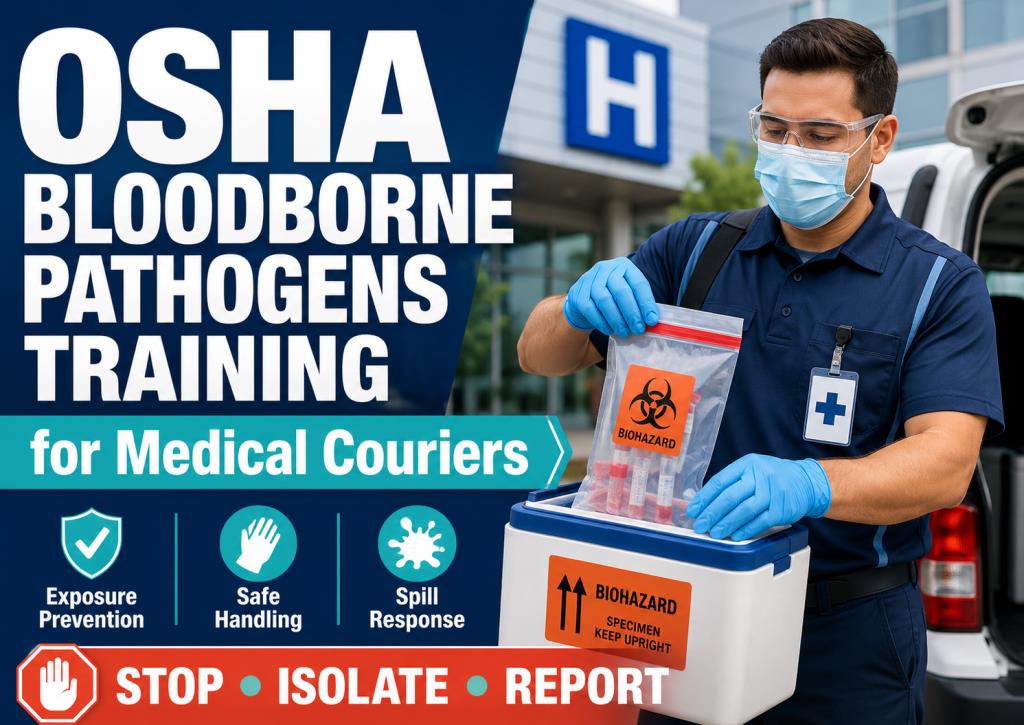
Medical couriers may work around blood specimens, human tissues, contaminated equipment, sharps containers, medical waste, and other materials that could present an occupational exposure risk.
A medical courier may not provide direct patient care, but exposure can still occur through leaking materials, contaminated surfaces, damaged sharps containers, broken glass, needlesticks, cuts, or splashes to the eyes, nose, or mouth.
This online Bloodborne Pathogens Training helps employees understand how bloodborne pathogens are transmitted, how workplace exposure may occur, which precautions reduce risk, and what to do after an exposure incident.
The course addresses important subjects found in OSHA’s Bloodborne Pathogens Standard, 29 CFR 1910.1030. Employers must also provide workplace-specific information based on each employee’s assigned duties and exposure risk.
What Is Bloodborne Pathogens Training?
Bloodborne Pathogens training teaches employees how bloodborne pathogens are transmitted, how occupational exposure may occur, and which precautions can help prevent exposure.
Bloodborne pathogens are disease-causing microorganisms that may be present in human blood. Important examples include:
- Hepatitis B virus, or HBV
- Hepatitis C virus, or HCV
- Human immunodeficiency virus, or HIV
The course also addresses other potentially infectious materials, commonly called OPIM.
An occupational exposure may occur when blood or OPIM contacts:
- The eyes
- The nose
- The mouth
- Another mucous membrane
- Cut, damaged, or non-intact skin
- The body through a needlestick or puncture wound
Employees should follow Standard Precautions, required safety practices, and their employer’s Exposure Control Plan.
Why Medical Couriers May Need BBP Training
Medical courier duties may involve reasonably anticipated exposure to blood or other potentially infectious materials.
Possible exposure situations include:
- Handling packages that contain blood specimens
- Working around contaminated equipment
- Transporting closed sharps containers
- Handling certain medical-waste containers
- Encountering broken or leaking materials
- Touching contaminated surfaces
- Experiencing a needlestick or puncture injury
- Receiving a splash to the eyes, nose, or mouth
- Performing assigned cleanup or decontamination duties
Not every medical courier has the same level of exposure. Employers must evaluate actual job classifications, tasks, and procedures to determine which workers have occupational exposure.
Who Should Take This Course?
This course may be appropriate for employees who could reasonably anticipate occupational exposure to blood or OPIM while performing their duties.
Medical courier learners may include:
- Medical courier drivers
- Laboratory specimen couriers
- Blood bank couriers
- Medical-waste transport personnel
- Sharps collection personnel
- Employees handling human specimens
- Employees cleaning transport equipment
- Employees assigned to blood or body-fluid cleanup
- Supervisors responsible for exposure procedures
- Other healthcare logistics personnel with occupational exposure
The employer is responsible for determining which employees require training under OSHA’s Bloodborne Pathogens Standard.
What You Will Learn
After completing the course, learners should be able to:
- Explain what bloodborne pathogens are
- Recognize other potentially infectious materials
- Identify common occupational exposure routes
- Understand Standard Precautions
- Explain the purpose of an Exposure Control Plan
- Recognize engineering and work practice controls
- Understand the purpose and limitations of PPE
- Follow proper glove-removal practices
- Describe appropriate hand hygiene
- Recognize basic sharps-safety requirements
- Understand biohazard labels and hazard communication
- Recognize factors affecting disease transmission
- Describe basic housekeeping and decontamination practices
- Explain the purpose of hepatitis B vaccination
- Identify immediate actions after an exposure
- Understand post-exposure evaluation and follow-up
- Recognize employer training and recordkeeping responsibilities
What To Do After a Possible Exposure
After a possible exposure, an employee should:
- Wash needlesticks, cuts, and exposed skin with soap and water.
- Flush the eyes, nose, mouth, or other mucous membranes with water.
- Report the incident immediately.
- Follow the employer’s Exposure Control Plan.
- Obtain prompt medical evaluation and follow-up.
- Provide accurate information about how the exposure occurred.
Employees should not wait for symptoms before reporting an exposure.
Employer Responsibilities
Online training supports an employer’s Bloodborne Pathogens program, but it does not complete every OSHA responsibility.
Depending on the workplace and exposure determination, employers may also need to:
- Identify jobs and tasks with occupational exposure
- Maintain a written Exposure Control Plan
- Review the plan annually
- Apply Standard Precautions
- Provide engineering and work practice controls
- Supply appropriate PPE at no cost
- Offer hepatitis B vaccination to eligible employees
- Establish post-exposure procedures
- Provide medical evaluation and follow-up
- Maintain medical and training records
- Provide initial and annual employee training
- Explain workplace-specific procedures
- Give employees an opportunity to ask questions
Employees should know where the Exposure Control Plan is located and whom to contact after an exposure.
Frequently Asked Questions
Prepare Your Medical Courier Workforce for Exposure Risks
Medical couriers need to know what to do when a specimen leaks, a sharps container is damaged, or potentially infectious material contacts the skin, eyes, nose, or mouth.
This online course provides practical training in:
- Bloodborne pathogen awareness
- Medical courier exposure risks
- Universal Precautions
- PPE and safe work practices
- Specimen transportation
- Sharps safety
- Spill response
- Exposure reporting
- Post-exposure procedures
Online and self-paced
Approximately one hour
116 audio-supported slides
60 days of course access
English and Spanish options
Certificate of completion
$25 per learner
Important Safety and Compliance Notice
This course provides general Bloodborne Pathogens education. It does not replace an employer’s exposure determination, written Exposure Control Plan, workplace-specific training, engineering controls, safe work practices, PPE instruction, hepatitis B vaccination responsibilities, post-exposure procedures, or medical follow-up.
Employers must evaluate each employee’s duties and provide initial and annual training when occupational exposure exists.
OSHA Bloodborne Pathogens Training for Medical Couriers is rated 4.9 out of 5 by 4862 users.