Transport Healthcare Gas Cylinders Safely and Securely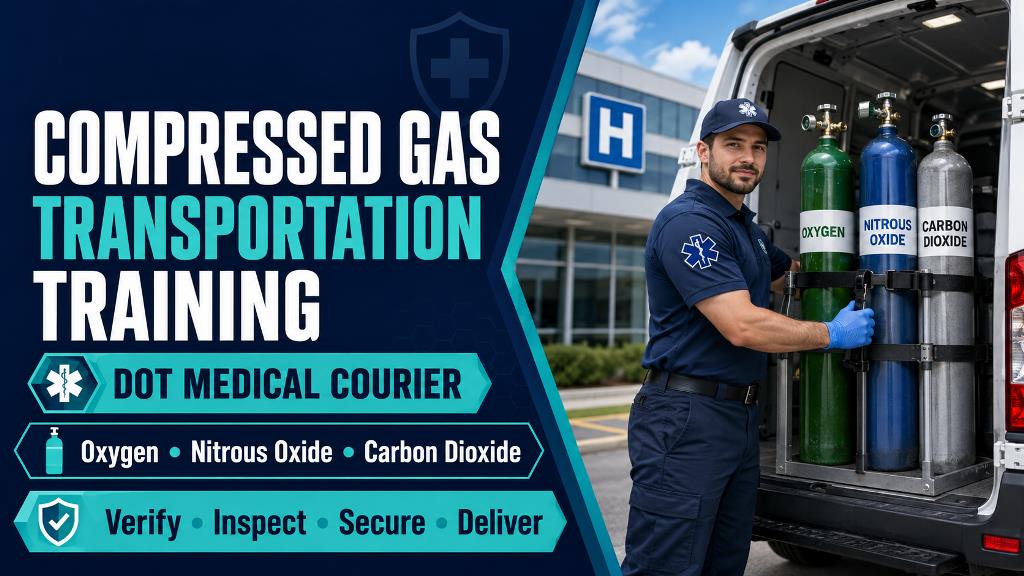
Compressed gas cylinders contain stored pressure. If a cylinder falls, its valve is damaged, gas escapes, or the load shifts during transportation, a routine healthcare delivery can quickly become an emergency.
This course teaches medical courier personnel how to identify approved healthcare gases, inspect cylinders, protect valves, match cylinders to shipping information, use approved handling equipment, secure cylinders inside a vehicle, complete authorized deliveries, manage returns, and respond to leaks, fires, crashes, or security concerns as per department of transportation requirements.
The course focuses on sealed, non-bulk compressed-gas cylinders transported by highway. It does not cover dry ice, cryogenic liquids, bulk containers, air transportation, or toxic or flammable gases unless separate training is provided.
Verify. Inspect. Secure. Deliver. Report.
What Is Medical Courier Compressed Gas Training?
This course provides job-role safety and transportation training for personnel who transport sealed, non-bulk healthcare gas cylinders by highway.
The gases covered include:
- Oxygen, compressed, UN1072
- Nitrous oxide, UN1070
- Carbon dioxide, UN1013
- Air, compressed, UN1002
- Nitrogen, compressed, UN1066
- Helium, compressed, UN1046
- Argon, compressed, UN1006
Learners review cylinder identification, department of transportation (DOT) labels and markings, shipping information, external inspection, valve protection, approved carts and racks, vehicle securement, driving practices, authorized delivery, return cylinders, leak response, incident reporting, and security awareness.
This course does not authorize cylinder filling, valve repair, gas administration, regulator installation, equipment connection, clinical service, system troubleshooting, dry ice transportation, cryogenic-liquid transportation, or air transportation.
Why Compressed Gas Cylinders Require Specialized Handling
Compressed gas cylinders can present several hazards:
- High internal pressure
- Sudden gas release
- Valve damage
- Forceful cylinder movement
- Fire intensification
- Oxygen displacement
- Asphyxiation
- Cold surfaces from rapid gas release
- Heat-related pressure increase
- Impact damage
- Unsecured loads
- Incorrect cylinder identification
- Unauthorized access
- Wrong delivery
A nonflammable gas can still create a serious pressure, atmosphere, or transportation hazard.
Safe handling depends on three basic controls:
- Identify the gas correctly.
- Protect the cylinder and valve.
- Secure the cylinder against movement.
Do Medical Couriers Need Training to Transport Medical Oxygen?
Employees who load, unload, handle, transport, or direct the transportation of compressed oxygen may perform functions that affect hazardous-material transportation safety.
Training must match the employee’s actual duties and may include:
- General awareness and recognition
- Function-specific courier duties
- Safety training
- Security-awareness training
- Highway-driver training
- Testing
- Employer-specific procedures
- Training records
The employer must also determine:
- Which gases and cylinder types are authorized
- Which vehicles and racks may be used
- Whether shipping papers are required
- Whether placards are required
- Whether CDL or hazmat-endorsement requirements apply
- Whether an exception applies
- Whether additional material-specific training is required
Healthcare Gases Covered
Oxygen, Compressed, UN1072
- Oxygen supports combustion and can make a fire burn faster and hotter. Keep cylinders away from flames, sparks, smoking, oil, grease, fuel contamination, and excessive heat.
Nitrous Oxide, UN1070
- Nitrous oxide has oxidizing properties. Protect the cylinder from heat, ignition sources, oil, grease, valve damage, and uncontrolled movement.
Carbon Dioxide, UN1013
- Carbon dioxide can displace oxygen inside an enclosed area. A leak may cause headache, dizziness, confusion, breathing difficulty, or collapse.
Air, Compressed, UN1002
- Compressed air is stored under pressure. Cylinders must be identified, inspected, protected from impact, and secured during transportation.
Nitrogen, Helium, and Argon
- These gases can displace oxygen and may provide little warning during a leak. They also present pressure, valve, securement, and enclosed-space hazards.
- Cylinder color alone should never be used to identify a gas. Drivers must use the label, proper shipping name, UN identification number, shipping information, and employer instructions.
What You Will Learn
After completing the course, learners should be able to:
- Explain why cylinders create pressure hazards
- Identify common healthcare gases and UN numbers
- Recognize Class 2 labels and markings
- Identify gases without relying on cylinder color
- Match cylinders to shipping information
- Inspect cylinders, valves, caps, and guards
- Reject leaking, damaged, unidentified, or contaminated cylinders
- Protect oxygen and nitrous oxide from oil and grease
- Use approved carts, racks, straps, and restraints
- Secure full, empty, partial, and returned cylinders
- Keep shipping papers accessible
- Complete a final load check
- Recognize when placards or added driver qualifications may apply
- Follow approved routes and driving practices
- Verify delivery recipients
- Recognize leaks and exposure symptoms
- Respond to fires, crashes, and gas releases
- Apply stop-work authority
- Protect route, load, and delivery information
- Stay within the medical courier transportation role
Who Should Take This Course?
This course is designed for personnel whose work affects the highway transportation safety of sealed healthcare gas cylinders, including:
- Medical courier drivers
- Medical oxygen delivery personnel
- Employees who load cylinders
- Employees who unload cylinders
- Vehicle loaders
- Independent medical couriers
- Owner-operators transporting cylinders in commerce
- Dispatchers who control loads or routes
- Supervisors who direct compressed-gas courier work
Training must be assigned according to the employee’s actual transportation functions.
How This Course Is Different
Developed for Medical Courier Transportation
The course focuses on healthcare gases, courier vehicles, cylinder inspection, handling equipment, loading, securement, driving, delivery, returns, and incident reporting.
Covers DOT and OSHA Topics for the Courier Role
Learners review general awareness, function-specific duties, safety, security awareness, highway-driver subjects, labels, Safety Data Sheets, PPE, and workplace reporting.
Focuses on Transportation Rather Than Clinical Use
The course does not teach gas administration, regulator installation, patient connection, cylinder filling, valve repair, or clinical-equipment operation.
Uses a Repeatable Courier Workflow
Drivers learn to:
- Verify the route assignment.
- Inspect the cylinder.
- Match the cylinder to documents.
- Load with approved equipment.
- Secure before driving.
- Deliver to an authorized recipient.
- Report problems immediately.
Reinforces Stop-Work Authority
The courier should stop when:
- Gas identity is unclear
- A label or document is missing
- A cylinder is leaking or damaged
- A valve or cap is unsafe
- The load cannot be secured
- The recipient is unauthorized
- The route or quantity changes unexpectedly
Course Boundaries and Additional Employer Requirements
This course addresses DOT and OSHA subjects relevant to medical courier transportation of sealed, non-bulk healthcare gas cylinders by highway. These subjects include general awareness, function-specific courier duties, safety, security awareness, highway-driver topics, HazCom labels, SDS access, cylinder inspection, loading, securement, and emergency response.
The employer must still:
- Add approved gases and cylinder sizes
- Identify approved vehicles and rack systems
- Provide the SDS access method
- Define PPE requirements
- Establish the shipping-paper process
- Make placard decisions
- Confirm driver qualifications
- Provide emergency and security contacts
- Administer required testing
- Provide a practical evaluation when assigned
- Correct missed assessment items
- Document employer authorization
- Retain the training record
- Provide recurrent training when required
This course does not authorize or replace requirements for:
- Cylinder filling
- Cylinder requalification
- Cylinder or valve repair
- Shipping-paper preparation
- Hazmat classification
- Clinical oxygen administration
- Regulator or equipment connection
- Respiratory-equipment operation
- Cryogenic liquids
- Dry ice
- Bulk cylinders or tanks
- Toxic or flammable gases
- Air transportation
- Specialized emergency response
- CDL or hazmat endorsements when required
- In-depth security-plan duties when applicable
Frequently Asked Questions
Prepare Medical Couriers for Healthcare Gas Deliveries
This course prepares medical courier personnel to:
- Identify approved healthcare gases
- Inspect cylinders and valves
- Match cylinders to shipping information
- Use approved carts and racks
- Secure cylinders inside the vehicle
- Follow highway transportation procedures
- Complete authorized deliveries
- Manage return cylinders
- Respond to leaks, fires, and crashes
- Apply stop-work authority
Verify. Inspect. Secure. Deliver. Report.
Important Training Notice
This course provides job-role training for medical courier personnel transporting sealed, non-bulk compressed healthcare gas cylinders by highway.
It does not cover dry ice, cryogenic liquids, bulk gas containers, toxic gases, flammable gases, or air transportation. It also does not authorize cylinder filling, requalification, repair, classification, shipping-paper preparation, clinical gas administration, regulator connection, or equipment service.
Employers must evaluate each employee’s assigned functions, gases, cylinder sizes, quantities, vehicles, racks, routes, shipping papers, placarding requirements, driver qualifications, and applicable exceptions.
The employer must add company-specific procedures, administer applicable testing, provide practical evaluation when assigned, correct missed items, document authorization, and retain required training records.
The course and certificate should not be described as issued, approved, or certified by DOT or PHMSA.
Compressed Gas Transportation Training for Medical Couriers is rated 4.5 out of 5 by 8943 users.