Recognize Specialized Shipments and Protect Them Throughout Delivery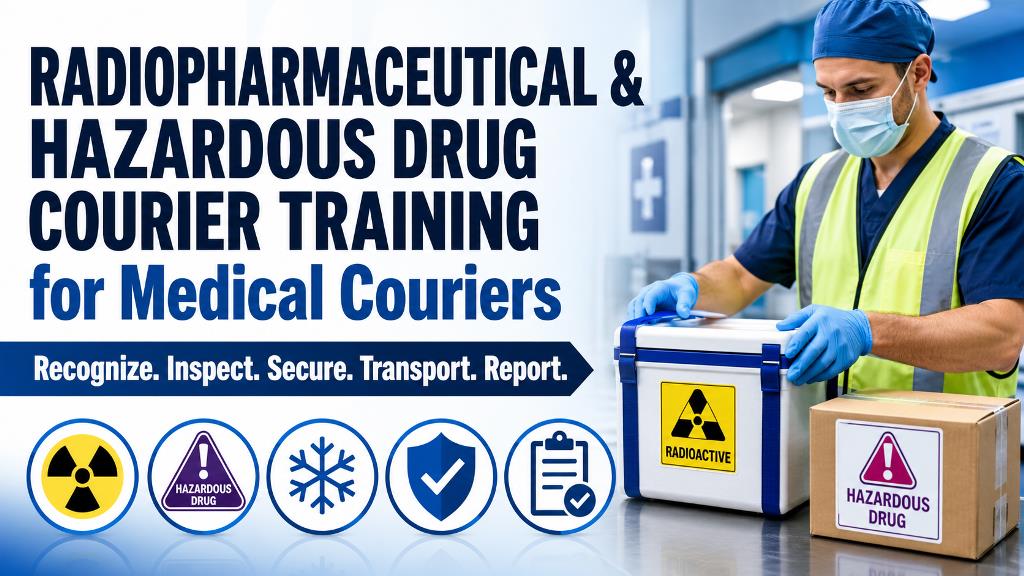
Medical couriers may transport chemotherapy drugs, other hazardous drugs, and radiopharmaceuticals used in diagnostic imaging, nuclear medicine, cancer treatment, and other patient-care services.
These shipments may require special labels, shielding, temperature controls, secure vehicle placement, shipping papers, controlled delivery, and prompt incident reporting.
This course prepares medical couriers to recognize hazardous healthcare shipments, inspect sealed packages, protect labels and paperwork, secure cargo, complete authorized handoffs, and respond appropriately to spills, damage, accidents, or suspected exposure.
The course focuses on the courier’s role:
Recognize. Inspect. Secure. Transport. Report.
What Is Radiopharmaceutical and Hazardous Drug Courier Training?
- This course teaches medical couriers how to transport sealed packages containing chemotherapy drugs, other hazardous drugs, or radiopharmaceuticals during pickup, vehicle loading, transportation, delivery, and incident response.
- Couriers learn to inspect the outside of a shipment, recognize warning labels, secure packages, protect shipping papers, follow temperature instructions, maintain chain of custody, and complete an authorized handoff.
- Medical couriers should not open, repair, reseal, repackage, or alter a prepared shipment. They should never open lead shielding, remove radioactive material, conduct radiation surveys, or clean radioactive contamination unless specifically trained and authorized.
- Limited containment of a small chemotherapy spill may be performed only when company procedures permit it and the courier has the required training, PPE, and spill kit.
Radiopharmaceuticals like Chemotherapy and Hazardous Drugs Present Different Risks
Radiopharmaceuticals contain radioactive material used for medical imaging, diagnosis, or treatment. Medical couriers may encounter products associated with Tc-99m, F-18 FDG, I-131, Lu-177, and Ga-68.
Courier responsibilities may involve radioactive labels, Transport Index information, package shielding, separation, shipping papers, security, time-sensitive delivery, and emergency reporting.
Hazardous drugs can include chemotherapy, cytotoxic, antineoplastic, and other hazardous-drug categories identified by NIOSH.
Courier concerns may include damaged packaging, visible residue, liquid, vapor, contaminated surfaces, exposure risks, PPE, spill procedures, temperature requirements, and approved disposal procedures.
Couriers must follow shipment labels, shipping papers, company procedures, client instructions, and the training that applies to their assigned work.
Why Medical Couriers Need Specialized Training
A medical courier may transport products such as:
- Chemotherapy drugs
- Cytotoxic drugs
- Other NIOSH-identified hazardous drugs
- Tc-99m shipments
- F-18 FDG shipments
- I-131 shipments
- Lu-177 shipments
- Ga-68 shipments
- Other sealed Class 7 medical shipments
An intact package may be safe to transport when all handling requirements are followed. Risk can increase when a package is damaged, leaking, wet, crushed, incorrectly labeled, unsecured, opened, or handled by someone without the proper training.
Drivers must be able to recognize when a shipment can proceed and when the safest decision is to stop and request assistance.
What Medical Couriers Will Learn
After completing the course, learners should be able to:
- Identify hazardous-drug and radiopharmaceutical shipments
- Recognize chemotherapy, cytotoxic, and radioactive-material labels
- Recognize White-I, Yellow-II, and Yellow-III labels
- Explain the basic purpose of a Transport Index
- Understand the courier’s authorized role and limits
- Inspect sealed packages before acceptance
- Recognize leaks, moisture, residue, broken seals, and damaged labels
- Use required PPE according to assigned procedures
- Protect shielding and secondary containment
- Secure packages inside a delivery vehicle
- Maintain required temperature conditions
- Protect shipping papers and delivery records
- Complete an authorized hand-to-hand delivery
- Respond to damaged packages, spills, exposures, and vehicle accidents
- Apply the Stop, Secure, Report procedure
- Report incidents accurately
Medical Courier Training Scenarios
- A radioactive-material package is damaged
- A chemotherapy tote has liquid on its exterior
- The shipping document does not match the package
- A temperature monitor displays an alert
- The delivery vehicle is involved in a collision
Who Should Take This Course?
This course is designed for personnel who transport or supervise sealed radiopharmaceutical and hazardous-drug shipments, including:
- Medical courier drivers
- Radiopharmaceutical couriers
- Nuclear-pharmacy delivery drivers
- Chemotherapy and hazardous-drug couriers
- Drivers delivering radioactive medicines
- Drivers serving hospitals and imaging centers
- Medical couriers responsible for Class 7 packages
- Couriers assigned to sealed hazardous-drug deliveries
Required training depends on the employee’s assigned functions and the materials being transported.
Frequently Asked Questions
Prepare Medical Couriers for Specialized Healthcare Shipments
This course helps medical couriers recognize chemotherapy, hazardous-drug, and radiopharmaceutical shipments, inspect packages, secure cargo, protect shipping papers, complete authorized deliveries, and report abnormal conditions.
Know what you transport. Protect yourself. Stop, secure, and report problems.
Important Training and Compliance Notice
This course provides role-specific safety and transportation training for medical couriers handling sealed chemotherapy, hazardous-drug, and radiopharmaceutical shipments.
Required training depends on the employee’s actual duties. This course may not, by itself, satisfy every applicable DOT, OSHA, NRC, Agreement State, radiation-safety, hazardous-drug, security, emergency-response, highway-driver, or function-specific training requirement.
Employers are responsible for identifying employee functions and providing applicable training, testing, certification, procedures, PPE, spill equipment, emergency contacts, supervision, and training records.
Couriers should perform only the functions for which they have been trained and authorized.
Radio-pharmaceutical and Hazardous Drug Courier Training is rated 4.3 out of 5 by 5047 users.