Understand Chemical Hazards in Medical, Dental, and Healthcare Workplaces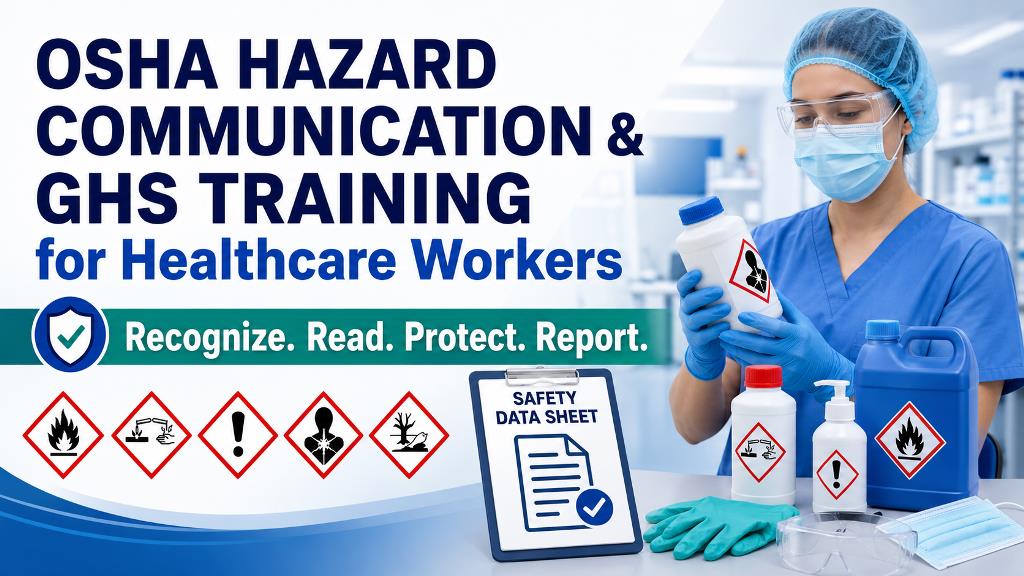
Healthcare and dental employees may work with disinfectants, sterilants, laboratory reagents, cleaning concentrates, dental materials, compressed gases, solvents, adhesives, and certain hazardous drugs.
This online course teaches employees how to recognize chemical hazards, read container labels, understand OSHA pictograms, locate and use Safety Data Sheets, follow protective measures, and respond safely to spills or possible exposures.
The course is designed for medical, dental, laboratory, pharmacy, environmental-services, facilities, receiving, supply, and related healthcare personnel who may encounter hazardous chemicals during normal work or a foreseeable emergency.
Recognize. Read. Protect. Report.
What Is OSHA HazCom and GHS Training?
OSHA Hazard Communication training teaches employees about hazardous chemicals present in their work areas and the measures they can use to protect themselves.
The Occupational Safety and Health Administration’s Hazard Communication Standard, 29 CFR 1910.1200, requires employers with hazardous chemicals in their workplaces to communicate information through:
- A written hazard communication program
- A workplace chemical inventory
- Chemical labels and other warnings
- Safety Data Sheets
- Employee information and training
The Globally Harmonized System of Classification and Labelling of Chemicals, commonly called GHS, provides a consistent approach for communicating chemical hazards through standardized label elements, pictograms, hazard statements, precautionary statements, signal words, and Safety Data Sheets.
This course helps healthcare employees understand and use that information during their daily work.
Learn more from the OSHA Hazard Communication overview.
Why Healthcare Workers Need Hazard Communication Training
Hazardous chemicals are found throughout healthcare facilities, not only in laboratories or maintenance departments.
Employees may encounter chemicals while:
- Cleaning and disinfecting treatment areas
- Sterilizing instruments
- Processing laboratory specimens
- Preparing dental materials
- Handling pharmaceutical products
- Receiving chemical supplies
- Managing medical waste
- Maintaining equipment
- Responding to leaks or spills
- Transferring chemicals into secondary containers
- Using compressed gases
- Performing environmental services
- Working around chemicals used by other departments
Employees need to know more than a chemical’s product name. They must understand where to find hazard information, what the warnings mean, and which workplace procedures apply.
Healthcare Chemicals Covered by Hazard Communication
Depending on the workplace, employees may encounter:
- Cleaning products and disinfectants
- Sterilants and high-level disinfectants
- Laboratory reagents, fixatives, and solvents
- Dental etchants and bonding agents
- Adhesives, acrylics, and monomers
- Aerosol and pressurized products
- Oxygen, nitrous oxide, and other compressed gases
- Anesthetic agents
- Formaldehyde-containing products
- Certain hazardous drugs
- Spill-control and instrument-processing chemicals
The presence of a chemical does not automatically mean every employee has the same level of risk. Exposure depends on the chemical, concentration, task, route of exposure, controls, and workplace conditions.
Employees should follow the label, Safety Data Sheet, written hazard communication program, and employer-specific procedures for the chemicals used in their work areas.
What You Will Learn
After completing this course, learners should be able to:
- Explain the purpose of OSHA Hazard Communication
- Describe how GHS supports chemical-hazard communication
- Recognize physical and health hazards
- Identify required chemical-label elements
- Interpret OSHA pictograms and signal words
- Locate important information in a Safety Data Sheet
- Recognize workplace and secondary-container labeling requirements
- Identify controls and chemical PPE
- Recognize a possible chemical release
- Respond safely to a spill or exposure
- Report missing labels, inaccessible SDSs, and unsafe conditions
Who Should Take This Training?
This course is designed for employees who use, handle, store, clean around, or may be exposed to hazardous chemicals in healthcare settings.
Potential learners include:
- Medical and clinical personnel
- Dental professionals and dental support employees
- Laboratory and diagnostic-services personnel
- Pharmacy personnel
- Instrument-processing employees
- Environmental-services personnel
- Facilities employees
- Receiving and supply personnel
- Research personnel
- Healthcare waste personnel
Administrative and front-desk employees may also need training if they work in areas where hazardous chemicals are present or their duties could expose them to chemical hazards.
Healthcare Workplaces That Can Use This Course
The training is relevant to:
- Hospitals
- Medical clinics
- Dental offices
- Dental laboratories
- Surgery centers
- Clinical laboratories
- Pharmacies
- Long-term care facilities
- Imaging facilities
- Research facilities
- Instrument-processing areas
- Healthcare support operations
How This Course Is Different
Developed for Healthcare and Dental Workplaces
The course uses chemicals, tasks, and scenarios found in clinical, dental, laboratory, pharmacy, sterilization, and healthcare-support environments.
Focused on Employee Decisions
Learners practice how to read labels, use SDSs, identify protective measures, stop unsafe work, and report chemical problems.
Covers the OSHA HCS 2024 Framework
The course reflects OSHA’s updated Hazard Communication Standard, which aligns primarily with GHS Revision 7 and includes changes affecting hazard classifications, labels, small containers, and Safety Data Sheets.
OSHA extended the HCS 2024 transition dates in January 2026. Employers should review current implementation dates and determine whether workplace labels, written programs, SDS procedures, or additional training require updates. See the OSHA HCS 2024 compliance-date extension.
Supports Workplace-Specific Training
The course provides foundational HazCom and GHS education. Employers must add information about:
- Chemicals present in the employee’s work area
- Location of the written HazCom program
- Location and availability of SDSs
- Workplace labeling systems
- Required PPE
- Exposure controls
- Spill procedures
- Emergency contacts
- Reporting procedures
- Newly introduced chemical hazards
What This Course Does Not Replace
This training does not replace specialized instruction that may be required for:
- Bloodborne Pathogens
- Infection control
- Hazardous drugs
- Laboratory Chemical Hygiene Plans
- Formaldehyde or ethylene oxide
- Respiratory protection
- Radiation safety
- Transportation requirements
- Employer-specific spill and emergency procedures
DOT hazmat employee training under 49 CFR 172.700 through 172.704 is a separate transportation requirement. Completing this healthcare HazCom course alone does not satisfy all DOT hazmat employee training requirements.
Employer and Employee Responsibilities
Employers Should
- Maintain a written HazCom program
- Keep a hazardous chemical list
- Make SDSs accessible
- Use an effective workplace labeling system
- Train employees on hazards and controls
- Explain nonroutine tasks and emergency procedures
Employees Should
- Read labels
- Know how to access the SDS
- Use controls and chemical PPE
- Do not mix or dilute unless trained
- Keep containers closed
- Report leaks, symptoms, or unsafe conditions
- Ask before mixing or cleaning
Benefits of Healthcare HazCom and GHS Training
Role-based chemical-safety training can help healthcare organizations:
- Improve recognition of chemical hazards
- Improve understanding of labels and pictograms
- Improve use of Safety Data Sheets
- Reinforce controls and chemical PPE
- Improve spill and exposure response
- Support employer-specific training
No generic online course can guarantee OSHA compliance. Compliance depends on the employer’s actual chemicals, written program, labeling, SDS access, employee exposure, controls, procedures, and effective workplace-specific training.
Frequently Asked Questions
Build Stronger Chemical-Hazard Awareness
Healthcare and dental employees need to recognize chemical warnings, locate reliable safety information, and follow the correct workplace procedures.
This course helps learners:
- Recognize physical and health hazards
- Understand chemical labels
- Interpret OSHA pictograms
- Use Safety Data Sheets
- Follow controls and chemical PPE requirements
- Respond safely to spills or possible exposures
- Report unsafe conditions
Important Notice
This course provides general OSHA Hazard Communication and GHS education for medical, dental, and healthcare personnel.
It does not replace the employer’s written Hazard Communication Program, hazardous chemical list, workplace labeling system, Safety Data Sheet access, exposure controls, chemical PPE assessment, spill procedures, or workplace-specific training.
Employers must provide employees with information about the actual chemicals, procedures, controls, emergency contacts, and reporting requirements in their work areas.