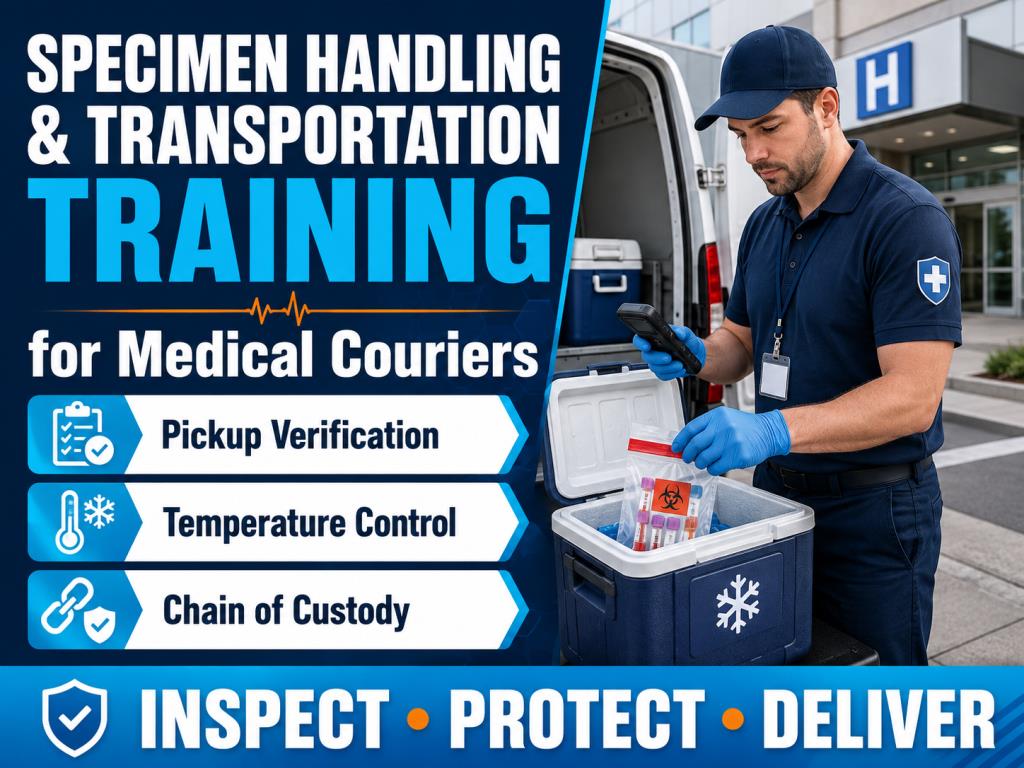

DOT Medical Courier: Specimen Handling, Collection and Transportation Best Practices

DOT Medical Courier: Specimen Handling, Collection and Transportation Best Practices2026-08-14T11:44:59+00:00

Protect Specimen Integrity From Pickup Through Final DeliveryMedical courier specimen handling training

A medical specimen is more than a package. It may support a diagnosis, guide a treatment decision, confirm a medical condition, or help a healthcare provider respond to an urgent patient need.

The condition of a specimen can change during transportation. Delays, temperature excursions, rough handling, damaged packaging, missing documentation, or an incomplete chain of custody may cause a laboratory to question or reject the specimen.

Our online Medical Courier Specimen Handling, Collection and Transportation Best Practices Course teaches couriers how to protect specimens throughout the delivery process. The course covers pickup verification, package inspection, transport container use, temperature awareness, route management, chain of custody, secure delivery, and incident reporting.

It is designed around the actual responsibilities of a medical courier. Learners are taught to inspect and transport prepared shipments without opening, altering, repackaging, or attempting to correct specimen containers unless their employer has specifically trained and authorized them to perform that function.

Course at a Glance

Course feature Details
Format Online and self-paced
Average completion time Approximately 1 hour
Course content 44 audio-supported slides
Online access 60 days
Certificate Certificate of completion included
Certificate period 2 years
Language options English and Spanish
License Single-user license
Individual price $25 per learner

What Is Medical Courier Specimen Handling Training?

Medical courier specimen handling training teaches drivers how to receive, secure, transport, document, and deliver prepared medical specimens while protecting specimen integrity and employee safety.

The course focuses on the period when responsibility moves from the sending location to the courier and then to the receiving facility.

Learners explore how to:

  • Inspect a shipment before accepting it
  • Confirm pickup information
  • Recognize damaged or leaking packages
  • Maintain the required transport environment
  • Prevent rough handling and package movement
  • Protect time-sensitive specimens from delays
  • Maintain chain-of-custody records
  • Verify the receiving person and location
  • Document delivery accurately
  • Report spills, accidents, delays, and temperature problems

Why Specimen Handling Matters

Laboratory specimens can be sensitive to time, temperature, movement, light, position, and contamination. A mistake during transportation can affect specimen quality even when the collection procedure was completed correctly.

Poor transportation practices may lead to:

  • Delayed testing
  • Specimen rejection
  • Recollection
  • Inaccurate or unreliable results
  • Interrupted patient care
  • Lost chain-of-custody evidence
  • Exposure to infectious materials
  • Contractual or regulatory concerns
  • Loss of trust from healthcare clients

A trained courier understands that safe specimen transport requires more than driving from one address to another. It requires careful observation, accurate documentation, secure handling, and prompt communication.

Who Should Take This Course?

This course is intended for people who handle or supervise medical specimen transportation.

The target audience includes:

  • Medical courier drivers
  • Laboratory couriers
  • Hospital and clinic delivery personnel
  • Diagnostic specimen drivers
  • Blood bank couriers
  • Pathology transport personnel
  • Pharmacy and healthcare logistics employees
  • Third-party healthcare delivery contractors
  • Dispatchers and route coordinators
  • Medical courier supervisors
  • Courier company owners
  • Laboratory logistics personnel
  • Healthcare employees who prepare courier pickups
  • Employees who receive transported specimens
  • New couriers preparing to work with healthcare clients

The course can also serve as refresher training for experienced couriers who need to review specimen integrity, transport documentation, and incident-response practices.

Learning Objectives

After completing this course, learners should be able to:

  • Explain the courier’s role in protecting specimen integrity
  • Identify common categories of transported specimens
  • Recognize factors that can affect specimen quality
  • Perform a visual package inspection before pickup
  • Verify pickup information without opening a shipment
  • Understand the importance of proper specimen identification
  • Recognize common packaging defects
  • Use transport containers correctly
  • Maintain required temperature conditions
  • Respond to time-sensitive and STAT deliveries
  • Prevent unnecessary movement and physical damage
  • Maintain an accurate chain of custody
  • Protect specimen-related patient information
  • Verify the recipient before releasing a shipment
  • Document pickup and delivery accurately
  • Respond appropriately to spills, delays, accidents, and temperature excursions
  • Recognize when additional DOT training may be required

Course Outline

Module 1: Introduction and the Medical Courier’s Role

1. Understanding the Medical Courier’s Responsibility

Medical couriers connect laboratories, hospitals, clinics, pharmacies, research facilities, blood banks, and other healthcare organizations.

The courier’s responsibility may include:

  • Receiving prepared specimens
  • Inspecting external packaging
  • Confirming pickup details
  • Protecting specimens during transportation
  • Maintaining required environmental conditions
  • Preserving the chain of custody
  • Delivering to an authorized recipient
  • Reporting incidents and delays

The courier should follow the client’s instructions, employer policies, route requirements, and applicable safety or transportation rules.

2. Common Specimens Transported by Medical Couriers

Depending on the client and route, a medical courier may transport:

  • Blood specimens
  • Urine specimens
  • Saliva specimens
  • Swab samples
  • Tissue specimens
  • Biopsy materials
  • Pathology specimens
  • Microbiology samples
  • Blood products
  • Diagnostic test kits
  • Research specimens
  • Veterinary specimens

Different specimens may require different handling, timing, packaging, and temperature conditions. The courier should follow the instructions assigned to the shipment and should not guess based on appearance.

3. Understanding the Collection Process

Medical couriers normally do not collect specimens directly from patients. However, they should understand the basic collection process because mistakes made before pickup can affect transportation and laboratory acceptance.

Collection awareness may include:

  • Correct patient identification
  • Correct specimen container
  • Accurate labeling
  • Required collection date and time
  • Proper closure of the container
  • Required documentation
  • Appropriate storage before pickup
  • Placement in transport packaging

The courier should never correct a patient label, transfer a specimen, open a primary container, or add missing information unless specifically trained and authorized.

4. Protecting Specimen Integrity

Specimen integrity means keeping the specimen in a condition suitable for its intended testing or use.

Factors that may affect integrity include:

  • Excessive heat or cold
  • Delayed transportation
  • Shaking or vibration
  • Direct sunlight
  • Incorrect orientation
  • Broken containers
  • Leaks
  • Contamination
  • Missing identification
  • Incomplete documentation
  • Incorrect delivery location

Couriers help protect integrity by following the assigned handling instructions from pickup through delivery.

Module 2: Specimen Storage and Transportation Systems

5. Pre-Pickup Preparation

Before beginning a specimen route, the courier should confirm that the required equipment is available and in suitable condition.

Pre-route preparation may include checking:

  • Vehicle cleanliness
  • Transport coolers
  • Insulated containers
  • Temperature-monitoring devices
  • Package securement equipment
  • Spill-response supplies
  • Required PPE
  • Route information
  • Communication devices
  • Pickup and delivery documentation

The courier should report missing or damaged equipment before accepting affected shipments.

6. Pickup Verification

At pickup, the courier should confirm that the shipment matches the assigned order.

A pickup check may include:

  • Correct pickup location
  • Correct number of packages
  • Destination information
  • Required service level
  • STAT, timed, or routine status
  • Special handling instructions
  • Required temperature range
  • Visible package condition
  • Required signatures or electronic confirmation

The courier should not sign for a package that has not been counted or visually inspected.

7. External Package Inspection

Medical couriers should inspect the outside of each package without opening it.

Warning signs may include:

  • Wet or stained packaging
  • Cracks or punctures
  • Broken seals
  • Missing closures
  • Visible leakage
  • Loose lids
  • Exposed sharps
  • Damaged secondary packaging
  • Incorrect orientation
  • Missing or unreadable labels
  • Frost, condensation, or unexpected heat
  • Unusual odors

A damaged or leaking package should be managed according to the employer’s rejection or incident-response procedure.

8. Primary, Secondary, and Outer Packaging Awareness

Medical specimens may use several protective packaging layers.

These can include:

  • A primary specimen container
  • Absorbent material
  • Leak-resistant secondary packaging
  • A rigid outer container
  • Cushioning material
  • Temperature-control materials
  • Required markings or labels

Couriers should understand the purpose of these layers, but they should not open or reconstruct a prepared shipment unless that task is part of their authorized duties and training.

9. Loading and Vehicle Securement

Specimens should be loaded in a way that prevents movement, crushing, tipping, contamination, and unauthorized access.

Safe loading practices may include:

  • Keeping packages upright when required
  • Separating incompatible shipment types
  • Securing transport containers
  • Protecting packages from direct sunlight
  • Keeping specimens away from personal items
  • Preventing heavy objects from crushing packages
  • Limiting access to authorized personnel
  • Locking the vehicle when unattended
  • Maintaining required airflow around cooling equipment
  • Following client-specific loading instructions

Specimens should never be placed loosely on a passenger seat, dashboard, or vehicle floor.

10. Temperature-Controlled Transportation

Some specimens require a controlled temperature environment throughout transportation.

Common transport conditions may include:

  • Controlled room temperature
  • Refrigerated
  • Frozen
  • Dry ice
  • Cryogenic
  • Protection from excessive heat
  • Protection from freezing

The courier should follow the temperature range listed in the transport instructions. Temperature requirements should not be guessed based on specimen type.

11. Temperature Monitoring

Depending on the shipment, temperature may be monitored using:

  • Digital thermometers
  • Data loggers
  • Temperature indicators
  • Vehicle monitoring systems
  • Validated transport containers
  • Pickup and delivery temperature records

Couriers should know:

  • When a reading is required
  • Where to locate the display
  • How to document the reading
  • What range is acceptable
  • Whom to contact after an alert
  • How to report a temperature excursion

The courier should not reset, disable, or alter a monitoring device unless instructed and authorized.

12. Time-Sensitive and STAT Specimens

Some specimens must reach the receiving facility within a limited period.

Couriers should understand the difference between:

  • Routine deliveries
  • Timed pickups
  • STAT deliveries
  • Scheduled route stops
  • Priority specimens
  • Emergency transportation

A STAT label does not authorize unsafe driving. Couriers must follow traffic laws while communicating delays and route problems promptly.

13. Protecting Specimens From Movement

Rough handling may damage containers or affect certain specimens.

Couriers should:

  • Avoid throwing or dropping packages
  • Prevent unnecessary shaking
  • Use cushioning when required
  • Secure containers during vehicle movement
  • Avoid placing packages beneath heavy items
  • Follow orientation markings
  • Use smooth loading and unloading practices
  • Report a dropped or impacted package

The receiving facility should determine whether a damaged or mishandled specimen remains acceptable.

14. Dry Ice and Other Refrigerants

Some specimen shipments use dry ice, gel packs, ice packs, or other cooling materials.

Couriers should recognize that dry ice is regulated as UN1845 and creates risks such as:

  • Carbon dioxide gas buildup
  • Cold burns
  • Pressure accumulation
  • Reduced oxygen in enclosed areas
  • Package damage from incorrect handling

Detailed dry ice requirements are covered in the separate DOT Medical Courier Dry Ice Transportation Training for Solid Carbon Dioxide, UN1845 course.

This specimen best-practices course does not replace required dry ice training.

Module 3: Chain of Custody, Delivery and Incident Response

15. Understanding Chain of Custody

Chain of custody documents who controlled a specimen at each stage of its movement.

A complete record may include:

  • Specimen or package identifier
  • Pickup location
  • Pickup date and time
  • Courier identity
  • Package condition
  • Temperature information
  • Transfer points
  • Recipient identity
  • Delivery date and time
  • Signatures or electronic confirmation
  • Notes about delays or incidents

A missing entry can create uncertainty about where a specimen was and who handled it.

16. Barcode Scanning and Electronic Records

Many medical courier operations use mobile applications and barcode scanners.

Couriers should:

  • Scan the correct package
  • Confirm that the scan was accepted
  • Review destination information
  • Avoid scanning one package for another
  • Protect login credentials
  • Record exceptions accurately
  • Report device or connection failures
  • Never create a false pickup or delivery event

If a device fails, the courier should follow the employer’s backup documentation procedure.

17. Protecting Patient Information

Specimen labels, manifests, delivery records, and mobile applications may contain protected health information.

Couriers should:

  • Keep documents out of public view
  • Secure mobile devices
  • Avoid photographing labels
  • Verify recipients
  • Prevent unauthorized access
  • Avoid discussing deliveries in public
  • Follow approved communication methods
  • Report missing records or devices

Detailed privacy responsibilities are covered in the separate HIPAA Privacy & Security in Medical Courier Operations course.

18. Delivery Verification

Before releasing a shipment, the courier should verify:

  • Correct facility
  • Correct department
  • Correct delivery area
  • Authorized recipient
  • Required signature
  • Package count
  • Delivery condition
  • Temperature information, when required
  • Date and time of delivery
  • Special transfer instructions

A specimen should not be left at an unattended desk, public counter, hallway, doorway, or other unapproved location.

19. Delivery Rejection

A receiving facility may reject a specimen because of:

  • Incorrect destination
  • Damaged packaging
  • Visible leakage
  • Improper temperature
  • Delayed delivery
  • Missing documentation
  • Missing identification
  • Incorrect package count
  • Broken chain of custody
  • Unacceptable specimen condition

The courier should not argue, discard the specimen, or return it without instructions. The courier should secure the shipment and contact dispatch or the designated supervisor.

20. Responding to a Delay

Delays may result from:

  • Traffic
  • Severe weather
  • Vehicle problems
  • Road closures
  • Incorrect addresses
  • Facility access problems
  • Security checkpoints
  • Route changes
  • Accidents
  • Communication failures

The courier should report delays early. Prompt communication allows the client or dispatcher to make an informed decision before specimen stability is affected.

21. Temperature Excursions

A temperature excursion occurs when a specimen may have been outside its required range.

If a temperature problem is discovered, the courier should:

  1. Keep the shipment secured.
  2. Do not open the package.
  3. Preserve available monitoring information.
  4. Record the time and observed temperature.
  5. Contact the designated supervisor.
  6. Follow client instructions.
  7. Document the final disposition.

The courier should not decide independently that the specimen is acceptable or unusable.

22. Responding to a Leak or Spill

A damaged specimen may expose the courier and others to blood or other potentially infectious materials.

A general response may include:

  1. Stop work.
  2. Avoid direct contact.
  3. Keep others away.
  4. Secure the affected area.
  5. Do not touch broken glass or exposed sharps.
  6. Contact the designated supervisor.
  7. Use a spill kit only if trained and authorized.
  8. Report a possible exposure immediately.
  9. Document the incident.

Detailed occupational-exposure prevention is covered in the separate OSHA Bloodborne Pathogens Training course.

23. Vehicle Accidents and Emergencies

After an accident, the courier should first address immediate personal safety and contact emergency services when needed.

The courier should then:

  • Notify the employer
  • Identify the presence of medical specimens
  • Keep unauthorized people away
  • Avoid handling damaged packages
  • Follow emergency instructions
  • Protect available documentation
  • Record damaged or missing shipments
  • Support the required incident report

The courier should not provide medical, chemical, or hazard information beyond what is documented or authorized.

24. Lost, Missing, or Misdirected Specimens

A missing specimen requires immediate attention.

The courier should:

  • Notify dispatch or a supervisor
  • Review the last confirmed scan
  • Check the vehicle without disturbing other shipments
  • Confirm pickup and transfer records
  • Avoid disclosing patient information
  • Follow the company’s search procedure
  • Document all actions
  • Report suspected theft or unauthorized access

Employees should never falsify a scan, signature, time, or location to hide a delivery error.

Module 4: PPE, Hygiene, Checklists and Final Review

25. Personal Protective Equipment

The employer determines which PPE is required for assigned tasks and exposure risks.

PPE may include:

  • Disposable gloves
  • Eye protection
  • Face protection
  • Protective clothing
  • Spill-response equipment
  • Other task-specific protection

Medical couriers should not perform spill cleanup unless they have been trained, equipped, and authorized to do so.

26. Hand Hygiene

Couriers should follow hand hygiene procedures:

  • After removing gloves
  • After handling a damaged package
  • After contact with contaminated surfaces
  • Before eating or drinking
  • At the end of a route
  • Following an exposure incident
  • Whenever required by workplace policy

Gloves do not replace handwashing.

27. Vehicle and Equipment Hygiene

Transport equipment should be kept clean and in working condition.

Couriers may be responsible for:

  • Inspecting transport containers
  • Reporting contamination
  • Following cleaning schedules
  • Using approved cleaning products
  • Separating clean and used equipment
  • Checking seals and closures
  • Reporting damaged coolers
  • Confirming monitoring equipment works

Employees should follow the employer’s approved procedure rather than selecting their own disinfectant or cleaning method.

28. Pre-Route Checklist

Before starting a route, confirm:

  • Vehicle is clean and secure
  • Transport containers are available
  • Monitoring devices are working
  • PPE is available
  • Spill supplies are present
  • Phone or scanner is charged
  • Route information is correct
  • Emergency contacts are available

29. Pickup Checklist

At each pickup, confirm:

  • Correct location
  • Correct package count
  • Correct destination
  • Service priority
  • Visible package condition
  • Required temperature
  • Required documentation
  • Pickup scan or signature

30. Delivery Checklist

At delivery, confirm:

  • Correct facility
  • Correct department
  • Authorized recipient
  • Package count
  • Package condition
  • Required temperature record
  • Recipient signature
  • Delivery scan and time

31. Final Review

The course concludes with a practical review of the courier’s responsibility:

Inspect. Verify. Secure. Monitor. Document. Deliver. Report.

A professional medical courier does not make assumptions about specimen condition. The courier follows instructions, protects the shipment, maintains documentation, and reports anything outside the expected process.

Medical Courier Specimen Scenarios

A package is wet at pickup

The courier notices moisture on the outside of a specimen bag. The package should not be accepted as if it were undamaged. The courier should avoid contact and follow the employer’s rejection or escalation procedure.

A refrigerated specimen feels warm

The courier should not guess whether the specimen is still usable. The courier should check the approved monitoring information, secure the shipment, and contact the designated supervisor.

A STAT delivery is delayed by traffic

The courier should drive safely and notify dispatch as soon as the delay becomes known. The courier should provide an updated arrival time and follow any route instructions.

The barcode will not scan

The courier should verify the package identifier and follow the approved backup documentation process. The courier should not scan a different package or create a false event.

The receiving department is closed

The courier should contact dispatch or the designated facility contact. The specimen should not be left outside the department or given to an unauthorized person.

A specimen container breaks during transport

The courier should stop, secure the area, avoid direct contact, and follow the spill or exposure-response procedure. The courier should not open the transport package or clean the spill unless trained and authorized.

How This Course Is Different

This course focuses on protecting specimen integrity during pickup, custody, transportation, and delivery. It works alongside your other medical courier courses without repeating their detailed content.

Course Main focus
Specimen Handling and Transportation Best Practices Pickup checks, specimen integrity, temperature, custody, and delivery
OSHA Bloodborne Pathogens Training Occupational exposure to blood and OPIM
UN3373 Training DOT requirements for Biological Substance, Category B
Dry Ice UN1845 Training Safe and compliant dry ice transportation
HIPAA for Medical Courier Operations Privacy and security during courier activities
DOT Hazmat Employee Training General awareness, security awareness, safety, and function-specific responsibilities
Infection Control Training Broader infection prevention practices
Regulated Medical Waste and Sharps Training Handling and transportation of UN3291 waste and sharps

Important Course Boundaries

This course teaches specimen transportation best practices. It does not independently qualify a learner to perform every regulated transportation function.

Additional training may be required when an employee:

  • Classifies a biological material
  • Selects or prepares regulated packaging
  • Marks or labels a hazardous material package
  • Prepares shipping papers
  • Handles UN3373 shipments
  • Uses dry ice, UN1845
  • Transports regulated medical waste
  • Transports Category A infectious substances
  • Performs a hazmat employer-assigned function

Employers must determine which training applies based on the materials transported and the employee’s actual job responsibilities.

Benefits of This Online Course

Designed for Medical Courier Duties

The content is based on the actual pickup, transport, documentation, and delivery responsibilities of a medical courier.

Helps Protect Specimen Integrity

Learners understand how time, temperature, handling, and documentation can affect a specimen.

Supports Consistent Courier Procedures

The course provides a common foundation for drivers, dispatchers, contractors, and supervisors.

Flexible Online Training

The self-paced format allows learners to complete the course around delivery schedules.

Audio-Supported Lessons

The course includes 44 slides with audio.

English and Spanish Options

Organizations can select the language that best supports each learner.

Certificate of Completion

Learners receive a certificate after successfully completing the course requirements.

Frequently Asked Questions

Specimen handling includes visually inspecting prepared packages, maintaining required transport conditions, securing shipments, documenting custody, and delivering specimens to an authorized recipient.

The course provides collection-process awareness so couriers can recognize common pickup concerns. It does not train medical couriers to draw blood or collect specimens directly from patients.

A courier should not open a prepared shipment unless opening it is part of an authorized job function and the courier has received appropriate training. Most drivers should inspect only the external packaging.

The average completion time is approximately one hour.

Yes. Learners receive online access and can complete the training at their own pace.

Online access is available for 60 days.

Yes. English and Spanish course options are available.

Yes. A certificate is provided after successful completion of the course requirements.

The course certificate period is two years. Employers and healthcare clients may require training more frequently based on company policies, contracts, changing duties, or incidents.

The course introduces specimen safety and incident response, but the OSHA Bloodborne Pathogens Training course provides the detailed occupational-exposure instruction. Employees with occupational exposure may need that separate course and workplace-specific training.

No. Detailed requirements for Biological Substance, Category B, UN3373 are addressed in the separate Medical Courier DOT Training for Infectious and Biological Substances course.

The course introduces temperature-control awareness, but detailed dry ice requirements are covered in the separate DOT Medical Courier Dry Ice Transportation Training for Solid Carbon Dioxide, UN1845.

The course provides packaging awareness for couriers receiving prepared shipments. Employees who select packaging, prepare packages, apply markings or labels, or perform another regulated hazmat function may need separate DOT function-specific training.

This course provides a certificate for the specimen handling course. The broader Certified Medical Courier Professional program includes additional training in HIPAA, OSHA, DOT, cybersecurity, infection control, and other medical courier responsibilities.

No. Specimen acceptability depends on collection, labeling, packaging, storage, transportation, and laboratory requirements. Training helps couriers reduce preventable transportation errors, but the receiving laboratory makes the final acceptance decision.

Build Better Specimen Transportation Practices

Medical couriers help protect the connection between specimen collection and laboratory testing.

This training gives learners a practical foundation in:

  • Pickup verification
  • Package inspection
  • Specimen integrity
  • Temperature awareness
  • Time-sensitive delivery
  • Vehicle securement
  • Chain of custody
  • Delivery documentation
  • Incident reporting
  • Medical courier professionalism

Online and self-paced
Approximately one hour
44 audio-supported slides
60 days of access
English and Spanish options
Certificate of completion
$25 per learner

Important Safety and Compliance Notice

This course provides general specimen handling and transportation education. It does not replace an employer’s workplace procedures, exposure-control requirements, client instructions, packaging protocols, or required DOT function-specific training.

Employers are responsible for evaluating each employee’s assigned duties, the materials transported, the mode of transportation, and the applicable federal, state, local, and client requirements.

Go to Top