

Recognize Cyber Threats and Protect Sensitive Information
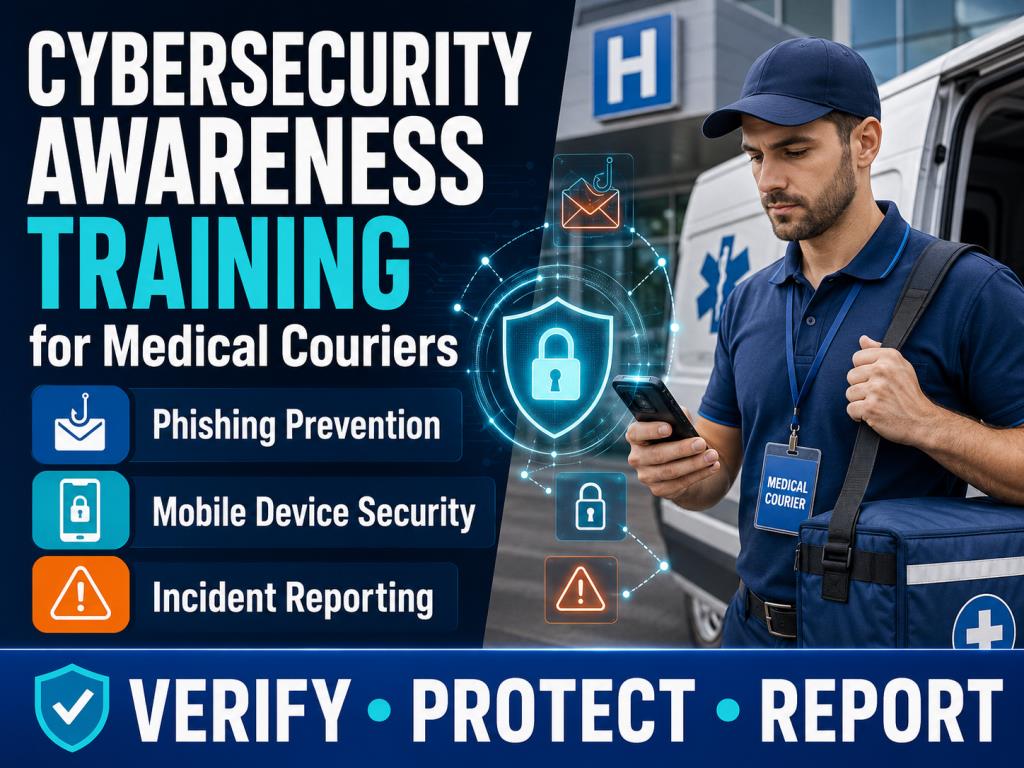
Medical couriers regularly use smartphones, email, Internet-connected devices, dispatch systems, GPS services, mobile applications, and electronic delivery tools.
These technologies support efficient healthcare deliveries, but they can also expose employees and organizations to phishing, spoofing, malware, ransomware, account theft, social engineering, and other cyber threats.
A single unsafe action can compromise confidential information, interrupt business operations, expose client data, or provide an attacker with access to company systems.
Cybersecurity Awareness Training for Employees provides foundational education about common cyber threats and safer technology practices. The course is relevant to medical couriers because they frequently use mobile devices, Internet services, email, cloud systems, and business applications while working remotely or traveling.
No technical background is required.
What Is Cybersecurity Awareness Training?
Cybersecurity awareness training teaches employees how to recognize common threats, protect sensitive information, and make safer decisions when using computers, smartphones, email, Internet services, cloud platforms, and other technology.
The course explains how criminals take advantage of trust, fear, urgency, curiosity, and human error. Learners examine phishing, spoofing, social engineering, malware, ransomware, password risks, mobile-device security, social media, cloud services, and generative AI.
The course does not train learners to become cybersecurity technicians. It focuses on the knowledge and everyday practices employees need to reduce their exposure to common cyber threats.
Medical couriers can apply these principles when using mobile devices, email, business applications, and online services during their work.
Why Cybersecurity Matters for Medical Couriers
Medical couriers may access sensitive business and healthcare information while working away from a central office. They may use technology from vehicles, client facilities, laboratories, hospitals, pharmacies, clinics, parking areas, and home offices.
Cybersecurity risks can affect:
- Mobile devices
- Employee accounts
- Business applications
- Email communications
- Cloud services
- Client information
- Confidential business information
- Healthcare delivery operations
- Company finances
- Personal information
- Organizational reputation
Cybersecurity awareness helps employees recognize suspicious activity before responding to a message, opening a link, downloading a file, sharing information, or approving an account request.
Who Should Take This Course?
The course is designed for employees and other everyday technology users who access computers, smartphones, email, cloud services, business systems, or the Internet.
For medical courier organizations, appropriate learners may include:
- Medical courier drivers
- Independent medical couriers
- Laboratory couriers
- Pharmacy delivery personnel
- Dispatch employees
- Route coordinators
- Operations managers
- Fleet supervisors
- Courier company owners
- Billing and administrative employees
- Customer service employees
- Contractors with system access
- Temporary and part-time employees
- Other healthcare logistics personnel
The course is suitable for new employees, existing workforce members, contractors, business owners, and employees completing cybersecurity refresher training
Learning Objectives
After completing this course, learners should be able to:
- Explain basic information-security concepts
- Recognize confidential, private, and sensitive information
- Identify common threat actors and their motivations
- Explain the meaning of cybersecurity threats, risks, and attacks
- Recognize common spoofing methods
- Identify phishing and social-engineering attacks
- Recognize vishing and smishing attempts
- Identify common types of malware
- Recognize signs of possible malware infection
- Apply safer password practices
- Understand two-factor authentication
- Apply safer Internet and download practices
- Recognize physical-security concerns
- Understand social media and BYOD risks
- Protect mobile devices and cloud information
- Recognize generative AI cybersecurity risks
- Follow safer generative AI practices
- Report suspicious activity and common attacks
How This Course Differs From HIPAA Training
Cybersecurity Awareness Training and HIPAA training support different parts of workforce protection.
| Cybersecurity Awareness Training | HIPAA Privacy and Security Training |
|---|---|
| Covers threats to accounts, devices, systems, and data | Covers legal and workplace responsibilities for PHI |
| Explains phishing, malware, ransomware, and social engineering | Explains permitted uses, disclosures, safeguards, and incident duties |
| Applies to business and personal cybersecurity behavior | Applies to HIPAA-regulated healthcare relationships |
| Covers passwords, MFA, public Wi-Fi, cloud services, and AI | Covers privacy, minimum necessary access, and protection of PHI |
| Helps employees recognize and report cyber incidents | Helps employees recognize and report privacy and security incidents |
Medical courier personnel may need both courses. HIPAA training explains why protected health information must be safeguarded. Cybersecurity awareness training explains how attackers may try to steal that information or gain access to the systems that contain it.
Frequently Asked Questions
Protect the Digital Side of Medical Courier Work
Medical couriers protect more than physical packages. They may also interact with mobile devices, business systems, client information, online services, and confidential healthcare data.
Cybersecurity Awareness Training helps learners understand:
- Information-security fundamentals
- Threat actors
- Spoofing
- Phishing
- Social engineering
- Physical security
- Social media risks
- Malware
- Ransomware
- Password security
- Two-factor authentication
- Internet security
- Mobile-device security
- Cloud security
- Generative AI risks
- Suspicious-activity reporting
Online and self-paced
Approximately four hours
Professionally narrated training
60 days of online access
English and Spanish options
Course-completion certificate
$45 per learner
Important Training Notice
This course provides general cybersecurity awareness education for employees. It is not a technical cybersecurity certification and does not replace an organization’s security policies, risk assessments, access controls, technical safeguards, incident-response procedures, or job-specific instruction.
The $45 course provides a course-completion certificate. It does not include the Certified CyberSecurity Awareness Professional examination or CCAP credential.
Employers should provide employees with organization-specific requirements for passwords, mobile devices, cloud services, Internet use, social media, generative AI, incident reporting, and the protection of confidential information.