

Build a Practical Path Into the Medical Courier Industry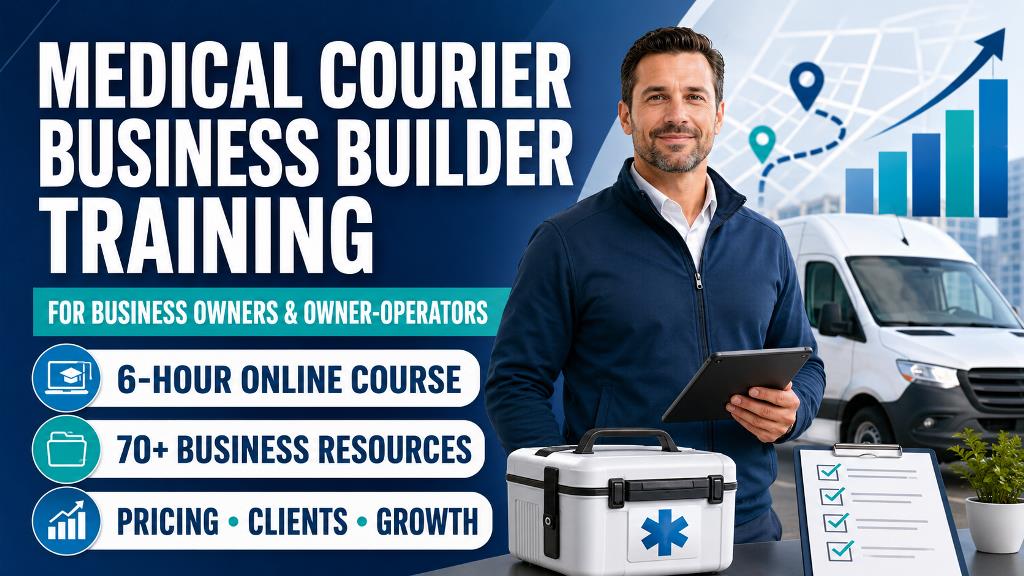
Medical courier work involves more than picking up and delivering packages. Successful couriers must understand client expectations, route costs, documentation, professional communication, pricing, invoicing, compliance readiness, and service quality.
Medical Courier Business Builder Training provides a structured system for entering and growing within the medical courier industry.
The course is designed for beginners, independent contractors, owner-operators, and growing courier businesses. It explains how to find W-2 employment, evaluate 1099 opportunities, approach direct clients, price work for profit, create professional operating systems, and expand responsibly.
Enrollment also includes access to more than 70 downloadable templates, calculators, scripts, trackers, checklists, and business documents.
Find opportunities. Evaluate the work. Price for profit. Operate professionally.
What Is Medical Courier Business Builder Training?
Medical Courier Business Builder Training is a practical course for people who want to find medical courier work, become independent contractors, start a courier company, or improve an existing operation.
Course Outline for Medical Courier Business Builder Training
Explore how to find medical courier opportunities, prepare for hiring and onboarding, market your services, and manage a courier business. These 20 practical modules cover three paths: working as an employee, becoming an independent contractor, and building your own company.
Part 1: Choose Your Path and Get Ready
Module 0: Orientation, Expectations, and Success Plan
Set your goals, create a learning schedule, and define how you will measure progress over the next 30–90 days.
Module 1: The Medical Courier Market: Services, Clients, and Entry Points
Explore opportunities with labs, clinics, hospitals, pharmacies, dental offices, and veterinary practices. Learn how delivery volume, service needs, and time windows affect the work and its earning potential.
Module 2: W-2 Employment, 1099 Contracting, and Business Ownership
Compare employment, independent contracting, business ownership, and hybrid approaches. Understand the practical tradeoffs involving benefits, taxes, flexibility, expenses, risk, and growth.
Module 3: Your Job-Ready and Client-Ready Packet
Build an organized onboarding folder with your compliance documents, training certificates, and other supporting materials so you can respond promptly to employer and client requests.
Module 4: Resume, LinkedIn, and Interviewing
Create a courier-focused resume and LinkedIn profile. Practice interview responses that demonstrate reliability, discretion, professionalism, and readiness for the role.
Part 2: Find Work and Market Your Services
Module 5: Finding W-2 Jobs and Strengthening Your Applications
Use relevant search terms, job platforms, and application strategies to find employee positions. Build a follow-up system to track applications and stay organized throughout the hiring process.
Module 6: Finding and Evaluating 1099 Contractor Opportunities
Learn where to look for contractor work and how to evaluate an offer. Review delivery requirements, time windows, waiting policies, return mileage, expenses, and payment terms before committing.
Module 7: Finding, Pitching, and Pursuing Direct Clients
Identify potential local clients, write a professional service pitch, and follow a consistent outreach schedule. Learn how to move conversations toward meetings, quotes, and potential contracts.
Module 8: Advertising and Marketing Your Medical Courier Services
Build a credible local presence through website basics, Google Business Profile considerations, and a capability statement that summarizes your services. Explore ethical ways to attract inquiries and promote your business.
Module 9: Using AI for Marketing, Sales, and Operations
Use AI to draft outreach messages, quote communications, marketing content, and standard operating procedures. Learn to review its output and protect sensitive information.
Part 3: Price Your Services and Manage Your Money
Module 10: Pricing and Quoting for Profit
Build quotes for scheduled routes and urgent, time-sensitive deliveries. Account for driving time, stops, waiting, return mileage, after-hours service, and additional service fees when evaluating profitability.
Module 11: Excel Pricing Toolkit and Guided Practice
Follow a step-by-step walkthrough of the Excel pricing toolkit. Work through practice scenarios, test your assumptions, and turn cost estimates into clear, client-ready quotes.
Module 12: Contracts, Documentation, and Getting Paid
Explore contract terms, proof of delivery (POD), invoicing, and payment tracking. Create a clear reminder and escalation process to follow up on overdue invoices and help reduce disputes.
Module 13: Bookkeeping, Cash Flow, and Tax Basics
Set up simple systems to track income, expenses, and cash flow. Understand the difference between money collected and money retained, and prepare questions for a qualified tax professional. Education only.
Part 4: Deliver Reliable Service and Grow
Module 14: Operational Excellence and Client Retention
Build consistent service through communication standards, delivery checklists, and procedures for delays or other problems. Use weekly reviews to identify improvements and strengthen client relationships.
Module 15: Risk Management and Insurance Conversations
Identify business risks, establish incident response procedures, and prepare informed questions for insurance providers. Learn what to confirm about your services, client expectations, and applicable requirements. Education only.
Module 16: Scaling Your Medical Courier Business
Plan how to add drivers, vehicles, and services without losing consistency. Explore driver onboarding, standard operating procedures, quality control, client retention, and responsible expansion.
Part 5: Put Your Plan into Action
Module 17: Your 30-Day and 90-Day Get-Work Plan
Bring the course together in a practical action plan. Set weekly targets for applications, outreach, follow-ups, quotes, and service improvements, then track progress and adjust your approach.
Module 18: Work-Winning Habits and Practical Business Basics
Develop everyday habits that support reliable service, including dispatcher-friendly communication, mileage and expense tracking, same-day proof-of-delivery scanning, and client follow-up. Practice local client mapping, combining compatible routes, and local search visibility basics.
Module 19: Money-Smart Launch Plan
Plan a lean launch using suitable equipment and a vehicle you already have. Budget responsibly for insurance, delay nonessential purchases, evaluate rural route costs, and set limits on acceptable losses. Build a financial cushion before leaving a paying job.
Who Should Take This Course?
This training is designed for:
- New medical couriers
- Drivers moving from general delivery into healthcare logistics
- People seeking W-2 medical courier positions
- Independent delivery contractors
- Medical courier owner-operators
- Entrepreneurs starting courier companies
- Existing courier businesses seeking healthcare clients
- Couriers who want to improve pricing
- Owners preparing to add drivers
- Companies preparing to expand services
- Operations managers
- Dispatch personnel
- People comparing employment and business ownership
No previous business ownership experience is required.
What You Will Learn
After completing the course, learners should be able to:
- Compare W-2, 1099, business-owner, and hybrid paths
- Identify common medical courier services and clients
- Build a job-ready or client-ready document packet
- Improve a courier-focused resume and LinkedIn profile
- Search for medical courier employment
- Evaluate independent-contractor opportunities
- Identify direct healthcare prospects
- Prepare professional outreach messages
- Build a basic local marketing presence
- Use AI tools with privacy and compliance guardrails
- Calculate route expenses
- Price scheduled, STAT, multistop, and after-hours work
- Use a spreadsheet-based pricing toolkit
- Prepare clearer quotes and rate sheets
- Understand basic contract and documentation practices
- Improve proof-of-delivery procedures
- Create an invoicing and payment follow-up process
- Track bookkeeping and cash flow
- Strengthen service quality and client retention
- Discuss insurance needs with qualified professionals
- Add drivers and vehicles more carefully
- Develop 30-day and 90-day action plans
- Start with a money-smart launch strategy
A Practical Medical Courier Business Roadmap
Phase 1: Choose
- Select the employment or ownership path
- Identify target clients
- Select a service niche
- Research local demand
Phase 2: Build
- Establish the business
- Evaluate licenses and registrations
- Obtain appropriate insurance
- Prepare the vehicle and equipment
- Build policies and procedures
Phase 3: Price
- Calculate operating costs
- Model route economics
- Create a rate structure
- Define additional charges
- Establish payment terms
Phase 4: Sell
- Build a prospect list
- Prepare a capability statement
- Conduct outreach
- Hold discovery calls
- Submit accurate proposals
Phase 5: Operate
- Onboard clients
- Train drivers
- Dispatch routes
- Document deliveries
- Manage exceptions
- Invoice accurately
Phase 6: Improve
- Measure performance
- Review route profitability
- Correct problems
- Strengthen backup plans
- Improve client communication
Phase 7: Scale
- Add drivers carefully
- Add vehicles when justified
- Expand service areas
- Add specialized services
- Build management systems
This 6 hour course also comes with over 70 downloadable templates, Excel calculators, contract agreements, client outreach scripts, and invoice trackers
Examples of Downloadable Resources
- Job‑Ready & Client‑Ready Compliance Packet Checklist (folders + required documents)
- Certificate Tracker (training proof + renewal reminders)
- W‑2 Job Search Tracker (applications, follow‑ups, interviews)
- 1099 Opportunity Scorecard (vet offers: time windows, waiting, miles, pay terms)
- Direct Client Target List + Outreach Tracker (lead sources + outcomes)
- Professional Communication Templates (dispatcher‑friendly texts + email scripts)
- 30‑Day Marketing Plan + Content Calendar (simple weekly actions)
- Pricing & Quoting Workbook (routes, STAT, multi‑stop, after‑hours, accessorials)
- Rate Sheet Template (standard, rush, STAT, wait‑time rules)
- Invoice Template + Proof‑of‑Delivery Log + Payment Follow‑Up Templates
- Daily Operations Checklist + Exception/Incident Report Template
- KPI Dashboard (profit per hour, profit per mile, days to get paid, quality metrics)
- 30‑Day and 90‑Day Get‑Work Plan (capstone execution plan)
View the full list of 70 Resources included with the Training
Frequently Asked Questions
Build a Repeatable Medical Courier Business System
Medical courier success requires more than finding a delivery.
Couriers and business owners need a clear plan for finding opportunities, evaluating routes, pricing services, communicating with clients, documenting deliveries, controlling expenses, and maintaining service quality.
Medical Courier Business Builder Training provides a structured path supported by practical tools and more than 70 downloadable business resources.
Online and self-paced
Approximately six hours
Modules 0 through 19
Approximately 300 audio-supported slides
Six months of access or until course completion
More than 70 downloadable resources
English and Spanish options
Certificate of completion
$150 per learner
Important Business and Training Notice
This course provides general educational information about medical courier employment, contracting, business development, pricing, operations, marketing, and growth.
It does not constitute legal, tax, accounting, insurance, investment, employment, or regulatory advice. It does not guarantee employment, interviews, routes, clients, contracts, revenue, profit, or business success.
Requirements vary according to the learner’s location, business structure, vehicle, cargo, clients, routes, employees, and assigned transportation functions.
Learners should verify current federal, state, and local requirements and consult qualified legal, tax, accounting, insurance, and regulatory professionals when necessary.