Complete 12 Required Online Courses and Build a Strong Medical Courier Training Record
The Certified Medical Courier Professional, or CMCP, is a professional training credential created for people who transport medical specimens, healthcare packages, protected information, medications, and other sensitive materials.
CMCP is not earned by completing only one short class. To qualify for the credential, learners must complete a coordinated program of 12 medical courier courses and meet the assessment requirements for each course.
The program brings together training on healthcare privacy, workplace safety, specimen transportation, hazardous materials, cybersecurity, biological substances, dry ice, professional conduct, and emergency reporting.
After you pass all 12 courses, you will get the CMCP certificate and right to use the CMCP logo.
CMCP at a Glance
- Credential: Certified Medical Courier Professional
- Credential abbreviation: CMCP
- Required courses: 12 course from Supremus Group
- Training format: Self-paced Online
- Assessments: Required for each course. Unlimited attempts till you pass. No extra cost
- Current bundle price: $150
- Completion documents: 12 Course certificates, CMCP certificate and CMCP credential
Designed for: Medical courier drivers and healthcare delivery professionals
What Is the CMCP Certification?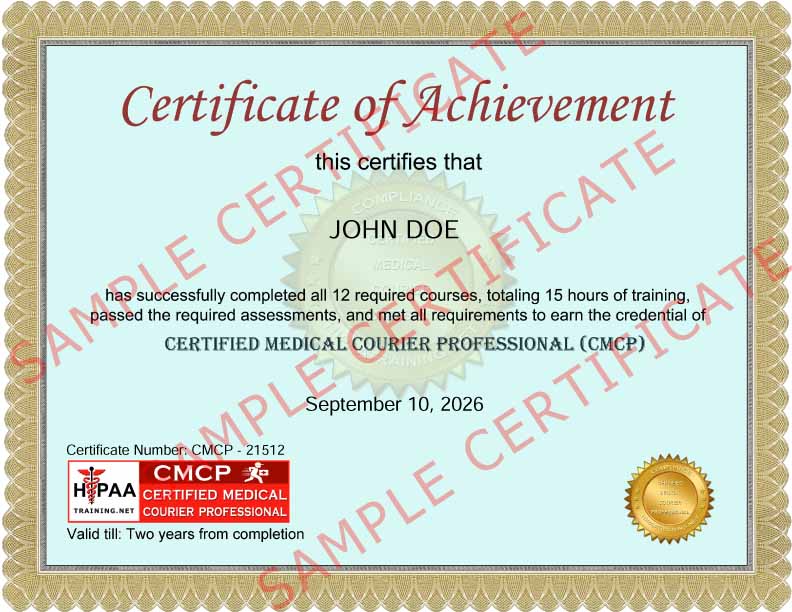
CMCP stands for Certified Medical Courier Professional.
It is a private professional credential that documents the successful completion of a structured medical courier training program. The credential is designed to show that the learner has completed education across several important areas of medical courier work rather than taking only one general delivery course.
A CMCP learner completes training related to:
- Protecting patient and client information
- Inspecting prepared packages before acceptance
- Maintaining package security during transportation
- Protecting specimen integrity
- Following chain-of-custody procedures
- Recognizing common healthcare shipment hazards
- Understanding package markings and labels
- Responding to damaged, leaking, or delayed shipments
- Protecting mobile devices and courier applications
- Following professional workplace conduct expectations
- Knowing when to stop, secure the shipment, and report a problem
The CMCP credential does not state that a person is authorized to perform every possible medical courier task. It shows that the individual completed the required 12-course CMCP training path.
How to Become a Certified Medical Courier Professional
Earning CMCP involves more than purchasing the training bundle. Follow these steps to complete the certification process.
Step 1: Enroll in the Complete CMCP Program
Purchase the complete 12-course CMCP certification bundle. By visiting Supremus Group’s shopping cart website Supremusstore.com make sure you add correct student full name and correct email address as logins will be sent to that email and name will show
The current bundle price is $150. One enrollment gives the learner access to all required CMCP courses included in the program.
Step 2: Access Your Online Learner Account
After you place the order, in 5 minutes, you will get the email from Mike@hipaatraining.net that will provide you the username and password and website URL of Hipaatraining.net
Step 3: Complete All 12 Required Courses
Work through every lesson and required training activity in the CMCP curriculum.
All 12 courses are required. Completing only the HIPAA, OSHA, specimen handling, or DOT portions does not qualify the learner for the full CMCP credential.
Because the program is self-paced, learners can progress according to their schedules. Completion time will vary by learner. You have 2 months to complete all courses. Once you start the test, you will not have access to the course.
Step 4: Complete the Required Assessments
Complete the knowledge assessments associated with each course.
Learners must meet the completion and 80% passing requirements. An assessment helps confirm that the learner reviewed and understood the main subjects presented in the course.
Step 5: Receive Your Individual Course Certificates
After successfully completing a course and its assessment, download or save the applicable course completion PDF certificate.
These certificates create a more detailed training record because they show the individual subjects completed as part of the CMCP program.
Step 6: Earn the CMCP Credential
After all 12 required courses and assessments have been successfully completed, the learner qualifies for the Certified Medical Courier Professional (CMCP) credential. Contact us that you have completed all 12 courses, we will add PDF certificate to the account for CMCP
The CMCP credential can then be added to a professional training packet, resume, LinkedIn profile, contractor application, or employer training record. You will also have the rights to use the CMCP logo.
CMCP Certification Requirements
To earn the Certified Medical Courier Professional credential, the learner must:
- Enroll in the complete CMCP certification program.
- Complete every required lesson in all 12 courses.
- Complete the required course assessments.
- Meet the passing and completion requirements for each course.
- Earn the applicable individual course certificates.
- Satisfy the full CMCP program requirements.
Important Requirement
The CMCP credential cannot be earned by purchasing the bundle without completing it.
It also cannot be earned by completing only selected courses. Every required course must be completed before the CMCP credential is awarded.
The 12 Required CMCP Courses
The CMCP curriculum is organized around the privacy, safety, transportation, security, and professional responsibilities that may apply to medical courier work.
Area 1: Healthcare Privacy and Information Security
Learn how HIPAA responsibilities may apply when a medical courier company creates, receives, maintains, transmits, or has access to protected health information while providing services to healthcare organizations. The course introduces privacy, security, permitted uses, safeguards, incident reporting, and Business Associate Agreement responsibilities.
Apply privacy and security principles directly to medical courier activities.
Training addresses patient information that may appear on:
- Shipping labels
- Courier manifests
- Route instructions
- Mobile applications
- Text messages
- Proof-of-delivery records
- Delivery photographs
- Pickup and delivery documents
Learners review how to prevent unauthorized access, misdelivery, unnecessary disclosure, and loss of protected information.
Learn how to protect the phones, applications, passwords, email accounts, client portals, and electronic records used during medical courier work. optics include phishing, suspicious links, password protection, device security, public Wi-Fi risks, lost devices, and reporting possible security incidents.
Area 2: Workplace Health and Safety
Learn how to recognize chemical hazards by reviewing labels, pictograms, signal words, hazard statements, precautionary statements, and Safety Data Sheets. The course helps medical couriers understand the importance of not opening, touching, or attempting to clean an unknown leaking chemical package.
Learn how to reduce the risk of occupational exposure to blood and other potentially infectious materials. Training covers exposure prevention, personal protective equipment, contaminated packages, sharps awareness, spill precautions, exposure reporting, and post-exposure procedures.
Learn how to recognize fire hazards, follow emergency procedures, respond to alarms, evacuate safely, and understand the limits of employee fire response. The course also addresses fire safety responsibilities when entering hospitals, laboratories, clinics, pharmacies, offices, and other client locations.
Learn how to maintain professional boundaries and respectful conduct while working with clients, patients, dispatchers, coworkers, vendors, and members of the public. The course covers inappropriate conduct, reporting procedures, retaliation, bystander awareness, and professional workplace expectations.
Area 3: Specimen and Healthcare Shipment Handling
Learn the courier’s responsibilities during specimen pickup, package inspection, loading, transportation, temperature control, delivery, documentation, and final handoff. The course addresses package integrity, chain of custody, delivery timing, temperature instructions, specimen rejection risks, and delivery exceptions.
The training does not authorize the courier to draw/collect specimens from patients unless the individual has received separate training and authorization for that function.
Learn how to recognize packages containing prepared hazardous drugs or radiopharmaceutical products. Training addresses warning symbols, package labels, documentation, secondary containment, vehicle loading, temperature requirements, package security, exposure awareness, and damaged package response. The course focuses on the courier’s transportation role. It does not authorize the learner to open radioactive packages, prepare hazardous drugs, or perform cleanup outside assigned procedures.
Area 4: DOT and Specialized Transportation
Learn about the hazards associated with dry ice, including extreme cold, carbon dioxide accumulation, reduced oxygen, ventilation concerns, and pressure buildup. The course covers safe handling, package ventilation, UN1845 markings, dry ice quantity information, vehicle placement, securement, and emergency response.
Learn the core subjects that may apply when a courier handles, loads, transports, or delivers regulated hazardous materials.
Training includes:
- General awareness and familiarization
- Hazard recognition
- Function-specific responsibilities
- Transportation safety
- Security awareness
- Shipping papers
- Package markings and labels
- Emergency information
- Package inspection
- Incident recognition
- Training documentation
An employer must still determine which function-specific, material-specific, and transportation-mode requirements apply to the employee’s actual duties.
Learn how to recognize and transport prepared packages marked Biological Substance, Category B, UN3373. The course covers package acceptance, triple-packaging awareness, required marks, package condition, absorbent material, cushioning, secure loading, protection from damage, leakage response, delivery exceptions, and incident reporting.
What the CMCP Credential Represents
The CMCP credential shows that the learner completed a broad medical courier training curriculum covering several connected responsibilities.
It documents training in:
Privacy: Protecting patient information, delivery records, labels, manifests, mobile devices, and electronic communications.
Safety: Recognizing exposure risks, chemical hazards, fire hazards, damaged packages, leaking containers, and unsafe conditions.
Specimen Protection: Following pickup instructions, checking package condition, maintaining temperature requirements, protecting specimens from damage, and documenting handoff.
Transportation Awareness: Recognizing common markings, labels, shipping documents, dry ice packages, biological substances, and hazardous shipment concerns.
Security: Keeping packages attended and secured, protecting route information, securing devices, and delivering only to authorized recipients.
Incident Response: Knowing when to stop transportation, secure the area, contact dispatch, notify the client, report a privacy concern, or request emergency assistance.
Who Should Earn the CMCP Credential?
CMCP is designed for people who perform or plan to perform medical delivery work, including:
- New medical courier drivers
- Experienced medical couriers
- Independent medical courier contractors
- Laboratory specimen couriers
- Pharmacy delivery drivers
- Healthcare delivery personnel
- Hospital and clinic courier employees
- Diagnostic laboratory couriers
- Courier company employees
- Route and dispatch personnel
- Employees being onboarded for healthcare delivery work
- Employers seeking coordinated driver training
CMCP can also help an ordinary delivery driver understand how medical courier work differs from food delivery, retail delivery, or general package transportation.
How to Use Your CMCP Credential
After completing the full program, present the credential clearly and accurately.
Add CMCP After Your Name
Example: Jordan Lee, CMCP Use the designation only after completing all CMCP requirements and according to the program’s credential-use guidelines.
Add CMCP to Your Resume
Suggested resume entry:
Certified Medical Courier Professional (CMCP)
MedicalCourierCertification.net
Completed: 2026
You may also list selected course subjects under a training or certifications section.
Add CMCP to LinkedIn
Place the credential in the Licenses and Certifications section of your LinkedIn profile.
Suggested credential name: Certified Medical Courier Professional (CMCP)
Suggested issuing organization: HIPAAtraining.net / Supremus Group
Include It in Your Professional Packet
A professional packet may include:
- CMCP credential
- Individual course certificates
- Resume
- Driver’s license
- Motor vehicle record, when requested
- Proof of insurance, when requested
- Background screening records, when requested
- Vehicle information
- References
- Employer or contractor application documents
CMCP can strengthen a training record, but employers and clients make their own hiring, onboarding, and contracting decisions.
What CMCP Does Not Authorize
Completing CMCP does not automatically authorize a learner to:
- Collect clinical specimens
- Classify hazardous materials
- Select or certify hazardous materials packaging
- Prepare shipping papers for every type of shipment
- Repackage damaged materials
- Open specimen containers
- Open radioactive material packages
- Handle Category A infectious substances
- Transport every hazardous material class
- Perform spill cleanup outside assigned procedures
- Ignore shipper, employer, client, or emergency instructions
- Replace required licenses, permits, insurance, or vehicle qualifications
A courier should perform only the functions for which the courier has been trained, assigned, equipped, and authorized.
Important Compliance Information
CMCP is a private professional training credential. It is not a federal or state medical courier license, government certification, government endorsement, accreditation, or guarantee of employment.
The program does not remove an employer’s responsibility to evaluate the worker’s actual duties and provide any additional training that applies to the workplace, route, equipment, material, client, or transportation function.
For example, PHMSA requires hazmat training to address general awareness, function-specific responsibilities, safety, security awareness, and applicable modal requirements. OSHA also places specific responsibilities on employers when workers have occupational exposure to blood or other potentially infectious materials, including initial and annual Bloodborne Pathogens training.
Healthcare organizations and business associates must also determine which HIPAA privacy, security, policy, and workforce training responsibilities apply to their operations.
Frequently Asked Questions About CMCP Certification
Complete the Training and Earn Your CMCP Credential
Medical courier work requires careful judgment, reliable documentation, secure transportation, and a clear understanding of professional responsibilities. The Certified Medical Courier Professional program provides one organized path for completing training across 12 important medical courier subjects.
Your CMCP Enrollment Includes
- 12 required medical courier courses
- Self-paced online training
- Online course assessments
- Individual course completion certificates
- Certified Medical Courier Professional credential
Current bundle price of $150
Certified Medical Courier Professional is rated 4.7 out of 5 by 7698 users.