Prepare the Driver, Protect the Vehicle, Control the Shipment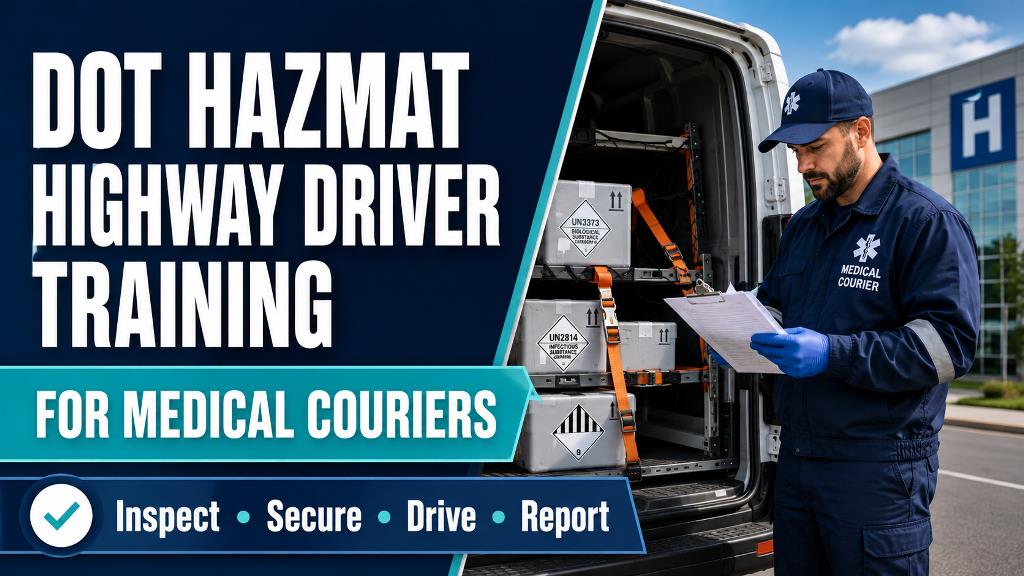
Transporting hazardous materials by highway requires more than recognizing a hazard label.
Medical courier drivers must inspect the vehicle, evaluate the shipment, protect shipping papers, secure packages, operate the vehicle safely, follow approved routes, prevent unauthorized access, and respond correctly to leaks, fires, collisions, breakdowns, or suspicious activity as per department of transportation (DOT) requirements.
This course combines the hazmat employee training framework under 49 CFR 172.704 with highway-driver instruction under 49 CFR 177.816.
It is designed for medical courier personnel who transport primarily non-bulk hazardous-material packages by highway in employer-approved courier vehicles.
Recognize. Inspect. Secure. Deliver. Report.
What Is DOT Hazmat Employee and Highway Driver Training?
This course provides two connected layers of transportation training as per department of transportation (DOT) requirements.
Hazmat Employee Training
The course addresses:
- General awareness and familiarization
- Function-specific medical courier duties
- Safety training
- Security-awareness training
- In-depth security training awareness
- Employee testing
- Employer documentation
- Recurrent training
Highway Driver Training
The course also addresses:
- Vehicle and cargo-area inspection
- Vehicle controls and safety equipment
- Shipping-paper accessibility
- Loading and unloading
- Compatibility and segregation
- Package securement
- Safe driving practices
- Route restrictions
- Railroad crossings
- Parking and attendance
- Security during pickup and delivery
- Breakdowns and towing
- Collision and release response
- DOT incident-reporting awareness
Training must match the materials, vehicles, documents, equipment, routes, and duties assigned by the employer.
Who May Be a Hazmat Employee or Highway Driver?
An employee’s assigned functions determine whether training requirements apply.
Covered functions may include:
- Loading hazardous-material packages
- Unloading hazardous-material packages
- Handling packages during transportation
- Accepting prepared shipments
- Inspecting packages before transport
- Reviewing shipment documents
- Securing packages inside a vehicle
- Operating a vehicle transporting hazardous materials
- Completing delivery
- Directly affecting hazardous-material transportation safety
Job title alone does not determine coverage. Employers must evaluate what the employee actually does.
Medical Courier Highway Scenarios
- A required shipping paper is missing
- The outer package is damp
- A cylinder moves inside the cargo area
- An unknown caller changes the delivery address
- The vehicle is involved in a collision
What You Will Learn
After completing this course, learners should be able to:
- Explain the DOT hazmat employee training framework
- Describe highway-driver responsibilities
- Recognize the nine DOT hazard classes
- Recognize package marks, labels, and placards
- Understand limited exceptions without assuming exemption
- Inspect packages without opening them
- Recognize unacceptable package conditions
- Confirm required shipment documents
- Recognize the basic shipping description
- Keep shipping papers accessible
- Locate emergency-response information
- Inspect the vehicle and cargo area
- Check vehicle controls and emergency equipment
- Confirm temperature and ventilation readiness
- Make a go or no-go decision
- Load and secure packages correctly
- Separate incompatible materials
- Follow package orientation markings
- Recheck securement during the route
- Drive smoothly and defensively
- Follow tunnel, bridge, railroad, and route restrictions
- Apply parking and attendance controls
- Protect the vehicle, keys, documents, and route information
- Recognize suspicious activity
- Respond to leaks, fires, collisions, and breakdowns
- Follow DOT incident-reporting procedures
- Understand recurrent training and employer recordkeeping
- Recognize when specialty training is required
Who Should Take This Course?
This course is designed for:
- Employee medical courier drivers
- Contracted medical courier drivers
- Independent medical couriers
- Owner-operators transporting hazardous materials
- Route supervisors who transport packages
- Employees who load medical courier vehicles
- Drivers transporting regulated healthcare materials
- Drivers assigned new hazardous-material functions
The employer must determine whether the employee performs functions subject to the Hazardous Materials Regulations.
What This Course Does Not Replace
This course provides a general and function-specific foundation for medical courier hazmat employees and highway drivers. It does not replace specialty training for:
- Biological Substance, Category B, UN3373
- Regulated medical waste and sharps
- Medical oxygen and compressed-gas cylinders
- Dry ice, UN1845
- Radiopharmaceuticals and Class 7 materials
- Lithium battery devices
- Other material-specific hazardous shipments
- Air transportation
- Cargo tanks
- Employer-specific package acceptance procedures
- Employer-specific securement systems
- In-depth security-plan responsibilities
- Material-specific emergency response
Required training depends on the materials, vehicle, route, documents, equipment, assigned functions, security responsibilities, and applicable exceptions.
Frequently Asked Questions
Prepare Medical Couriers for the Entire Highway Journey
This course helps medical courier drivers:
- Recognize hazardous materials
- Inspect packages before acceptance
- Protect shipping papers
- Prepare the vehicle
- Load and secure shipments
- Follow approved routes
- Protect the vehicle and cargo
- Respond to leaks, fires, crashes, and breakdowns
- Complete authorized delivery
- Report irregularities promptly
Safe transportation begins before the vehicle moves.
Important Training Notice
This course provides general-awareness, function-specific, safety, security-awareness, and highway-driver training for medical courier personnel transporting primarily non-bulk hazardous materials by highway.
The course does not provide air-mode or cargo-tank qualification. It also does not replace material-specific training required for infectious substances, regulated medical waste, compressed gases, dry ice, radiopharmaceuticals, lithium batteries, or other specialized hazardous materials.
Employers must identify each employee’s assigned functions and add company-specific information about approved materials, prohibited materials, vehicles, package acceptance, securement equipment, shipping papers, routes, parking, security procedures, and incident reporting.
Employees must complete applicable testing, practical verification, employer-procedure review, acknowledgment, and required specialty courses. Employers are responsible for maintaining the documented training record.
DOT Hazmat Employee and Highway Driver Training is rated 4.7 out of 5 by 5685 users.