
Transport Frozen Medical Shipments Safely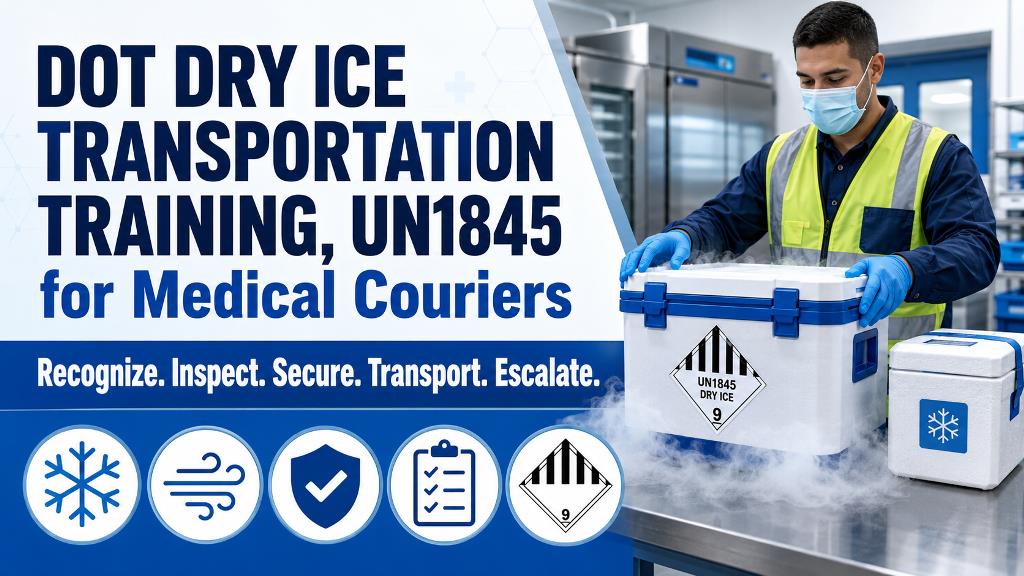
Medical couriers may transport diagnostic specimens, biological materials, clinical trial products, specialty medications, and other frozen medical shipments cooled with dry ice.
Dry ice is solid carbon dioxide. As it warms, it changes directly from a solid into carbon dioxide gas through a process called sublimation.
The released gas can accumulate inside vehicles and enclosed areas. It can also create dangerous pressure when a package does not allow gas to escape. Direct contact with dry ice can cause cold burns and frostbite.
This course teaches medical courier drivers how to recognize dry ice shipments, inspect prepared packages, protect package venting, maintain vehicle airflow, secure cargo, verify airport-bound shipments, and respond to damaged packages or suspected carbon dioxide exposure.
The course is designed for drivers transporting prepared dry ice shipments. It does not authorize dangerous-goods classification, package preparation, relabeling, or opening medical shipments.
What Is Dry Ice Transportation Training?
Dry ice transportation training teaches employees how to work safely with shipments cooled by solid carbon dioxide.
For medical courier personnel, the training focuses on practical responsibilities such as:
- Dry ice recognition
- Carbon dioxide hazards
- External package inspection
- Package venting
- Vehicle ventilation
- Package securement
- Marks and labels
- Documentation
- Exposure response
- Airport-bound shipments
- Function-specific training requirements
This course focuses on medical courier driver responsibilities. It does not authorize the learner to classify dangerous goods, select packaging, add dry ice, create overpacks, apply or replace labels, prepare dangerous-goods documentation, or perform shipper functions. Those duties require separate training and authorization.
Is Dry Ice a DOT Hazardous Material?
Dry ice is identified for transportation as Carbon dioxide, solid or Dry ice, UN1845, Class 9. The requirements that apply depend on the transportation mode, package contents, employee functions, and complete transportation route.
Dry ice by itself is generally not subject to the UN1845 Hazardous Materials Regulations when transported only by domestic highway. However, this does not make dry ice harmless.
Medical couriers must still address:
- Extreme cold and contact injuries
- Carbon dioxide accumulation
- Oxygen displacement
- Pressure inside unvented packages
- Vehicle ventilation
- Package securement
- Employer and client procedures
- Hazards from the material being cooled
A highway delivery to an airport, airline, freight forwarder, or air-cargo facility may be part of an air shipment. Employees must understand the complete transportation route and perform only the functions for which they are trained and authorized.
Why Medical Couriers Need Dry Ice Training
Medical couriers may encounter dry ice while transporting:
- Frozen diagnostic specimens
- Biological substances
- Biological Substance, Category B, UN3373 shipments
- Clinical trial products
- Specialty medications
- Urgent laboratory specimens
- Prepared airline cargo packages
- Other temperature-controlled medical shipments
Couriers often transport these packages inside small vehicles. Multiple packages, long routes, traffic delays, enclosed parking areas, poor airflow, and waiting inside the vehicle can increase the risk of carbon dioxide exposure.
A routine-looking package can still present cold-contact, gas, pressure, and ventilation hazards.
Primary Hazards of Dry Ice
Extreme Cold
Dry ice has a surface temperature near minus 78.5°C, or minus 109.3°F.
Direct contact may cause:
- Frostbite
- Cold burns
- Tissue damage
- Eye injury
- Damage to unprotected skin
Dry ice should not be handled with bare hands.
Carbon Dioxide Accumulation
Dry ice releases carbon dioxide gas as it sublimates.
Carbon dioxide can collect inside:
- Passenger compartments
- Cargo vans
- Vehicle trunks
- Small storage rooms
- Walk-in coolers
- Elevators
- Unventilated containers
- Enclosed loading areas
Carbon dioxide is colorless and may not provide an obvious warning before conditions become dangerous.
Oxygen Displacement
As carbon dioxide concentration increases, available oxygen may decrease.
Possible symptoms can include:
- Headache
- Dizziness
- Rapid breathing
- Shortness of breath
- Confusion
- Drowsiness
- Loss of coordination
- Unconsciousness
Employees should move to fresh air and call for emergency assistance when exposure is suspected.
Pressure Buildup
Dry ice must never be placed in a completely airtight package. Sublimation can create pressure that ruptures or violently opens the container.
Packaging must allow carbon dioxide gas to escape without losing its ability to protect the contents.
Fogging and Visibility
Dry ice fog can hide package damage, distract employees during loading, or reduce visibility inside a vehicle.
Heavy fog may indicate active sublimation or inadequate ventilation.
The courier should pause the task, step away, increase ventilation when it is safe to do so, and report unusual fogging. The package should not be opened.
The Medical Courier Dry Ice Safety Process
Recognize. Inspect. Secure. Transport. Escalate. Document.
- Recognize UN1845 marks, dry ice warnings, and possible hazards.
- Inspect the outside of the package before accepting custody.
- Secure the package in a separated and ventilated cargo area.
- Transport it by a direct route without opening or altering it.
- Escalate damage, missing marks, mismatched documents, exposure symptoms, or delivery problems.
Who Should Take This Course?
This course is designed for medical courier drivers who transport prepared dry ice shipments, including:
- Medical courier drivers
- Laboratory specimen couriers
- Biological specimen couriers
- Clinical trial couriers
- Specialty-medication couriers
- Airport delivery couriers
- Drivers collecting prepared packages from air-cargo facilities
- Healthcare delivery contractors transporting prepared UN1845 packages
The employer must determine whether a driver is a hazmat employee and which general-awareness, function-specific, safety, security-awareness, testing, and recordkeeping requirements apply.
Learning Objectives
After completing the course, learners should be able to:
- Explain dry ice and sublimation
- Identify the main dry ice hazards
- Recognize Carbon dioxide, solid or Dry ice, UN1845
- Recognize Class 9 labels and air-shipment marks
- Understand courier duties and shipper duties
- Distinguish ground, air, vessel, and multimodal transportation
- Recognize when UN3373 and UN1845 appear together
- Inspect prepared packages without opening them
- Recognize venting, marking, label, and documentation problems
- Secure dry ice packages inside a delivery vehicle
- Apply vehicle airflow and route controls
- Use appropriate PPE for assigned dry ice handling
- Refuse or escalate an unsafe pickup
- Respond to carbon dioxide exposure symptoms
- Complete authorized delivery and reporting procedures
- Medical Courier Dry Ice Scenarios
- A package is bulging at pickup
- A driver becomes dizzy inside the vehicle
- A shipment is going to an airport
- The dry ice marking is missing
- A UN3373 package contains dry ice
Frequently Asked Questions
Prepare Medical Couriers for Dry Ice Shipments
Dry ice supports the cold chain, but it must be handled with a clear understanding of its hazards and transportation conditions.
This course gives medical couriers practical knowledge about:
- Dry ice and sublimation
- Cold-contact and carbon dioxide hazards
- Vented package requirements
- UN1845 marks and Class 9 labels
- Vehicle airflow and securement
- Ground and air-shipment differences
- Pickup and delivery checks
- Emergency and exposure response
Important Safety and Compliance Notice
This course provides role-focused dry ice safety and transportation training for medical courier drivers handling prepared shipments.
It does not authorize dangerous-goods classification, package preparation, overpack creation, dry ice replenishment, marking, relabeling, documentation preparation, or other shipper functions.
Requirements depend on the employee’s assigned duties, shipment contents, transportation mode, package quantity, complete route, carrier requirements, and employer procedures.
Employers are responsible for determining whether a driver is a hazmat employee and for providing applicable general-awareness, function-specific, safety, security-awareness, testing, certification, recordkeeping, and workplace-specific instruction.
This course does not replace UN3373 training, OSHA Hazard Communication training, complete shipper training, or employer-specific vehicle, ventilation, emergency, and incident-reporting procedures.
Medical couriers should keep packages closed, protect required marks and documents, follow company procedures, and report unsafe or noncompliant shipments immediately.
DOT Dry Ice UN1845 Training for Medical Couriers is rated 4.4 out of 5 by 4565 users.