
Learn How to Prevent Occupational Exposure to Blood and Other Potentially Infectious Materials
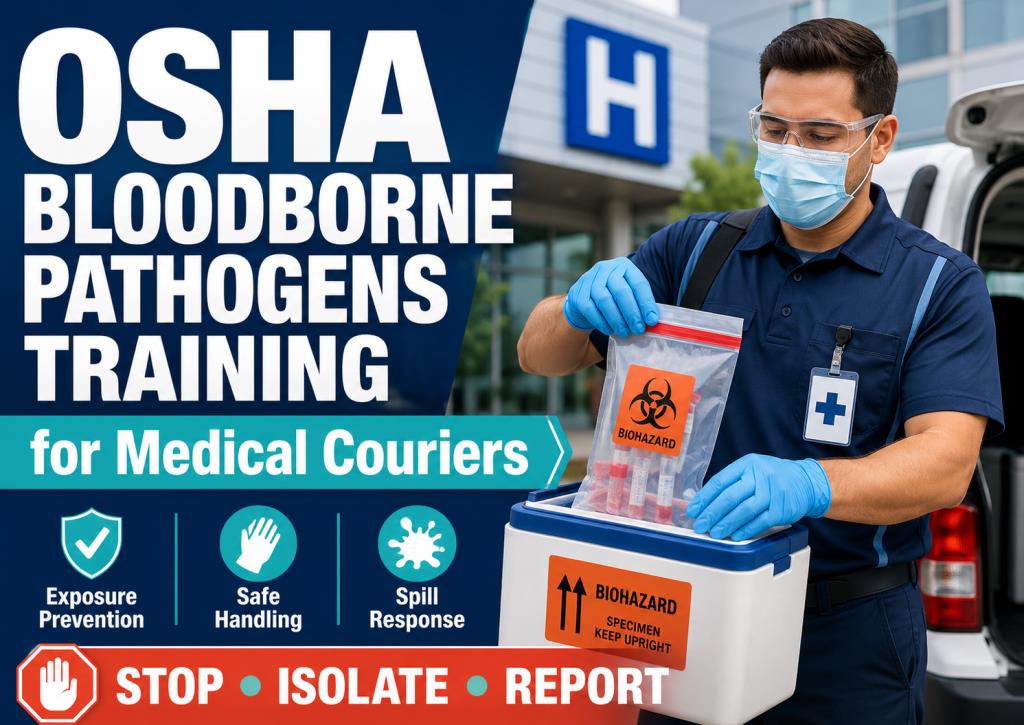
Medical couriers may transport blood specimens, diagnostic samples, contaminated medical equipment, closed sharps containers, regulated medical waste, and other healthcare materials that can present an exposure risk if their packaging fails.
Unlike clinical employees, couriers often work alone and away from sinks, supply rooms, supervisors, and facility spill-response teams. A leaking specimen, damaged sharps container, contaminated cooler, or vehicle collision may require the driver to make an immediate safety decision.
This online Bloodborne Pathogens Training connects OSHA exposure-prevention principles to medical courier activities. Learners examine package acceptance, specimen pickup, vehicle loading, route security, delivery, leak recognition, spill isolation, exposure reporting, and post-exposure procedures.
The course helps couriers understand when to continue a delivery and when to stop, isolate the package, protect others, and contact dispatch or a supervisor.
Course at a Glance
| Course Features | Details |
|---|---|
| Intended audience | Medical couriers and healthcare logistics personnel |
| Training focus | Courier package handling and occupational exposure prevention |
What Is Bloodborne Pathogens Training?
Bloodborne Pathogens training teaches employees how to prevent or reduce occupational exposure to blood and other potentially infectious materials, also known as OPIM.
For a medical courier, the concern is not routine patient care. The concern is unexpected contact caused by leaking specimens, contaminated exterior packaging, unsecured sharps, damaged waste containers, broken glass, or contaminated vehicle and cooler surfaces.
Bloodborne pathogens are disease-causing microorganisms that can be present in human blood. Three significant examples are:
- Hepatitis B virus, or HBV
- Hepatitis C virus, or HCV
- Human immunodeficiency virus, or HIV
The course explains how exposure can happen through a needlestick, a puncture wound, broken skin, or contact with the eyes, nose, mouth, or another mucous membrane.
It also introduces the safeguards addressed by OSHA’s Bloodborne Pathogens Standard, 29 CFR 1910.1030. These include Universal Precautions, engineering controls, safe work practices, personal protective equipment, housekeeping, vaccination, and post-exposure procedures.
Why Medical Couriers Need Bloodborne Pathogens Training
Medical couriers do not normally provide direct patient care. However, their duties may place them near materials containing blood, human specimens, contaminated sharps, or other infectious materials.
Possible medical courier exposure situations include:
- A specimen container leaks inside a transport bag
- A specimen bag is placed inside the wrong route tote
- A courier discovers contamination after leaving the pickup facility
- A leaking package contaminates a scanner, phone, cart, or vehicle handle
- A package has visible blood on its outer surface
- Broken glass punctures a specimen container
- A sharps container is open, damaged, or overfilled
- A transport cooler becomes contaminated
- A courier touches contamination with damaged skin
- Blood or body fluid splashes into the eyes
- A vehicle collision damages specimen packages
- A medical waste container releases its contents
- An employee attempts spill cleanup without proper PPE
This training helps couriers recognize that stopping and reporting a problem is often safer than trying to fix it themselves.
STOP. ISOLATE. DO NOT TOUCH. REPORT.
Who Should Take This Course?
This course is designed for medical couriers whose assigned duties may involve reasonably anticipated skin, eye, mucous membrane, or parenteral contact with blood or other potentially infectious materials. Employers must evaluate the courier’s actual job tasks to determine whether occupational exposure exists under OSHA’s Bloodborne Pathogens Standard.
Potential learners include:
- Medical courier drivers
- Laboratory specimen couriers
- Hospital and clinic couriers
- Blood bank couriers
- Pharmacy delivery personnel who also handle specimens, contaminated returns, or other materials presenting occupational exposure
- Diagnostic specimen drivers
- Specialized couriers transporting human tissue when their assigned duties present occupational exposure
- Regulated medical waste drivers
- Sharps collection personnel
- Route supervisors
- Dispatch or operations personnel who supervise leak, spill, or exposure response
- Employees who clean transport equipment
- Employees assigned to spill-response duties
- Independent contractors with relevant exposure risks
Not every medical courier has the same risk. Employers should evaluate actual job classifications, tasks, and procedures to determine which employees have occupational exposure.
What You Will Learn
After completing this course, learners should be able to:
- Explain what bloodborne pathogens are
- Identify shipments and courier tasks involving blood or OPIM
- Recognize courier tasks that may create exposure
- Describe how a courier may be exposed during pickup, transport, delivery, or incident response
- Explain the purpose of Universal Precautions
- Understand the role of an Exposure Control Plan
- Identify engineering and work practice controls
- Select employer-approved PPE for assigned package-handling and incident-response tasks
- Follow safe specimen transportation practices
- Recognize unsafe sharps containers
- Understand biohazard labels and color coding
- Apply the STOP, ISOLATE, REPORT process to a leaking or contaminated shipment
- Follow immediate steps after an exposure
- Report incidents through the approved process
- Explain the purpose of post-exposure evaluation
- Understand the importance of hepatitis B vaccination
- Identify vehicle surfaces that may become contaminated
- Protect phones, scanners, manifests, and delivery equipment from cross-contamination
- Follow dispatch and client escalation procedures
- Recognize when a package should not be accepted
- Describe immediate actions after an exposure on the road
Bloodborne Pathogens Training Course Outline
1. Introduction to Bloodborne Pathogens
This section introduces bloodborne pathogens and explains why occupational exposure is a workplace safety concern.
Learners examine:
- The meaning of bloodborne pathogen
- Common workplace exposure risks
- Why medical couriers may be at risk
- The role of OSHA
- Why route drivers require task-specific exposure training
- Differences between clinical exposure and courier exposure
- Risks created by package failure
- Risks associated with working alone or away from a facility
2. Understanding OSHA 29 CFR 1910.1030
Learners receive an introduction to OSHA’s Bloodborne Pathogens Standard and its application to employees with occupational exposure.
The section explains important employer responsibilities, including:
- Completing an exposure determination
- Maintaining a written Exposure Control Plan
- Providing employee training
- Supplying appropriate PPE
- Offering hepatitis B vaccination when applicable
- Establishing post-exposure procedures
- Maintaining required records
3. Blood and Other Potentially Infectious Materials
Blood is not the only material that may create an occupational exposure risk.Couriers should not attempt to identify the contents of a leaking package by sight, smell, label interpretation, or information from the patient. Treat the situation according to the package type, employer procedures, and available hazard information.
4. How Occupational Exposure Happens
This section explains how bloodborne pathogens may enter the body.
Potential routes include:
- A damaged specimen tube punctures its transport bag
- A loose sharp penetrates a package or glove
- Broken contaminated glass cuts the courier
- Fluid from a leaking package contacts damaged skin
- A splash reaches the courier’s eyes, nose, or mouth
- A courier touches a contaminated cooler handle
- Contaminated gloves touch a phone, scanner, or steering wheel
- A vehicle collision damages several specimen containers
- Gloves are removed incorrectly after incident response
5. Important Bloodborne Diseases
Learners receive a general awareness-level introduction to:
- What HBV, HCV, and HIV are
- How occupational transmission may occur
- Why appearance cannot identify infectious material
- Availability of HBV vaccination
- Importance of immediate exposure reporting
- Need for confidential medical evaluation
The course discusses basic transmission information, health effects, prevention, vaccination, and the importance of prompt medical evaluation after an exposure.
Medical couriers are not expected to determine whether a patient or specimen is infectious. Required precautions should be followed for all relevant shipments.
6. Universal Precautions
Universal Precautions means treating human blood and certain body fluids as if they are known to be infectious.Universal Precautions do not mean that every sealed package requires gloves. PPE use should be based on the assigned task, anticipated exposure, the employer’s Exposure Control Plan, and package condition.
For medical couriers, this means following established safety procedures even when:
- A package appears clean
- No infection warning is provided
- The shipment comes from a familiar client
- The courier has handled similar packages before
- No visible blood is present
A clean-looking package may still contain infectious material.
7. The Exposure Control Plan
An Exposure Control Plan explains how an employer will eliminate or minimize employee exposure.
The plan may address:
- Who the driver contacts after normal business hours
- Where spill-response supplies are stored
- Whether the driver is authorized to perform cleanup
- How a contaminated vehicle is removed from service
- Where an exposed driver should obtain immediate medical evaluation
- How to handle packages remaining in the vehicle
- How dispatch protects other drivers from entering the area
- How incidents are documented from the road
Employees should know where the plan is located and whom to contact following a spill, leak, needlestick, or possible exposure.
8. Engineering and Work Practice Controls
Engineering controls isolate or remove hazards. Work practice controls change how employees perform their duties.
Medical courier examples include:
- Leak-resistant specimen containers
- Puncture-resistant sharps containers
- Secondary containment
- Secure vehicle storage systems
- Spill-control supplies
- Approved package inspection procedures
- Safe vehicle loading practices
- Hand hygiene procedures
- Rules against opening specimen packages
- Rigid, washable transport totes
- Segregated cargo zones
- Vehicle tie-downs and package restraints
- Hands-free communication with dispatch
- Clearly marked spill kits
- Tools for isolating damaged packages
- Procedures prohibiting packages in passenger seating areas
Medical couriers should never reach into a damaged package or sharps container.
9. Personal Protective Equipment
Personal protective equipment is selected according to the task and anticipated exposure.
Depending on the assigned duties, PPE may include:
- Disposable gloves
- Protective gowns
- Aprons
- Eye protection
- Face shields
- Masks
- Shoe covers
- Other protective clothing
The course explains the purpose and limitations of PPE. Learners also review appropriate removal and disposal practices.
Medical couriers should use only the PPE selected by their employer. They should not perform spill cleanup unless they are trained, equipped, and authorized.
10. Hand Hygiene
Gloves do not replace proper hand hygiene.
Learners review:
- When hands should be washed
- Proper handwashing practices
- Hand hygiene after removing gloves
- What to do following skin contact
- Temporary use of antiseptic hand cleaner
- Washing with soap and water as soon as feasible
- Keep employer-approved hand-cleaning supplies in the vehicle
- Remove gloves before touching the steering wheel or phone
- Clean hands after removing PPE
- Do not use a contaminated sink or shared supply container
- Wash with soap and running water as soon as feasible
- Never eat or drink in a contaminated cargo area
11. Inspecting Packages Before Pickup
Medical couriers should visually inspect packages without opening them.
Before accepting a shipment, the courier should look for:
- Leaks
- Wet or stained packaging
- Broken seals
- Cracked containers
- Exposed sharps
- Missing closures
- Damaged secondary containment
- Required labels or markings that appear missing, damaged, or inconsistent with the shipment documentation
- Other visible signs of unsafe packaging
- Inspect without squeezing or manipulating the package
- Confirm closures without opening secondary packaging
- Keep the package at the pickup location if it fails acceptance checks
- Contact dispatch before placing a questionable package in the vehicle
- Document rejection without exposing patient information
The courier should follow company procedures when a package does not appear safe for transport.
12. Safe Specimen Transportation
Specimen containers should prevent leakage during handling, storage, transportation, and shipping.
The course explains why couriers should:
- Keep packages closed
- Use approved secondary containment
- Maintain required package orientation
- Secure shipments inside the vehicle
- Protect containers from damage
- Separate specimens from food and personal belongings
- Follow temperature-control instructions
- Avoid opening or repackaging shipments
- Report packaging defects immediately
- Place packages in the designated cargo compartment
- Prevent packages from shifting or falling
- Keep specimens separate from the driver’s personal property
- Avoid placing specimens on vehicle seats
- Maintain the required route and delivery schedule
- Do not leave specimens unattended
- Record temperature or custody information when assigned
- Report delays, collisions, or temperature excursions
If the outside of a primary container becomes contaminated, proper secondary containment may be required.
13. Sharps Safety for Medical Couriers
Sharps include needles, lancets, scalpels, broken glass, and other objects capable of puncturing the skin.Couriers should not decide whether a damaged sharps container is acceptable based only on appearance. Follow the employer’s acceptance criteria, waste transporter procedures, and client instructions.
Medical couriers should never:
- Reach inside a sharps container
- Push contents down
- Accept an open sharps container
- Carry a severely damaged container
- Handle a loose needle
- Pick up contaminated glass by hand
- Bend or recap a needle
- Transfer sharps between containers
- Transport an overfilled container against policy
- Keep sharps containers upright
- Secure them against tipping
- Do not place heavy packages on top of them
- Do not transport a container with protruding contents
- Do not attempt to close a lid that requires contact with the contents
Appropriate sharps containers are closable, puncture-resistant, leak-resistant on the sides and bottom, and properly labeled or color-coded.
14. Biohazard Labels and Color Coding
Learners are introduced to the biohazard symbol and the use of labels or red containers for certain regulated materials.A biohazard label does not provide complete DOT classification or transportation instructions. Couriers must also follow applicable package markings, shipping documents, employer procedures, and material-specific training.
Employees learn to:
- Read package markings
- Recognize biohazard warnings
- Keep labeled containers closed
- Avoid covering or removing required labels
- Report missing or damaged labels
- Follow employer and facility procedures
15. Responding to a Leak or Spill
A leaking package should be treated as a potential exposure hazard.
A general response may include:
- Stop handling the package.
- Keep people away from the affected area.
- Avoid touching fluid, broken glass, or exposed sharps.
- If driving, pull over safely before contacting dispatch.
- Do not open or repackage the shipment.
- Notify dispatch or the designated supervisor.
- Follow instructions for isolating the package or vehicle.
- Use a spill kit only if trained, equipped, and authorized.
- Report any contact with blood or OPIM immediately.
- Follow the employer’s exposure and incident-reporting procedures.
Employees should not use personal cleaning supplies or create an improvised cleanup procedure.
16. Exposure Incident Response
An exposure incident may involve contact with blood or OPIM through:
- A needlestick
- A puncture wound
- The eyes
- The nose
- The mouth
- Another mucous membrane
- Cut, damaged, or non-intact skin
Following a possible exposure, the employee should:
- Wash needlesticks, cuts, and exposed skin with soap and water
- Flush the eyes or other mucous membranes with water
- Report the incident immediately
- Follow the employer’s post-exposure instructions
- Obtain prompt medical evaluation
- Explain accurately how the incident occurred
Employees should not delay reporting while waiting for symptoms.
17. Hepatitis B Vaccination
The hepatitis B vaccine is an important protection for workers with occupational exposure.
OSHA requires covered employers to make hepatitis B vaccination available at no cost to eligible employees with occupational exposure, subject to the conditions and exceptions in the standard.
Employees should speak with their employer or the designated healthcare professional about eligibility, vaccination status, and medical questions.
18. Housekeeping and Decontamination
The employer determines the appropriate cleaning schedule and decontamination procedure for affected work areas, vehicles, and transport equipment.
The course introduces practices such as:
- Following an approved cleaning schedule
- Using an appropriate disinfectant
- Cleaning contaminated surfaces promptly
- Inspecting reusable transport containers
- Disposing of contaminated materials properly
- Keeping food and drinks away from exposure areas
- Reporting contaminated vehicles or equipment
- Placing used PPE in designated containers
- Never taking contaminated PPE home for cleaning
Only trained and authorized personnel should clean a blood or OPIM spill.
19. Medical Courier Emergency Response
Medical courier operations can create unique response challenges because incidents may happen inside a vehicle, at a customer facility, or during a route.
Learners review how to respond when:
- A specimen leaks in the vehicle
- A cooler is dropped
- A package breaks during loading
- A sharps container becomes damaged
- A vehicle collision affects medical shipments
- Contamination is discovered at delivery
- A package is refused because it is unsafe
Employees should follow the company’s emergency contact and reporting procedures.
20. Training and Recordkeeping
Employees with occupational exposure must receive appropriate training when first assigned to tasks involving exposure and at least annually thereafter.
Additional instruction may be necessary when:
- Job responsibilities change
- New procedures are introduced
- New equipment is used
- An employee receives new exposure-related duties
- Workplace incidents reveal a training need
Employers should maintain applicable training records and document workplace-specific instruction.
Medical Courier Safety Scenarios
A specimen leaks inside a transport cooler
The courier notices liquid at the bottom of a cooler. The courier should not open or handle the leaking container without authorization. The correct response is to stop, isolate the area, and contact the designated supervisor.
A sharps container is cracked
A courier notices a crack in a sharps container and can see needles near the damaged area. The courier should not touch, tape, repair, or transfer the contents. The shipment should be managed according to the employer’s rejection or emergency procedure.
A splash reaches the courier’s eye
Liquid from a damaged specimen package splashes into the courier’s eye. The courier should flush the eye with water and report the exposure immediately.
A package has visible blood on its surface
The courier should avoid direct contact and contact the appropriate facility representative or supervisor before accepting the package.
Specimens are damaged in a vehicle accident
The courier should first address immediate personal safety. The courier should keep others away from the affected materials and contact emergency services and the designated employer representative as required.
What Employers Must Provide
Online training can support an employer’s Bloodborne Pathogens safety program, but training alone does not complete every OSHA responsibility.
Depending on the workplace and exposure determination, the employer may also need to provide:
- A written Exposure Control Plan
- A job-specific exposure determination
- Workplace-specific procedures
- Engineering and work practice controls
- Appropriate PPE at no cost
- Hepatitis B vaccination when applicable
- Post-exposure evaluation and follow-up
- An opportunity for interactive questions and answers
- Additional training when duties change
- Required medical and training records
Employees should receive information about their company’s PPE, spill procedure, reporting contacts, Exposure Control Plan, and post-exposure process.
How This Course Relates to Other Medical Courier Training
Bloodborne Pathogens training focuses on employee exposure prevention. It does not replace other training that may apply to medical courier work.
| Course | Primary purpose |
|---|---|
| Bloodborne Pathogens Training | Preventing occupational exposure to blood and OPIM |
| Infection Control Training | Broader infection prevention practices |
| UN3373 Training | Transportation of Biological Substance, Category B |
| Specimen Handling Training | Safe collection, custody, handling, and delivery |
| Regulated Medical Waste and Sharps Training | Transportation of regulated waste, including UN3291 |
| HazCom and GHS Training | Chemical hazard communication and labeling |
| DOT Hazmat Employee Training | General and function-specific hazmat responsibilities |
Benefits of This Course
Relevant to Medical Courier Work
The course connects Bloodborne Pathogens safety principles to specimens, sharps, transport coolers, delivery vehicles, leaks, spills, and emergency situations.
Flexible Online Format
Employees can complete the course online and at their own pace during the 60-day access period.
Audio-Supported Learning
The course includes 116 slides with audio.
English and Spanish Options
Organizations can select the language that best supports individual employees.
Certificate of Completion
Learners receive a certificate after successfully completing the course requirements.
Individual and Group Enrollment
Training is available for individual medical couriers, small businesses, and organizations with multiple employees.
Frequently Asked Questions
Prepare Your Medical Courier Workforce for Exposure Risks
Medical couriers need to know what to do when a specimen leaks, a sharps container is damaged, or potentially infectious material contacts the skin, eyes, nose, or mouth.
This online course provides practical training in:
- Bloodborne pathogen awareness
- Medical courier exposure risks
- Universal Precautions
- PPE and safe work practices
- Specimen transportation
- Sharps safety
- Spill response
- Exposure reporting
- Post-exposure procedures
Online and self-paced
Approximately one hour
116 audio-supported slides
60 days of course access
English and Spanish options
Certificate of completion
$25 per learner
Important Safety and Compliance Notice
This course provides general safety and compliance education. It does not replace an employer’s exposure determination, written Exposure Control Plan, workplace-specific instruction, PPE training, hepatitis B vaccination responsibilities, post-exposure procedures, or other requirements that may apply under OSHA 29 CFR 1910.1030.
Employers should evaluate each employee’s actual duties and provide additional instruction based on the employee’s workplace and occupational exposure risk.
