OSHA Hazard Communication and GHS Training for Healthcare

OSHA Hazard Communication and GHS Training for Healthcare2026-08-13T10:22:06+00:00

Understand Chemical Hazards in Healthcare and Dental Workplaces

Healthcare employees work with more hazardous chemicals than many people realize. Disinfectants, sterilants, laboratory reagents, cleaning agents, dental materials, compressed gases, adhesives, medications, and maintenance chemicals may create health or physical hazards if they are used incorrectly.

OSHA Hazard Communication and GHS Training for Healthcare teaches employees how to recognize chemical hazards, understand container labels, locate and use Safety Data Sheets, select required protective measures, and respond appropriately to spills or exposures.

The course applies OSHA Hazard Communication principles to hospitals, clinics, dental practices, laboratories, pharmacies, surgery centers, long-term care facilities, and other healthcare workplaces.

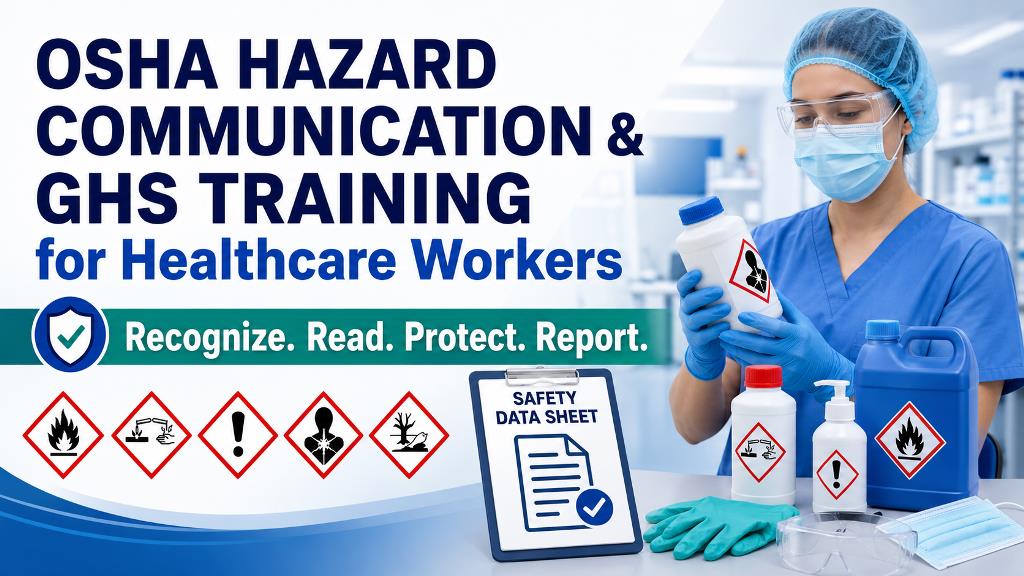
Recognize the hazard. Read the label. Use the SDS. Protect yourself. Report problems.

What Is OSHA HazCom and GHS Training?

OSHA Hazard Communication training teaches employees about hazardous chemicals present in their work areas and the measures they can use to protect themselves.

The Occupational Safety and Health Administration’s Hazard Communication Standard, 29 CFR 1910.1200, requires employers with hazardous chemicals in their workplaces to communicate information through:

  • A written hazard communication program
  • A workplace chemical inventory
  • Chemical labels and other warnings
  • Safety Data Sheets
  • Employee information and training

The Globally Harmonized System of Classification and Labelling of Chemicals, commonly called GHS, provides a consistent approach for communicating chemical hazards through standardized label elements, pictograms, hazard statements, precautionary statements, signal words, and Safety Data Sheets.

This course helps healthcare employees understand and use that information during their daily work.

Learn more from the OSHA Hazard Communication overview.

Why Healthcare Workers Need Hazard Communication Training

Hazardous chemicals are found throughout healthcare facilities, not only in laboratories or maintenance departments.

Employees may encounter chemicals while:

  • Cleaning and disinfecting treatment areas
  • Sterilizing instruments
  • Processing laboratory specimens
  • Preparing dental materials
  • Handling pharmaceutical products
  • Receiving chemical supplies
  • Managing medical waste
  • Maintaining equipment
  • Responding to leaks or spills
  • Transferring chemicals into secondary containers
  • Using compressed gases
  • Performing environmental services
  • Working around chemicals used by other departments

Employees need to know more than a chemical’s product name. They must understand where to find hazard information, what the warnings mean, and which workplace procedures apply.

Healthcare Chemicals Covered by Hazard Communication

Depending on the workplace, employees may encounter:

  • Cleaning products
  • Disinfectants
  • Sterilants
  • High-level disinfectants
  • Laboratory reagents
  • Fixatives and preservatives
  • Dental etchants
  • Dental bonding agents
  • Adhesives
  • Acrylics and monomers
  • X-ray processing chemicals
  • Aerosol products
  • Compressed gases
  • Anesthetic gases
  • Oxygen
  • Nitrous oxide
  • Solvents
  • Formaldehyde-containing products
  • Pharmaceutical compounds
  • Hazardous drugs
  • Maintenance chemicals
  • Fuel and battery-related chemicals

The presence of a chemical does not automatically mean every employee has the same level of risk. Exposure depends on the chemical, concentration, task, route of exposure, controls, and workplace conditions.

Employees should follow the label, Safety Data Sheet, written hazard communication program, and employer-specific procedures for the chemicals used in their work areas.

What You Will Learn

After completing this course, learners should be able to:

  • Explain the purpose of OSHA’s Hazard Communication Standard
  • Describe how GHS supports consistent chemical hazard communication
  • Identify hazardous chemicals in healthcare workplaces
  • Recognize common physical and health hazards
  • Interpret GHS pictograms
  • Understand signal words
  • Locate hazard and precautionary statements
  • Read a shipped-container label
  • Follow workplace and secondary-container labeling procedures
  • Find information in a 16-section Safety Data Sheet
  • Use labels and Safety Data Sheets together
  • Recognize signs of a possible chemical release
  • Follow required exposure-control measures
  • Use assigned personal protective equipment properly
  • Apply safe chemical storage and handling principles
  • Respond appropriately to leaks, spills, and exposures
  • Locate the employer’s written Hazard Communication Program
  • Report missing labels, inaccessible SDSs, and unsafe conditions

Course Topics

Learners receive an understandable introduction to OSHA’s Hazard Communication Standard and its role in workplace chemical safety.

Topics include:

  • Purpose of hazard communication
  • Employer responsibilities
  • Employee responsibilities
  • Written Hazard Communication Program
  • Chemical inventory
  • Labels and warnings
  • Safety Data Sheets
  • Employee information and training
  • Workplace-specific chemical procedures

OSHA requires effective information and training when employees receive their initial assignment and whenever a new chemical hazard is introduced for which they have not already received training. The employer remains responsible for ensuring its training is effective and specific to the workplace. See 29 CFR 1910.1200(h).

GHS creates a structured system for communicating chemical hazards.

Learners examine:

  • Hazard classes
  • Hazard categories
  • Health hazards
  • Physical hazards
  • Environmental information
  • Label elements
  • Pictograms
  • Signal words
  • Hazard statements
  • Precautionary statements
  • Standardized Safety Data Sheets

The course focuses on helping employees understand hazard information. Most healthcare employees are not responsible for classifying chemicals or creating manufacturer labels.

Employees learn how chemicals may affect the body.

Topics include:

  • Acute toxicity
  • Skin irritation
  • Eye irritation
  • Skin sensitization
  • Respiratory sensitization
  • Carcinogenicity
  • Reproductive toxicity
  • Germ-cell mutagenicity
  • Target-organ toxicity
  • Aspiration hazards
  • Corrosive effects

Learners also review common routes of exposure:

  • Inhalation
  • Skin contact
  • Eye contact
  • Ingestion
  • Injection through a puncture or damaged skin

Some chemicals can burn, explode, react, or release pressure.

Topics include:

  • Flammable chemicals
  • Oxidizers
  • Gases under pressure
  • Corrosive chemicals
  • Self-reactive chemicals
  • Organic peroxides
  • Pyrophoric chemicals
  • Chemicals that release flammable gas
  • Explosive hazards
  • Chemical incompatibility
  • Heat and ignition risks

Employees learn why physical hazards must be considered during use, storage, transfer, and emergency response.

Learners review the OSHA pictograms that may appear on hazardous-chemical labels:

  • Health hazard
  • Flame
  • Exclamation mark
  • Gas cylinder
  • Corrosion
  • Exploding bomb
  • Flame over circle
  • Skull and crossbones

The environmental pictogram may appear on some labels, although OSHA does not enforce environmental-hazard labeling under the Hazard Communication Standard.

Each pictogram must be interpreted together with the rest of the label. A symbol alone does not provide all the information needed to use a chemical safely.

See the official OSHA Hazard Communication pictograms.

Employees learn how to locate and interpret:

  • Product identifier
  • Supplier identification
  • Signal word
  • Hazard statements
  • Precautionary statements
  • Pictograms
  • Supplemental information

The course explains the difference between the signal words “Danger” and “Warning” and why employees should read the entire label before using an unfamiliar chemical.

Chemicals are sometimes transferred from their original containers into spray bottles, trays, basins, or smaller working containers.

Learners examine:

  • Employer labeling procedures
  • Secondary-container risks
  • Missing or damaged labels
  • Illegible labels
  • Temporary use considerations
  • Unidentified chemicals
  • Employee reporting responsibilities
  • Prohibition against guessing container contents

Employees should never use an unidentified chemical. A missing label should be reported and corrected according to workplace procedures.

A Safety Data Sheet provides detailed information about a hazardous chemical.

Learners review the standardized 16-section SDS format:

  1. Identification
  2. Hazard identification
  3. Composition and ingredient information
  4. First-aid measures
  5. Firefighting measures
  6. Accidental-release measures
  7. Handling and storage
  8. Exposure controls and personal protection
  9. Physical and chemical properties
  10. Stability and reactivity
  11. Toxicological information
  12. Ecological information
  13. Disposal considerations
  14. Transport information
  15. Regulatory information
  16. Other information

OSHA requires SDS information to be readily accessible to employees during each work shift when they are in their work areas.

A chemical label provides immediate warnings at the point of use. The SDS provides more detailed information.

Employees learn to use both resources when answering questions such as:

  • What are the chemical’s hazards?
  • What PPE is required?
  • What should be done after eye contact?
  • How should the chemical be stored?
  • Which materials are incompatible?
  • What should be done after a spill?
  • Are special ventilation controls required?
  • What symptoms may indicate exposure?

The course introduces the hierarchy of controls used to reduce chemical exposure:

  • Elimination
  • Substitution
  • Engineering controls
  • Administrative controls
  • Work-practice controls
  • Personal protective equipment

PPE is important, but it may not be the only control required. Employees must follow the control measures established by the employer for each task and chemical.

Depending on the chemical and task, protection may include:

  • Chemical-resistant gloves
  • Protective clothing
  • Eye protection
  • Face protection
  • Closed footwear
  • Aprons or gowns
  • Respiratory protection

Employees should not choose gloves or respirators based only on appearance. Chemical compatibility, breakthrough time, task duration, exposure level, and employer procedures must be considered.

This course does not replace required PPE assessments, respirator medical evaluations, fit testing, or respiratory-protection training.

Learners review practical chemical-safety habits:

  • Read the label before use
  • Follow dilution instructions
  • Never mix chemicals unless authorized
  • Use only approved containers
  • Keep containers closed
  • Maintain required ventilation
  • Protect chemicals from heat and ignition
  • Avoid eating or drinking in chemical-use areas
  • Wash hands after handling chemicals
  • Do not smell or taste a chemical to identify it
  • Report unusual odors, vapor, heat, or container damage
  • Follow manufacturer and employer instructions

Chemical-storage decisions should account for:

  • Compatibility
  • Flammability
  • Oxidizing properties
  • Corrosivity
  • Temperature
  • Ventilation
  • Container condition
  • Secondary containment
  • Access restrictions
  • Separation from food and medications
  • Protection from ignition sources
  • Manufacturer instructions

Employees should not organize chemicals only by product name or container size.

Not every employee is trained or authorized to clean every chemical spill.

The course teaches employees to:

  1. Recognize the release.
  2. Stop work when necessary.
  3. Warn people in the immediate area.
  4. Move to a safe location.
  5. Prevent unauthorized entry.
  6. Notify the designated supervisor.
  7. Follow the workplace spill procedure.
  8. Use a spill kit only when trained and authorized.
  9. Seek medical attention when required.
  10. Document and report the event.

Employees should not attempt to manage an unknown, highly hazardous, rapidly spreading, or uncontrolled release without proper training, equipment, and authorization.

Employees learn to act promptly after possible exposure.

The correct response may include:

  • Moving away from the source
  • Using an eyewash station
  • Using an emergency shower
  • Removing contaminated clothing
  • Obtaining the SDS
  • Contacting a supervisor
  • Seeking medical evaluation
  • Following first-aid directions
  • Reporting symptoms
  • Documenting the exposure

The exact response depends on the chemical, route of exposure, severity, SDS instructions, and employer emergency procedures.

The course applies HazCom principles to realistic situations:

  • A disinfectant is transferred into an unlabeled spray bottle
  • A dental employee finds a container with a damaged label
  • A laboratory worker cannot locate an SDS
  • A sterilant causes eye or respiratory irritation
  • Two cleaning chemicals are accidentally combined
  • A compressed-gas cylinder is stored improperly
  • A chemical package arrives damaged
  • A worker notices an unusual odor in a treatment area
  • A spill occurs in an instrument-processing room
  • An employee is asked to use a chemical without training
  • A clinic introduces a new disinfectant
  • A pharmacy employee finds leaking chemical packaging

These scenarios help learners connect label and SDS information to workplace decisions.

Who Should Take This Training?

This course is designed for employees who use, handle, store, clean around, or may be exposed to hazardous chemicals in healthcare settings.

Potential learners include:

  • Nurses
  • Medical assistants
  • Dental assistants
  • Dental hygienists
  • Dentists
  • Physicians
  • Laboratory personnel
  • Pharmacy employees
  • Surgery-center employees
  • Environmental-services personnel
  • Instrument-processing employees
  • Sterile-processing personnel
  • Maintenance personnel
  • Facilities personnel
  • Receiving employees
  • Medical office employees
  • Healthcare students and interns
  • New employees
  • Supervisors
  • Safety coordinators
  • Support personnel

Administrative and front-desk employees may also need training if they work in areas where hazardous chemicals are present or their duties could expose them to chemical hazards.

Healthcare Workplaces That Can Use This Course

The training is relevant to:

  • Hospitals
  • Medical clinics
  • Dental offices
  • Orthodontic practices
  • Oral-surgery centers
  • Clinical laboratories
  • Pathology laboratories
  • Pharmacies
  • Surgery centers
  • Dialysis facilities
  • Long-term care facilities
  • Assisted-living facilities
  • Home healthcare organizations
  • Diagnostic centers
  • Research facilities
  • Veterinary healthcare facilities
  • Healthcare support operations

How This Course Is Different

Developed for Healthcare and Dental Workplaces

The course uses chemicals, tasks, and scenarios found in clinical, dental, laboratory, pharmacy, sterilization, and healthcare-support environments.

Focused on Employee Decisions

Learners practice how to read labels, use SDSs, identify protective measures, stop unsafe work, and report chemical problems.

Covers the OSHA HCS 2024 Framework

The course reflects OSHA’s updated Hazard Communication Standard, which aligns primarily with GHS Revision 7 and includes changes affecting hazard classifications, labels, small containers, and Safety Data Sheets.

OSHA extended the HCS 2024 transition dates in January 2026. Employers should review current implementation dates and determine whether workplace labels, written programs, SDS procedures, or additional training require updates. See the OSHA HCS 2024 compliance-date extension.

Supports Workplace-Specific Training

The course provides foundational HazCom and GHS education. Employers must add information about:

  • Chemicals present in the employee’s work area
  • Location of the written HazCom program
  • Location and availability of SDSs
  • Workplace labeling systems
  • Required PPE
  • Exposure controls
  • Spill procedures
  • Emergency contacts
  • Reporting procedures
  • Newly introduced chemical hazards

What This Course Does Not Replace

This training does not replace specialized instruction that may be required for:

  • Bloodborne Pathogens
  • Infection control
  • Hazardous drugs
  • Laboratory Chemical Hygiene Plans
  • Formaldehyde
  • Ethylene oxide
  • Respiratory protection
  • Radiation safety
  • Compressed-gas handling
  • Emergency response
  • Hazardous-waste operations
  • DOT hazardous-material transportation
  • Shipping papers and transport documentation
  • Hazardous-material package marking and labeling

DOT hazmat employee training under 49 CFR 172.700 through 172.704 is a separate transportation requirement. Completing this healthcare HazCom course alone does not satisfy all DOT hazmat employee training requirements.

Employer and Employee Responsibilities

Employers Should

  • Maintain a written Hazard Communication Program
  • Identify hazardous chemicals in the workplace
  • Maintain an accurate chemical inventory
  • Ensure containers are properly labeled
  • Make SDSs readily accessible
  • Train employees effectively
  • Explain workplace-specific hazards
  • Provide required controls and PPE
  • Establish spill and exposure procedures
  • Update training when new hazards are introduced
  • Maintain appropriate training records

Employees Should

  • Read labels before using chemicals
  • Know how to access SDSs
  • Follow handling and storage procedures
  • Use required controls and PPE
  • Never use unidentified chemicals
  • Report missing or damaged labels
  • Report symptoms and exposures promptly
  • Follow spill procedures
  • Ask questions before performing unfamiliar chemical tasks
  • Stop and seek guidance when conditions appear unsafe

Benefits of Healthcare HazCom and GHS Training

Role-based chemical-safety training can help healthcare organizations:

  • Improve chemical-hazard awareness
  • Reinforce safer handling practices
  • Improve employee understanding of labels
  • Increase effective use of Safety Data Sheets
  • Reduce preventable mixing mistakes
  • Improve recognition of chemical exposures
  • Strengthen spill-reporting practices
  • Support employee onboarding
  • Prepare employees for workplace-specific training
  • Promote a stronger culture of safety

No generic online course can guarantee OSHA compliance. Compliance depends on the employer’s actual chemicals, written program, labeling, SDS access, employee exposure, controls, procedures, and effective workplace-specific training.

Course Information

Course title: OSHA Hazard Communication and GHS Training for Healthcare
Audience: Healthcare, dental, laboratory, pharmacy, and support personnel
Format: Online Anytime
Estimated duration: [Insert course duration]
Assessment: [Insert assessment information]
Completion requirement: [Insert completion standard]
Certificate: [Insert certificate information]
Access period: [Insert access period]
Group enrollment: [Insert group enrollment details]
Language: [Insert available languages]

Frequently Asked Questions

OSHA HazCom training teaches employees about hazardous chemicals in their work areas, how to recognize chemical hazards, how to read labels and Safety Data Sheets, and how to protect themselves during normal work and foreseeable emergencies.

GHS means the Globally Harmonized System of Classification and Labelling of Chemicals. It provides standardized elements for communicating chemical hazards, including pictograms, signal words, hazard statements, precautionary statements, and a 16-section Safety Data Sheet format.

OSHA requires effective information and training at the time of an employee’s initial assignment and whenever a new chemical hazard is introduced into the work area for which the employee has not already received training. Employers may require periodic refresher training under their own policies.

A Safety Data Sheet is a standardized document that provides information about a chemical’s hazards, protective measures, safe handling, storage, first aid, spill response, and other safety information.

A standardized Safety Data Sheet contains 16 sections. Employees should know how to locate the sections most relevant to their duties and possible emergencies.

OSHA requires eight GHS-style pictograms for hazards within its jurisdiction. An additional environmental pictogram may appear on chemical labels, but environmental hazards are outside OSHA’s jurisdiction.

Yes. The course explains how labels, SDSs, exposure assessments, and employer procedures help determine protective measures. It does not replace the employer’s PPE hazard assessment or specialized respiratory-protection requirements.

Build a Safer Healthcare Workplace

Chemical safety begins when employees can recognize a hazard, understand the warning, find reliable information, and follow the correct protective procedure.

OSHA Hazard Communication and GHS Training for Healthcare gives healthcare and dental employees practical knowledge for working more safely around hazardous chemicals.

Help your workforce learn how to:

  • Recognize chemical hazards
  • Understand GHS pictograms
  • Read chemical labels
  • Navigate Safety Data Sheets
  • Follow protective measures
  • Respond to spills and exposures
  • Report unsafe conditions

Important Notice

This course provides general educational information. It does not constitute legal advice and does not replace an employer’s written Hazard Communication Program, chemical inventory, Safety Data Sheets, workplace labeling system, exposure controls, PPE assessment, emergency procedures, or workplace-specific training.

Employers should evaluate their operations under applicable federal OSHA, OSHA-approved state-plan, state, and local requirements.

Go to Top