

HIPAA Privacy & Security in Medical Courier Operations Training

HIPAA Privacy & Security in Medical Courier Operations Training2026-08-12T08:52:23+00:00

Protect Patient Information During Every Pickup, Transport, and DeliveryHIPAA Privacy & Security in Medical Courier Operations Training
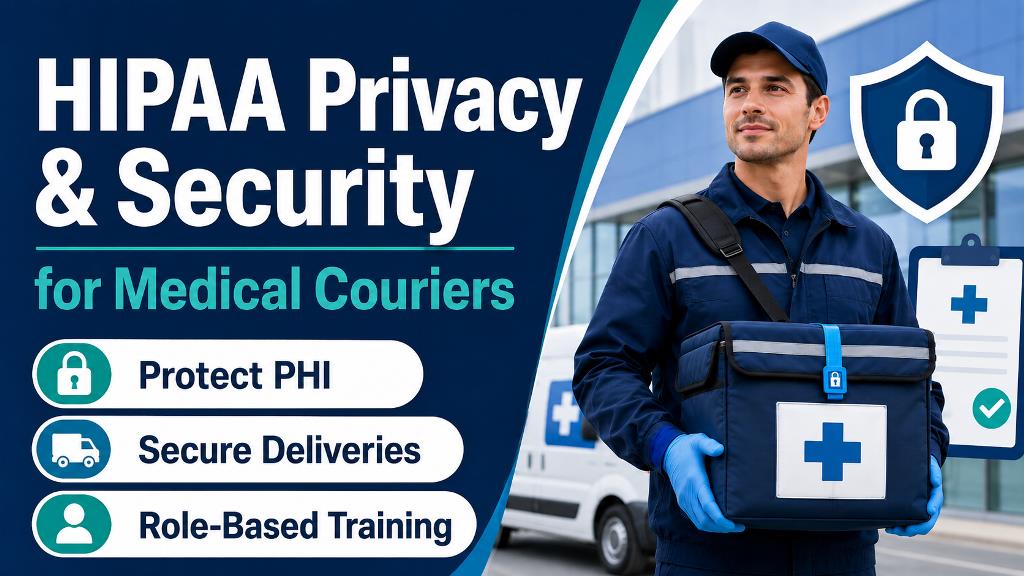
Medical couriers regularly transport specimens, medications, medical records, test kits, supplies, and other healthcare materials. These assignments may expose drivers to protected health information, or PHI, found on labels, manifests, mobile applications, delivery instructions, packaging, and shipping documents.

HIPAA Privacy & Security in Medical Courier Operations Training teaches drivers how to protect patient information while completing real-world courier duties.

Unlike general HIPAA courses, this training focuses on the situations medical couriers encounter on the road, at healthcare facilities, inside vehicles, and during pickup and delivery.

Protect patient privacy. Strengthen information security. Reduce preventable mistakes.

What Is HIPAA Training for Medical Couriers?

HIPAA training for medical couriers explains how federal health information privacy and security requirements apply during healthcare transportation activities.

The course helps medical courier drivers recognize protected health information, follow authorized delivery procedures, secure documents and electronic devices, and respond correctly when information is lost, exposed, misdirected, or accessed without authorization.

Medical couriers may encounter patient information when transporting:

  • Laboratory specimens
  • Prescription medications
  • Medical records
  • Diagnostic materials
  • Pathology materials
  • Home healthcare supplies
  • Patient-specific medical equipment
  • Healthcare documents
  • Pharmacy deliveries
  • Hospital and clinic shipments

The course translates HIPAA concepts into practical actions that drivers can use before, during, and after every route.

Why Medical Couriers Need Role-Based HIPAA Training

A traditional HIPAA course often explains privacy rules from the perspective of physicians, nurses, office staff, or hospital employees. Medical courier drivers perform a different job and face different risks.

A driver may see PHI on:

  • Specimen labels
  • Patient names on packages
  • Prescription labels
  • Laboratory requisitions
  • Shipping manifests
  • Chain-of-custody records
  • Route sheets
  • Mobile delivery applications
  • Email and text instructions
  • Photographs used as delivery confirmation
  • Signatures and electronic delivery records

A privacy incident can happen without opening a medical record. Leaving a labeled package visible, sending a delivery photograph to the wrong person, discussing a patient in public, or delivering an item to an unauthorized recipient can expose protected information.

This course helps drivers recognize these risks before they become incidents.

Is a Medical Courier a HIPAA Business Associate?

A medical courier’s HIPAA status depends on the services performed, the information involved, the contractual relationship, and the courier’s level of access to protected health information.

Some medical courier companies may perform services for covered healthcare organizations that involve creating, receiving, maintaining, or transmitting PHI. These arrangements may require a Business Associate Agreement and additional HIPAA responsibilities.

However, not every delivery organization is automatically a business associate. The U.S. Department of Health and Human Services recognizes a limited conduit exception for certain organizations that merely transport information and access it only randomly or infrequently when necessary to complete transportation.

Because courier arrangements vary, organizations should determine their status based on the actual services performed and the applicable contract.

This course does not assume that every driver or courier company has the same legal classification. It teaches the privacy and security practices drivers need when patient information is present during courier operations.

Learn more from the HHS guidance concerning couriers and the conduit exception.

What Medical Courier Drivers Will Learn

After completing this training, learners should be able to:

  • Explain why HIPAA matters in medical courier operations
  • Recognize common forms of PHI during transportation
  • Distinguish permitted job-related access from unnecessary access
  • Apply the minimum necessary principle to courier duties
  • Protect visible information on packages and documents
  • Secure PHI inside a delivery vehicle
  • Use mobile devices and courier applications more safely
  • Verify recipients before releasing sensitive shipments
  • Prevent misdelivery and unauthorized disclosure
  • Protect passwords, access codes, and electronic accounts
  • Recognize common social engineering attempts
  • Respond to lost, stolen, damaged, or compromised items
  • Report suspected privacy and security incidents promptly
  • Follow employer policies and client instructions
  • Document deliveries without exposing patient information

Course Topics

1. HIPAA Fundamentals for Medical Couriers

Learners receive a clear introduction to HIPAA and its application to healthcare transportation.

Topics include:

  • Purpose of HIPAA
  • Covered entities
  • Business associates
  • Workforce responsibilities
  • Privacy Rule overview
  • Security Rule overview
  • Breach Notification Rule overview
  • Courier and conduit considerations
  • Employer policies and contractual duties

2. Understanding Protected Health Information

Drivers learn how to identify PHI in both obvious and less obvious forms.

Examples include:

  • Patient names
  • Addresses
  • Telephone numbers
  • Medical record numbers
  • Account numbers
  • Prescription information
  • Laboratory test information
  • Specimen labels
  • Diagnoses and treatment information
  • Delivery records connected to a patient
  • Electronic information displayed in courier applications

The course also explains that information can become PHI when health information is connected to a person who can be identified.

3. The Minimum Necessary Principle

Medical couriers should access only the information needed to complete their assigned work.

Learners examine practical questions such as:

  • Does the driver need to open this package?
  • Is the patient’s diagnosis needed to complete delivery?
  • Should a driver photograph an entire label?
  • Who is authorized to receive the shipment?
  • What information should appear in delivery notes?
  • When should a driver contact a supervisor?

The course emphasizes that curiosity is not a valid reason to view patient information.

4. Privacy During Pickup

Privacy protection begins before the vehicle leaves the pickup location.

Drivers learn how to:

  • Confirm the correct shipment
  • Verify the pickup location
  • Review only necessary information
  • Avoid discussing patient information in public areas
  • Protect paperwork from public view
  • Follow established handoff procedures
  • Report labeling or documentation concerns
  • Avoid accepting improperly prepared shipments without guidance

5. Securing PHI During Transportation

The vehicle becomes part of the security environment during a medical delivery.

Topics include:

  • Keeping shipments out of public view
  • Securing documents and delivery manifests
  • Locking unattended vehicles
  • Limiting unnecessary stops
  • Protecting keys and access devices
  • Preventing passengers from viewing sensitive information
  • Avoiding shipment storage in personal areas
  • Following employer rules for temporary stops
  • Protecting information during vehicle breakdowns and emergencies

6. Privacy During Delivery

Drivers must confirm that a shipment is released to the correct person or location.

Learners examine:

  • Recipient verification
  • Authorized delivery areas
  • Signature procedures
  • Unattended delivery restrictions
  • After-hours deliveries
  • Incorrect address situations
  • Recipient refusal
  • Facility access problems
  • Failed delivery procedures
  • Delivery photographs and electronic proof of delivery

The course reinforces a simple rule: when authorization is unclear, stop and contact the designated supervisor or dispatcher.

7. Mobile Device and Application Security

Medical couriers may use smartphones, tablets, scanners, email, text messages, GPS applications, and delivery platforms.

Learners receive practical guidance on:

  • Strong passwords and passcodes
  • Multifactor authentication
  • Automatic screen locking
  • Approved courier applications
  • Secure wireless connections
  • Software updates
  • Phishing and fraudulent messages
  • Lost or stolen devices
  • Delivery photographs
  • Personal device restrictions
  • Secure deletion and retention practices
  • Avoiding unauthorized cloud storage

8. Verbal Privacy and Professional Communication

PHI can be exposed through conversation as easily as through a document.

Drivers learn why they should not discuss patient information:

  • In elevators
  • In waiting rooms
  • At restaurants
  • At fuel stations
  • With family or friends
  • On social media
  • With unauthorized facility personnel
  • Through unapproved messaging platforms

The course also explains how to communicate with dispatchers and healthcare clients while limiting unnecessary patient details.

9. Social Media, Photography, and Recording

Medical courier work should not be used as social media content.

Learners are instructed to avoid:

  • Photographing patients
  • Posting pictures of healthcare shipments
  • Sharing route information
  • Recording inside healthcare facilities
  • Displaying labels or manifests online
  • Discussing unusual deliveries
  • Posting information about clients
  • Sharing patient-related stories, even without using a name

Removing a patient’s name may not be enough if other details can identify the individual.

10. Privacy and Security Incidents

Drivers learn to recognize events that may require immediate reporting.

Examples include:

  • A package delivered to the wrong location
  • Missing paperwork
  • A lost or stolen mobile device
  • An unlocked vehicle containing PHI
  • A delivery photograph sent to the wrong person
  • An email containing PHI sent to an incorrect address
  • An unauthorized person viewing a patient label
  • A package left in an unapproved location
  • Credentials shared with another worker
  • Suspicious access to a courier account
  • Documents discarded in regular trash
  • A conversation overheard by an unauthorized person

11. Incident Response for Drivers

Drivers are not expected to conduct their own breach investigation. Their responsibility is to recognize the event, protect what they can, and report it through the correct channel.

The course teaches the following response sequence:

  1. Stop the activity creating the exposure.
  2. Secure the shipment, document, or device when safe.
  3. Preserve relevant information.
  4. Contact the designated supervisor or privacy contact.
  5. Follow company and client reporting procedures.
  6. Document facts accurately.
  7. Do not conceal, alter, or independently investigate the event.
  8. Do not contact a patient unless specifically authorized.

Prompt internal reporting matters because HIPAA breach-notification duties can apply after a breach of unsecured PHI. Business associates must notify the applicable covered entity following a breach and may not delay notification beyond the federal deadline. Employer and contract requirements may require much faster reporting. Review the HHS Breach Notification Rule guidance.

12. Practical Medical Courier Scenarios

Learners apply the course principles to realistic situations, including:

  • A patient label is visible through transparent packaging
  • A driver receives a text requesting a delivery photograph
  • A shipment is addressed to a department that has closed
  • A facility employee asks about the contents of a package
  • A mobile phone containing route information is missing
  • A package is delivered to the wrong suite
  • A vehicle must be left during an emergency
  • A customer asks the driver to leave a shipment at an unsecured desk
  • A friend asks what the driver transported that day
  • A driver notices patient paperwork in a parking lot

These scenarios help learners move from memorizing terminology to making safer job-related decisions.

Who Should Take This Course?

This training is designed for people who transport healthcare materials or manage medical courier operations, including:

  • Medical courier drivers
  • Independent medical couriers
  • Pharmacy delivery drivers
  • Laboratory couriers
  • Specimen transport personnel
  • Healthcare logistics employees
  • Route supervisors
  • Dispatchers
  • Courier company owners
  • Operations managers
  • Delivery contractors
  • Employees who handle healthcare packages
  • New hires entering medical courier work

Organizations may also use this course as part of onboarding, refresher training, corrective training, or client-specific workforce education.

Healthcare Organizations Served by Medical Couriers

The course is relevant to courier work performed for:

  • Hospitals
  • Clinical laboratories
  • Physician practices
  • Dental offices
  • Pharmacies
  • Long-term care facilities
  • Home healthcare organizations
  • Dialysis centers
  • Diagnostic imaging centers
  • Outpatient clinics
  • Surgery centers
  • Pathology laboratories
  • Blood banks
  • Research organizations
  • Medical supply companies
  • Pharmaceutical distribution operations
  • Veterinary healthcare organizations, when applicable policies require similar safeguards

How This Course Is Different

Developed Specifically for Medical Courier Operations

The content is centered on pickups, vehicles, route management, mobile devices, handoffs, delivery verification, and incident reporting.

Focused on Driver Decisions

Learners are shown what to do when an address is wrong, a recipient cannot be verified, a device is lost, or a delivery instruction could expose PHI.

Covers Physical and Electronic Information

The course addresses printed documents, labels, manifests, photographs, applications, text messages, email, and electronic delivery records.

Separates HIPAA Concepts from Courier Procedures

Learners receive enough regulatory background to understand their responsibilities, followed by job-specific procedures they can use in daily work.

Designed to Support Organizational Training

Courier companies can use the course alongside their own privacy policies, security procedures, Business Associate Agreements, client instructions, and incident-reporting processes.

HIPAA Privacy and Security Risks in Medical Courier Work

Common risks include:

  • Visible patient labels
  • Unsecured paperwork
  • Incorrect deliveries
  • Unverified recipients
  • Unattended packages
  • Unlocked vehicles
  • Lost mobile devices
  • Weak passwords
  • Shared user accounts
  • Unapproved delivery photographs
  • Texting PHI through personal applications
  • Public conversations
  • Social media posts
  • Improper disposal
  • Delayed incident reporting

The course teaches drivers how routine habits can reduce these risks.

Employer Responsibilities and Driver Responsibilities

Employers and Courier Organizations Should

  • Establish written privacy and security procedures
  • Determine whether Business Associate Agreements are required
  • Define authorized access to PHI
  • Provide workforce training
  • Maintain incident-reporting procedures
  • Apply appropriate access controls
  • Address mobile-device security
  • Establish sanctions for policy violations
  • Maintain training documentation
  • Provide client-specific instructions
  • Review risks when operations or technologies change

Medical Courier Drivers Should

  • Follow authorized procedures
  • Access only necessary information
  • Secure packages, documents, and devices
  • Verify recipients
  • Protect passwords
  • Avoid unapproved applications
  • Report suspected incidents promptly
  • Follow employer and client requirements
  • Ask for guidance when authorization is unclear
  • Never conceal a privacy or security mistake

Business Benefits of Medical Courier HIPAA Training

Role-based training can help an organization:

  • Build more consistent delivery practices
  • Reduce preventable privacy mistakes
  • Strengthen client confidence
  • Improve driver awareness
  • Support workforce onboarding
  • Reinforce security expectations
  • Improve incident recognition
  • Encourage prompt internal reporting
  • Demonstrate a commitment to patient privacy
  • Maintain organized training records

Training does not replace policies, contracts, risk analysis, technical safeguards, or legal advice. It gives drivers the knowledge needed to follow those controls more effectively.

Course Information

Course title: HIPAA Privacy & Security in Medical Courier Operations
Delivery format: [Online, self-paced training]
Estimated duration: [Insert course duration]
Intended audience: Medical courier drivers and courier operations personnel
Assessment: [Insert assessment details]
Completion requirement: [Insert passing score or completion standard]
Certificate: [Insert certificate details]
Access period: [Insert access period]
Language: [Insert available languages]
Group enrollment: [Insert group enrollment information]

Frequently Asked Questions

A driver who may encounter PHI should receive privacy and security training appropriate to the driver’s duties, employer policies, and contractual responsibilities. The required training approach depends on the organization’s role and the services performed.

No. Status depends on the courier’s functions, access to PHI, relationship with the healthcare organization, and applicable agreements. Certain couriers that act only as conduits may fall within a limited exception. Organizations should evaluate their specific operations instead of relying only on a company label.

PHI is individually identifiable health information maintained or transmitted by a covered entity or business associate. In courier work, it may appear on specimen labels, prescription packages, manifests, laboratory requisitions, mobile applications, delivery instructions, and proof-of-delivery records.

A driver may see information needed to complete an authorized delivery. The driver should access and use only the information required for the assigned task and should not disclose it to unauthorized people.

Only when the photograph is required by an approved procedure and captured through an authorized system. Drivers should avoid including patient labels, documents, computer screens, or other PHI unless specifically required and properly protected.

Only when the delivery location and recipient method are authorized by the employer, client, and applicable procedure. If the driver cannot verify that the location is approved, the driver should stop and contact dispatch or a supervisor.

The driver should immediately report the incident through the organization’s designated reporting process, follow instructions, and document the facts accurately. The driver should not conceal the mistake or attempt an unauthorized recovery.

The driver should promptly notify the designated supervisor or security contact and follow the organization’s lost-device procedure. Fast reporting may allow the organization to lock the account, disable access, remotely erase information, or protect affected systems.

The course explains the role of Business Associate Agreements and why they may apply. It does not create, review, or replace an organization’s legal agreement.

No. General HIPAA training often focuses on clinical or administrative employees. This course applies privacy and security concepts to medical courier pickups, transportation, vehicle security, mobile applications, recipient verification, delivery documentation, and incident response.

No single course guarantees compliance. HIPAA compliance may also require appropriate policies, risk analysis, safeguards, contracts, documentation, supervision, technical controls, and ongoing review. Training is an important part of a broader compliance program.

Organizations should provide additional training when required by their policies, when job duties change, when new systems or risks are introduced, or when corrective education is needed. Organizations may also establish periodic refresher training as part of their compliance program.

Build a Privacy-Conscious Medical Courier Workforce

Every medical delivery depends on trust. Healthcare organizations expect couriers to protect the shipment and the information connected to it.

HIPAA Privacy & Security in Medical Courier Operations Training gives drivers practical guidance for protecting PHI during pickups, transportation, delivery, documentation, mobile-device use, and incident response.

Help your drivers understand what information must be protected, how common exposures occur, and what to do when something goes wrong.

Important Notice

This course provides general educational information. It does not constitute legal advice and does not replace an organization’s policies, Business Associate Agreements, risk analysis, security procedures, client instructions, or advice from qualified legal or compliance professionals.

Organizations should adapt operational procedures to their services, contracts, technologies, workforce, clients, and applicable federal and state requirements.

Go to Top