

Texas Medical Privacy Training for Healthcare Delivery Personnel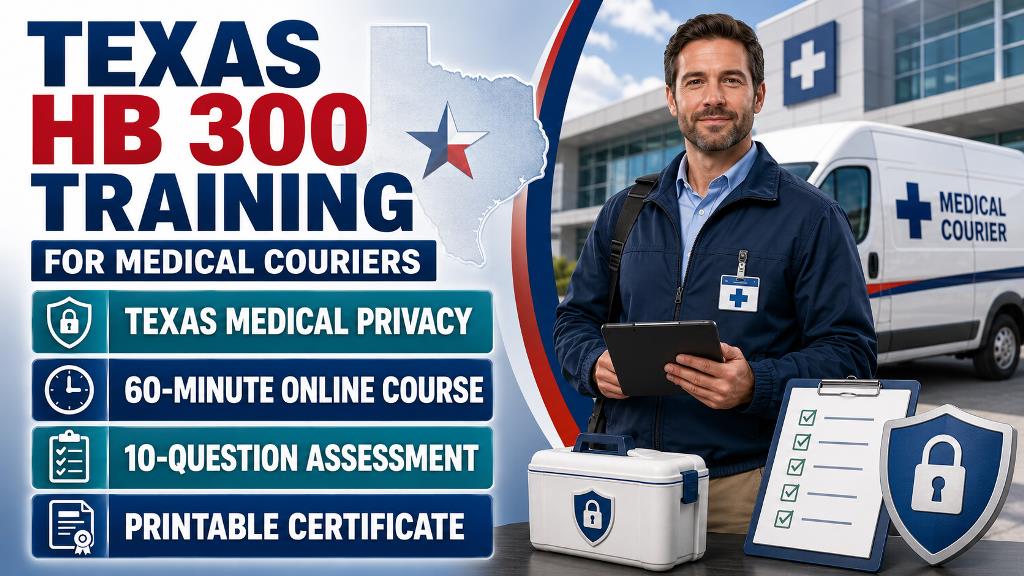
Medical couriers working in Texas may encounter protected health information during specimen pickups, pharmacy deliveries, healthcare transportation, and delivery documentation.
Patient information may appear on:
- Specimen labels
- Laboratory requisitions
- Pharmacy packages
- Medical records
- Delivery manifests
- Chain-of-custody documents
- Route instructions
- Electronic delivery records
- Mobile applications
- Proof-of-delivery documentation
Texas House Bill 300 strengthened medical privacy protections under Texas law. It also established training requirements for employees of covered entities whose duties involve protected health information.
This online Texas HB 300 Training provides an overview of Texas medical privacy requirements for healthcare workforce members, including medical couriers whose duties involve protected health information.
The course covers protected information, covered entities, restricted activities, consumer rights, notice and authorization, breach notification, employee training, enforcement, audits, and civil penalties.
What Is Texas HB 300?
Texas House Bill 300 amended several parts of Texas law relating to medical privacy, including Chapter 181 of the Texas Health and Safety Code.
The law is sometimes informally called “Texas HIPAA.” However, Texas HB 300 and federal HIPAA are not the same law.
HIPAA establishes federal privacy and security requirements for covered entities, business associates, and their workforces. Texas medical privacy law adds state requirements and uses a broader definition of a covered entity.
Organizations operating in Texas may need to evaluate both federal and Texas requirements.
Does Texas HB 300 Apply to Medical Couriers?
Texas HB 300 does not automatically apply to every person who drives or makes deliveries in Texas.
The employer should consider:
- Whether the organization is a covered entity under Texas law
- Whether the courier creates, receives, obtains, maintains, uses, or transmits protected health information
- Whether the employee’s duties involve medical information
- Whether the courier performs services for a Texas healthcare organization
- Whether state and federal privacy training is necessary and appropriate for the employee’s duties
A courier delivering ordinary products without access to protected health information may have different responsibilities from a courier transporting patient specimens, medical records, or prescription medications.
Texas law uses a broader definition of covered entity than federal HIPAA. Depending on the services performed and information handled, a medical courier company or another organization may fall within that definition.
Employers should evaluate their operations and seek qualified legal guidance when the law’s application is unclear.
Texas HB 300 and HIPAA Training
Texas HB 300 training does not automatically replace HIPAA training.
The stand-alone $25 course focuses on Texas HB 300. Learners who also need foundational HIPAA education may select the combined HIPAA Overview and Texas HB 300 course for $45.
Medical courier employees may also need separate role-based HIPAA training addressing everyday courier activities, such as protecting delivery records, securing mobile devices, verifying recipients, and reporting possible privacy incidents.
Employers must determine which courses are appropriate based on the organization’s legal status, contracts, policies, and employee duties.
Why Texas Medical Couriers May Need Privacy Training
A medical courier can encounter protected health information without opening a package or reviewing a medical record.
Information may be visible through:
- Patient names on labels
- Delivery addresses
- Prescription information
- Laboratory paperwork
- Medical record numbers
- Shipping documents
- Route manifests
- Electronic scanning systems
- Dispatch instructions
- Delivery confirmation records
Training helps workforce members understand the legal framework governing this information and the importance of following approved privacy procedures.
The Texas HB 300 course provides the state-law foundation. Employers should add workplace procedures explaining how these requirements apply to the courier’s actual duties.
Who Should Take This Course?
This course may be appropriate for people working for Texas covered entities or organizations that handle protected health information in Texas.
Potential medical courier learners include:
- Medical courier drivers working in Texas
- Laboratory couriers
- Specimen transportation personnel
- Pharmacy delivery drivers
- Medical-record couriers
- Healthcare logistics employees
- Dispatchers with access to patient information
- Route coordinators
- Medical courier supervisors
- Courier company owners
- Administrative employees
- Independent contractors
- Employees using healthcare delivery applications
- Other workforce members handling Texas protected health information
Employers should determine whether training is necessary and appropriate for each employee’s duties.
What You Will Learn
After completing this course, learners should be able to:
- Explain the purpose of Texas HB 300
- Recognize the potentially broad impact of the law
- Identify information protected by Texas medical privacy law
- Recognize organizations that may qualify as covered entities
- Describe restricted activities involving protected health information
- Understand basic consumer record-access rights
- Identify consumer complaint options
- Explain notice and authorization requirements
- Review Texas breach-notification requirements
- Explain employee training requirements
- Understand the effect of SB 1609 training updates
- Recognize enforcement and audit considerations
- Describe possible civil and additional penalties
- Apply course concepts to example violation scenarios
- Identify organizational HB 300 action items
Texas HB 300 Employee Training Requirements
Texas Health and Safety Code §181.101 requires each covered entity to provide employees with training concerning state and federal law about protected health information.
The training must be necessary and appropriate for the employees to perform their duties.
Initial Training Deadline
An employee of a covered entity must complete the required training no later than the 90th day after the employee is hired.
Training After Material Legal Changes
Additional training is required when a material change in state or federal law concerning protected health information affects the employee’s duties.
The employee must receive the updated training within a reasonable period, but no later than the first anniversary of the date the legal change takes effect.
Completion Verification
The covered entity must require the employee to sign an electronic or written statement verifying completion of the training.
Record Retention
The covered entity must maintain the signed verification until the sixth anniversary of the date it was signed.
How Often Is Texas HB 300 Training Required?
Current Texas Health and Safety Code §181.101 does not establish a universal annual or two-year retraining schedule.
Training is required:
- No later than the 90th day after hiring
- When a material change in state or federal law affects the employee’s duties
- At other times required by the employer’s policies, contracts, or risk-management program
An employer may establish annual or two-year refresher training as an internal policy. That schedule should not be described as a universal requirement of Texas HB 300.
Certificate of Completion
Learners who complete the course and score at least 80% on the 10-question assessment can print a certificate of completion.
The assessment may be repeated until the learner earns a passing score.
The certificate can support the employer’s training documentation. It does not establish that an organization has satisfied every Texas or federal privacy requirement.
The certificate is not:
- A Texas-issued license
- A government certification
- A professional license
- Proof of complete organizational compliance
- A legal determination that the learner’s employer is a covered entity
Employers remain responsible for providing appropriate workplace policies, role-specific instruction, reporting procedures, safeguards, supervision, and training records.
Frequently Asked Questions
Important Legal and Training Notice
This course provides general education about Texas HB 300 and Texas medical privacy requirements. It does not constitute legal advice.
The course does not determine whether a particular person or organization is a covered entity. It also does not replace an employer’s privacy policies, security procedures, incident-response process, role-specific instruction, HIPAA training, or legal review.
Employers are responsible for evaluating applicable requirements, providing training that is necessary and appropriate for each employee’s duties, obtaining required completion verification, and maintaining training records.
Organizations should consult qualified legal or compliance professionals when they are uncertain about how Texas medical privacy law applies to their operations.
Texas HB 300 Training for Medical Couriers is rated 4.7 out of 5 by 7495 users.